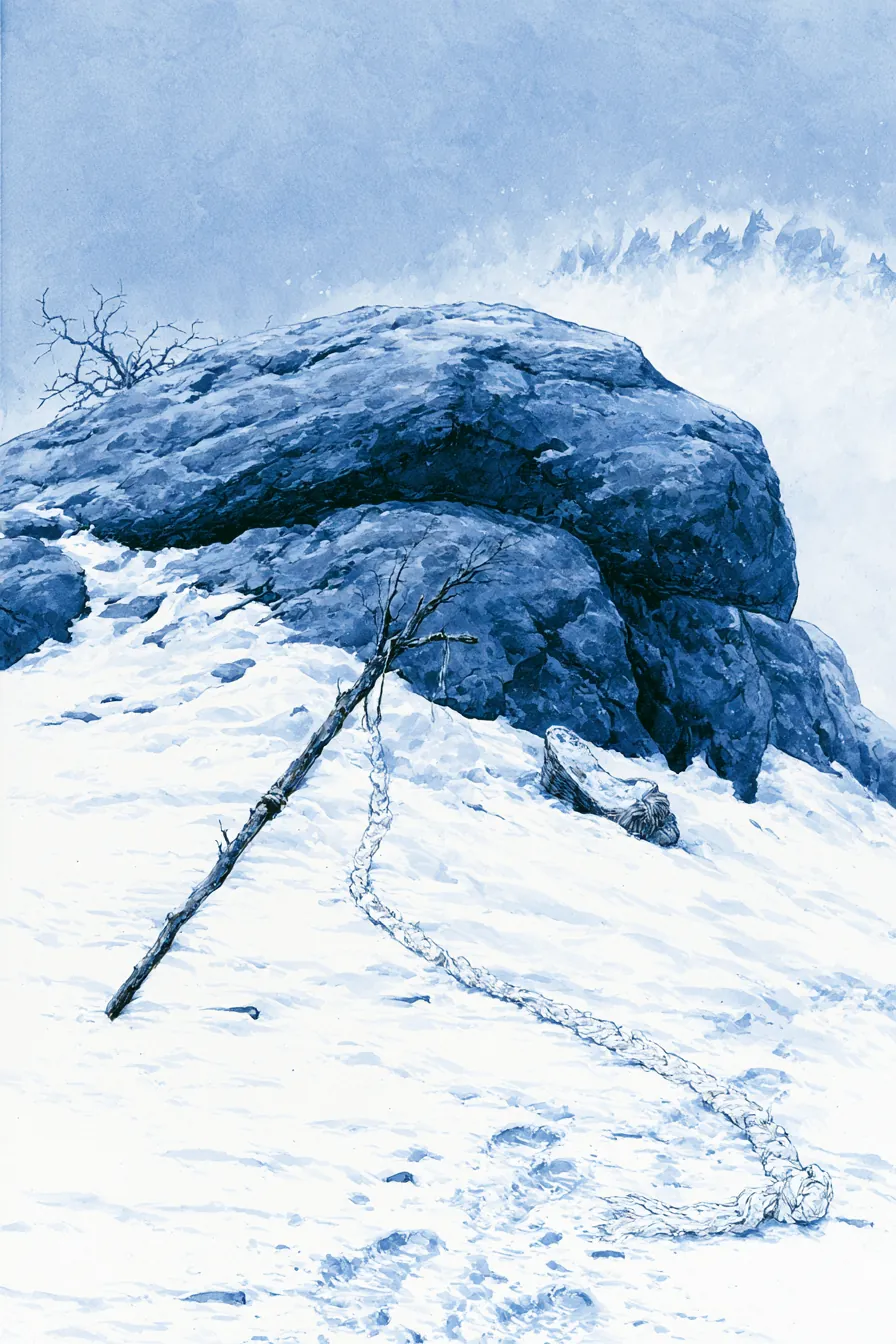
Chapter Twenty-Eight
The slope above the willow grove of the east shoulder of Inwangsan. The seventh of the fifth month of the first year of King Injo's reign. Eleven-oh-three in the morning.
The junior body of the Westerners' faction is, on the slope above the willow grove of the east shoulder of Inwangsan at eleven-oh-three on the morning of the seventh of the fifth month, sixteen years old.
He has, in his right hand, the village butcher's knife.
The knife is — by seventy years of Bukhansan-sanshin's instruction at the village butcher's stall at the foot of the east path of Inwangsan — the one with the notch at the eight-millimeter point from the tip. The handle is hornbeam, worn smooth on the inside curve by a left-handed grip that was not the boy's grip. The boy is right-handed. The handle does not fit him. He has not, in the climb, noticed.
The junior body, by the four-month preparation his own senior in the Westerners' faction had — at the barracks in Daejeon — given him in the autumn of the fifteenth year of King Gwanghae's reign, knows the one instruction.
The instruction is: cut the slit, forty-one millimeters deep and twenty-two centimeters wide, on the left side of the Joseon mudang's daughter's neck.
The junior body has not, in his sixteen years, killed.
He has slaughtered one wild boar, in the autumn of his thirteenth year, on the foothills of Bukhansan with his own father — who was, by the morning of the seventh of the fifth month, dead two years and seven months. The boar had screamed. The father had told him afterward, by the willow-bark fire, that the scream was the work, and that a man learned the work by hearing the scream, and that the next time the scream came the man's hand was the hand the work had asked for. The boy had nodded. The boy had not, in the three years since, killed anything else.
He has been raised, since the autumn of his fourteenth year, by his senior in the Westerners' faction.
His senior has told him that the slit on the left side of a Joseon mudang's daughter's neck is, by the new Joseon-court regime of the first year of King Injo's reign, the clean ceremonial mark of the faction's careful Joseon-scholar discipline of the new Confucian state.
The clean ceremonial mark is, by the four-month preparation, the ethics of the new regime.
The junior body has accepted the clean ceremonial mark for what his senior told him it was.
He has climbed the east shoulder of Inwangsan.
He does not know that the knife in his hand is the wrong knife — that the notch was put into the edge by the village butcher in the autumn of the previous year on the neck of a winter pig, and never sharpened since.
He does not know that the village butcher at the foot of the east path is — by seventy years of Bukhansan-sanshin's instruction — the one creature whose own four-tailed body has, since the spring of the seventh year of King Seonjo's reign, kept that knife dull on purpose, so that the cut would be slow.
He does not know.
He climbs.
He climbs in the grey hemp jeogori and the grey hemp chima and the grey hemp gat of the lowest rank of Westerners'-faction junior bodies, the grey hemp wrap-belt at his waist. The hemp is cold against his ribs. The wrap-belt is tied at the small flat knot his senior tied for him at five-fourteen in the barracks dark — the knot a junior body wore when his discipline was, by his senior's instruction, not yet his own.
The east path is steep. The willows below the slope are out. The willow leaves are the new yellow-green of the fifth-month new growth; the catkins are gone, dropped in the jeong-seol a month back. The wind is coming up the south path at a slant. It carries, from the lower shrine far down on the south face, the faint thin smell of hyang smoke — the hyang the lower mudangs burn at the eleventh-stick censer on the seventh of every fifth month — and the boy does not know to recognise the smell.
He reaches the slope above the willow grove at eleven-oh-two.
The willow grove is fourteen meters below the slope.
The Joseon-court mudang's daughter Yun Da-eun of the paje line of Chungcheong-do is on the slope. She is in the grey hemp jeogori and the grey hemp chima the woman at the foot of the east path brought up to her at the lower wayside shrine on the third morning of the jeong-seol of the third month. The braided four-strand white linen mourning ribbon is at her own left wrist. The thick wool overcoat of an older creature — whose own four-hundred-year discipline has not yet, on this morning, ended — is on her shoulders.
She is kneeling.
She is kneeling the way her mother taught her on the kitchen floor in Chungcheong-do in the autumn of her eighth year — knees a hand's-breadth apart, the weight balanced low at the saddle of the pelvis where the long high note her mother showed her on the same kitchen floor would, in extremis, draw from. Her mother had said: Daughter, the kneeling is the kneeling of a Korean woman whose own discipline is, by the loom, the discipline of carrying. The knees are the knees that carry. The lower back is the lower back that carries. The throat is the throat that carries. The carrying is the work, and the work is mine to give you, and yours to give the one who comes after.
The one who comes after is, this morning, four hundred and three years away.
The carrying is, this morning, the work.
She is ready.
The junior body of the Westerners' faction arrives at the slope at eleven-oh-three.
He bows.
Fifteen degrees.
Da-eun bows.
Fifteen.
He says, in the clear Joseon-court Korean of a Westerners'-faction junior body of sixteen years of age on the slope above the willow grove of the east shoulder of Inwangsan at eleven-oh-three on the morning of the seventh of the fifth month of the first year of King Injo's reign:
Daughter.
Da-eun says: Yes.
He says: I am, on the order signed at the lower court at six-forty-three by Yi Hwan of the Westerners' faction, the junior body whose discipline is — at eleven-oh-three — to cut.
Da-eun says: Yes.
He says: Daughter. The clean ceremonial mark is the slit, forty-one millimeters deep and twenty-two centimeters wide, on the left side of your neck.
Da-eun says: Yes.
He says: Are you ready.
Da-eun says: Yes.
She says: One thing.
He says: Daughter.
She says: Junior. Show me the knife.
He shows her the knife.
He shows her the knife at the one-meter distance the slope permits.
Da-eun looks at the knife.
Da-eun looks at the notch at the eight-millimeter point from the tip.
She does not, on the slope, weep.
She says: Junior.
He says: Yes, daughter.
She says: You do not know the knife.
He says: Daughter.
She says: The knife is the wrong knife. Its notch was kept dull, for seventy years, by the creature at the village butcher's stall at the foot of the east path — the four-tailed creature of the Joseon-court line whose discipline put it, this morning, in your hand.
He does not, on the slope, blink.
He says: Daughter. The order was given.
She says: Yes, junior.
He says: Daughter. I am the junior body whose discipline, at eleven-oh-three this morning, is to cut.
She says: Yes, junior.
He says: Daughter. Do you forgive me.
Da-eun kneels on the slope above the willow grove.
She breathes.
She breathes once. She breathes twice. She breathes a third time.
In the third breath she sees, in the way her mother had taught her to see, three things at once.
She sees her mother in the cell beneath the consort's pavilion, the night before — the chipped clay bowl, the one cup of water her mother had not drunk, the wet ribbon her mother had pressed into her own palm. She sees the older creature on his bench at the lower shrine of the south path, listening at this moment to a wrong bell he does not yet know is wrong. She sees, four hundred and three years from this slope, a young Korean woman in a black cashmere sweater across a low table in a Bukchon anbang taking from a brass cup, and a folded screen with a fox on the third panel, and a marble warming at the back of a tongue that has carried it cold for the length of a Joseon dynasty.
The three are, by the loom, one image.
The image is hers to send.
She says, in the Joseon-mother grammar her mother taught her on the kitchen floor in Chungcheong-do in the autumn of her eighth year:
Junior. I do not forgive you — not by the wrong knife, not by the notch, not by the four-tailed creature at the village butcher's stall.
He says: Daughter.
She says: I do not forgive Yi Hwan of the Westerners' faction.
He says: Daughter.
She says: But I do not give the not-forgiving to you, or to him. I send it forward.
He says: Daughter.
She says: Forward.
He does not understand.
He does not need to.
He says: Daughter.
She says: Junior. Cut.
He cuts.
The cut takes eleven seconds. The dull notch drags. The slit opens on the left side of her neck — forty-one millimeters deep, twenty-two centimeters wide.
It bleeds.
She kneels. She does not fall.
She holds.
She holds the braided ribbon at her own left wrist in her own right hand.
The junior body steps back.
He does not know what to do.
His senior told him only this: that he is to cut, and then to stand on the slope for the seven minutes it takes to finish.
The senior was right about one thing more — that the daughter would not scream.
She does not scream.
The junior body stands. He watches.
He watches her kneel. He watches her hold the ribbon. He watches her not scream.
The morning is clear. The cold sun is over the slope, and the cold sun does not intervene. It is only the sun. A single magpie crosses the air above the willow grove at eleven-oh-five and goes on, calling, toward the south path. The boy, watching, hears it and does not turn his head. He has not, in his four months of training at the Daejeon barracks, been told what the call of a magpie at the seventh of the fifth month is. His senior had told him only that the work was the work and that the work was not, on the slope, the work of birds.
Da-eun kneels.
The cut has reached, by the depth of it, the lower register her mother taught her to draw the long high note from. The note will not come. What comes is a breath without a vowel — air over a broken reed.
She does not fight it.
She breathes the breath without a vowel.
She had braided this. On the granite cap of the Seonbawi rocks, eight days ago, she braided four strands of it into the white ribbon, and she kept the braid for this morning. Now she finishes it. The first strand. The second. The third. The fourth.
The first strand is her mother's strand — the one her mother had wet in the cell beneath the consort's pavilion, and on which her mother had knotted the seven syllables of the paje-line private call in the script the line had carried since her own great-grandmother on the riverbank at Chungcheong-do. Her mother is, this morning, three days in the unmarked ground of the riverside grove east of the Geunjeongjeon. The strand carries her.
The second strand is the boy she had been told she would marry, the second son of a county magistrate of Boeun who had — at fifteen — sent her, by a court runner, a single quince leaf pressed in a paper of his own. The boy is, this morning, dead two months, struck down for the carrying of the wrong note in the wrong cousinship. The strand carries him.
The third strand is the strand of her own throat. Da-eun has, in the cold seven days at the lower wayside shrine, woven into it the small ordinary unborn life of a Korean woman who had been going to grow old in a paje-line kitchen with her own daughter on the kitchen floor in front of her, learning the lower note. The strand carries that life — the one she will not live.
The fourth strand is the strand of the un-vowelled breath of the older creature who has not, this morning, arrived. She had not, on the granite cap, known if the strand would carry him or accuse him. She had braided it anyway. By the loom, the line had carried fourth strands before. The line knew the work. She braided the fourth strand in trust and in not-trust, and she sealed it with the small clear knot her mother had taught her was the knot the line tied when a thing it did not know the shape of was, by the carrying, going to be the shape it took.
The braid is the private call.
She does not send it to the creature she could not, on the granite cap, trust to arrive — the creature who has not, this morning, arrived.
She does not send it in vengeance.
She sends it the way her mother showed her: forward, into the line — to a daughter of the paje line not yet born, who will be born in the autumn of nineteen-ninety-nine in a hospital in a city called Cupertino, four hundred and three years from this slope. Into that daughter's hands, the not-forgiving. To carry, and to deliver, on a morning the line will know, to the four-tailed creature whose dull knife is this morning in a sixteen-year-old's hand.
Forward.
Not at him. Not at the boy. Forward.
She braids the call into the ribbon, and she holds the braid, and she breathes.
Once.
Twice.
A third time.
Her sight is loosening now. The slope, the willow grove, the fourteen meters between — they go soft and far. And in the softness, through a door she has never walked through, she sees a room.
She sees a folding screen against the wall of a hanok she will never enter, in a city that does not yet exist.
On the white silk of the screen, in one brushstroke, there is a fox.
She knows the brushstroke. It is his — the older creature whose discipline she could not, on the granite cap, trust. The fox is his hand. The hand is unmistakable; the line of the back is the one curve she has watched him draw three times in three different ledgers when he thought she was not looking, the curve of an animal carrying something it has been told not to set down.
And she understands, in the loosening, what the brushstroke is for. It is the image her own line will wake to — the daughter of nineteen-ninety-nine, on a low futon in that hanok at the fifth hour of an afternoon in February four hundred and three years from now, after he has caught her in an elevator. The screen will be the first thing the line sees.
So she sends the brushstroke forward too. The fox. The room. The waking. By the loom, the brushstroke goes ahead of the call so that the daughter who carries the call will, on first waking in the room, know the carrying without yet knowing whose carrying it is.
She breathes.
She does not weep.
She breathes once.
She breathes —
She —
—
—
The junior body of the Westerners' faction, at eleven-ten, watches her finish.
She does not fall. She kneels, upright, and does not move.
He stands a moment longer. He does not understand.
He had been told the daughter would, in the seven minutes, finish. He had been told the body would settle. He had been told that the discipline of the new regime was a discipline that, in the seven minutes, made the body of a Joseon-court mudang's daughter quiet in a way the slope would not, after, remember. The senior had not told him that the daughter would, in the seven minutes, choose what the body did. The senior had not told him that some Korean women, by their mother's grammar at the kitchen floor, decided in advance what the seven minutes were going to be.
He turns. He walks back down the east path of the east shoulder of Inwangsan. He does not look back.
He carries the wrong knife in his right hand. He does not know it is the wrong knife.
He carries it down.
He will, in the third year of his own twenties, hang it on a pine peg at the back of his mother's kitchen in Cheongju, and he will not, for the rest of his life, take it down. The dull notch will, in the kitchen smoke of forty years, blacken. His mother will not ask. He will not tell her. He will die at sixty-one of a winter cough in the ninth year of King Hyojong's reign and the knife will, two months after, be wrapped by a granddaughter in oiled paper and sold to a passing tinker for three coppers and lost from the record, and the record will not, by the loom of the paje-line, need it.
On the slope above the willow grove, Yun Da-eun of the paje line of Chungcheong-do kneels and does not fall and does not weep and does not scream.
She has sent it: the breath without a vowel, the braided ribbon, the slit on the left side of her neck, the fox on the screen four hundred and three years forward.
The cold sun is over the slope. It does not answer. It does not need to. The breath without a vowel has answered for it.
The creature whose discipline she could not, on the granite cap, trust — the one who has not, this morning, arrived — is at eleven-twelve on the south path of Inwangsan, at the lower shrine, listening to a bell.
He does not know.
The bell he is listening to is the carved wooden bell of the Joseon scholar of the Westerners' faction, made to mimic the call of a lower mudang in distress. He has answered that call for one hundred and seventy-three years. He answers it now. It is the wrong bell. He does not know.
The wood of the wrong bell is the wood of a pine cut at the lower slope of Inwangsan in the eleventh year of King Gwanghae's reign by a Joseon-court craftsman who had been paid in white silver by the scholar of the Westerners' faction to make a bell that would carry, in the third octave above middle, the lower mudang's seventh interval. The craftsman had not known what the bell was for. The craftsman had taken the silver and made the bell. The craftsman had died, two winters later, of a lung complaint, and the bell had been carried in oiled paper from Hanyang to the lower shrine of the south path at the third hour of the seventh of the fifth month by a hired body, and the hired body had rung it at the second hour, and had walked away, and had been paid in copper at the lower gate of the city at noon, and had spent his copper on rice wine at the riverside, and had not, in the seven years he had to live, thought of the bell again.
The bell rings. It carries the seventh interval. The older creature, at the lower shrine, hears it. By one hundred and seventy-three years of habit he stands, sets the brass kettle down, leaves the yakju in the chipped cup, and goes down the south path at the unhurried pace of a creature whose own discipline at the lower shrine is the discipline of going to the call.
He goes.
The going is the going of the seventh of the fifth month at the second hour.
He will know at the ninth hour of the night.
At the ninth hour he will come back to the east shoulder. He will find her on the slope, kneeling, the ribbon untied and laid a half-step from her right knee where she, in the last of her own careful Joseon-mother grammar, set it down — and where the junior body, by his senior's instruction, did not take it.
He will lift her in his arms.
He will weep — the older creature who, by the carved wooden bell, had been broken from the only thing he had ever stood watch over. The weeping will not be the weeping of a mortal man. It will be a thing the slope above the willow grove will not, in the four centuries that follow, forget. The willows below will, on each seventh of every fifth month, drink the small dampness off the slope an hour earlier than the meteorology of the eastern slope of Inwangsan would suggest, and no Joseon or Korean scholar of climatology will ever isolate the cause.
He will carry her down the east path to the kitchen of the woman who, for forty-six years, made his wrapped jeotgal. He will bury her there — in the small flat ground behind the kitchen, between the jangdok of soybean paste and the persimmon tree the woman had planted in the autumn of the eleventh year of King Gwanghae's reign on the day her own husband had gone east to the war and not come back. The woman, at the burying, will not speak. She will hold a pewter bowl of water. She will pour it once, at the foot of the persimmon. She will bow. She will go back into the kitchen. She will, the next morning, set out an extra wrapped jeotgal on the low shelf for the older creature to take, and he will, when he comes down the east path at the seventh of the fifth month for the four hundred and three years after, take it, and the woman's three granddaughters and their three granddaughters and so on will keep the practice without knowing what it is for.
And he will take the braided four-strand white linen mourning ribbon — the fourth strand of which is the breath of the daughter whose discipline he had, on the granite cap, not trusted — into the inner pocket of his thick wool overcoat.
He will carry it for four hundred and three years.
He will give it back — on a clear square of mulberry paper at the center of a low table in the anbang of a middle hanok in a Bukchon compound, at four-thirty-four on the afternoon of a Tuesday in March of 2026 — to the daughter of the loom who has, on the grey morning of a Sunday in March of 2026 at four-eleven, on a folded futon in that same anbang, arrived.
He does not, at eleven-twelve on the morning of the seventh of the fifth month, know any of this.
He is listening to the wrong bell.
In the village butcher's stall at the foot of the east path, at eleven-twelve, an older Korean man in the grey hemp of a Joseon-village butcher stands at the chopping board with a side of mountain hare in front of him and does not lift the cleaver.
He is Bukhansan-sanshin in the body of a Joseon-village butcher of seventy years, and he has, by his own seventy years of cedar-box discipline, kept the village butcher's knife — the one with the notch — dull on purpose, and he has, this morning at five-twelve, given the knife to the senior of the Westerners' faction who had come down the east path for it, and the senior of the Westerners' faction had walked it up the south path to the barracks tent on the lower slope at six-oh-one, and the senior had given it at six-fourteen to the junior body of sixteen, and the junior body had carried it up the east path to the slope above the willow grove at eleven-oh-two, and at eleven-oh-eight had begun the cut, and at eleven-eleven had finished it, and was at eleven-twelve walking back down the east path with the wrong knife in his right hand.
The older Korean man in the grey hemp of a Joseon-village butcher knows all of this in the small flat way an older mountain god knows the working of his own seventy years.
He does not lift the cleaver.
He stands.
He breathes.
He waits.
He waits for the older creature of the south path to know — at the ninth hour of the night — that the bell was the wrong bell, and for the older creature to go up the east path at the tenth hour of the night and lift the body of the paje-line mudang's daughter off the slope, and for the older creature to carry her down to the kitchen of the jeotgal-woman, and for the older creature to bury her. He waits in the careful Joseon-village butcher's stillness of seventy years of his own discipline.
The discipline, by his own count, is the discipline of carrying the wrong knife — across four hundred and three years — to a morning he has not yet, on this morning, seen.
He has seen it now.
He sets the cleaver down. He sets the side of mountain hare aside. He goes to the back of the stall, to the small low pine chest where he keeps the second-best of his knives, and he takes from it a square of white linen, and he writes on it, in cinnabar ink, the seven syllables of the call the paje-line lower mudang of the eastern shoulder uses when she goes into body distress — the seven syllables he has been keeping in the back of his throat for seventy years.
He folds the square of white linen.
He sets it on the low pine chest.
He bows to it.
Forty-five degrees.
He holds the bow three breaths.
He straightens.
The bow is not, by his own discipline, for the paje-line. It is for the seventy years.
He will, in the four hundred and three years he has yet to wait, sharpen no knife. He will keep the dull notch at the eight-millimeter point. He will keep the four-tailed body of his own line. He will instruct his juniors in the careful Joseon-mountain-god grammar of the discipline that is, by the four-hundred-year accounting, the discipline of waiting.
He will, on the second pillar of B3 of the JL building in Seoul at seven-sixteen on the morning of Saturday February the twenty-first of 2026, learn that the four-tailed creature of the north slope has, by her own private hour, decided that the discipline of carrying the wrong knife is, by her own century, done.
He will, by the surrender at the Seonbawi rocks at six-fifteen on the morning of Tuesday March the thirty-first of 2026, surrender it too. The river-stone in the 2026 body of his Korean village-butcher discipline will, by the line going forward, be set down at the north corner of the Seonbawi rocks, and the wrong notch will, by the river, be taken.
He does not, at eleven-twelve on the morning of the seventh of the fifth month of King Injo's first year, know this either.
He waits.
The cold sun comes through the open south wall of the stall at the slant of the seventh of the fifth month, and it falls across the dull edge of the second-best of his knives, and the dull edge does not, in the cold sun, look like the wrong knife. The wrong knife is on the slope above the willow grove. He waits for it to come down.
On the slope, Da-eun kneels. She does not fall. The ribbon is in her right hand, a half-step from her right knee. The private call is going forward.
The cold sun is over the slope at eleven-twelve. It does not weep. Da-eun does not weep.
She holds. She kneels.
She is gone.
She is, by the breath without a vowel, going forward into the line.
The willow grove is fourteen meters below the slope. The willows are the willows. They drink. The new yellow-green of the fifth-month new growth takes a small darker shade in the cold sun, by a process of leaf-water the willows of the east shoulder of Inwangsan have been performing on every seventh of every fifth month for as long as a willow has stood on the eastern slope. The willows will, this seventh of the fifth month, perform it an hour earlier than the meteorology suggests.
The cold sun is the cold sun.
The line is the line.
The carrying is the carrying.
Forward.