Chapter 1 — The Bowl That Doesn't Ring
Lin Wei finished the page with his right hand, because his left was still in a splint.
The brush was a cheap thing — pig bristle, the binding loose at the ferrule — and it shed a hair every few characters. He used to fish them out as he went. Three years had broken him of that. Now he let them lie. A few black hairs in the margins of a manual nobody would read was the only kind of protest he could afford.
The character was harmony. Six strokes. The senior elder, the one who came through the Copyhouse every fifth dawn, insisted on six. Lin Wei, who had transcribed harmony nine hundred and twelve times in the last forty months, had counted seven strokes in two of the older manuals — both pre-Sundered, both in the rotting box at the back of stack three, both marked DISCARD in a brush hand that had been dead since before he was born. Seven strokes. A stroke pruned from the world.
He filed the thought next to all the others, in the part of his mind he had learned not to speak from.
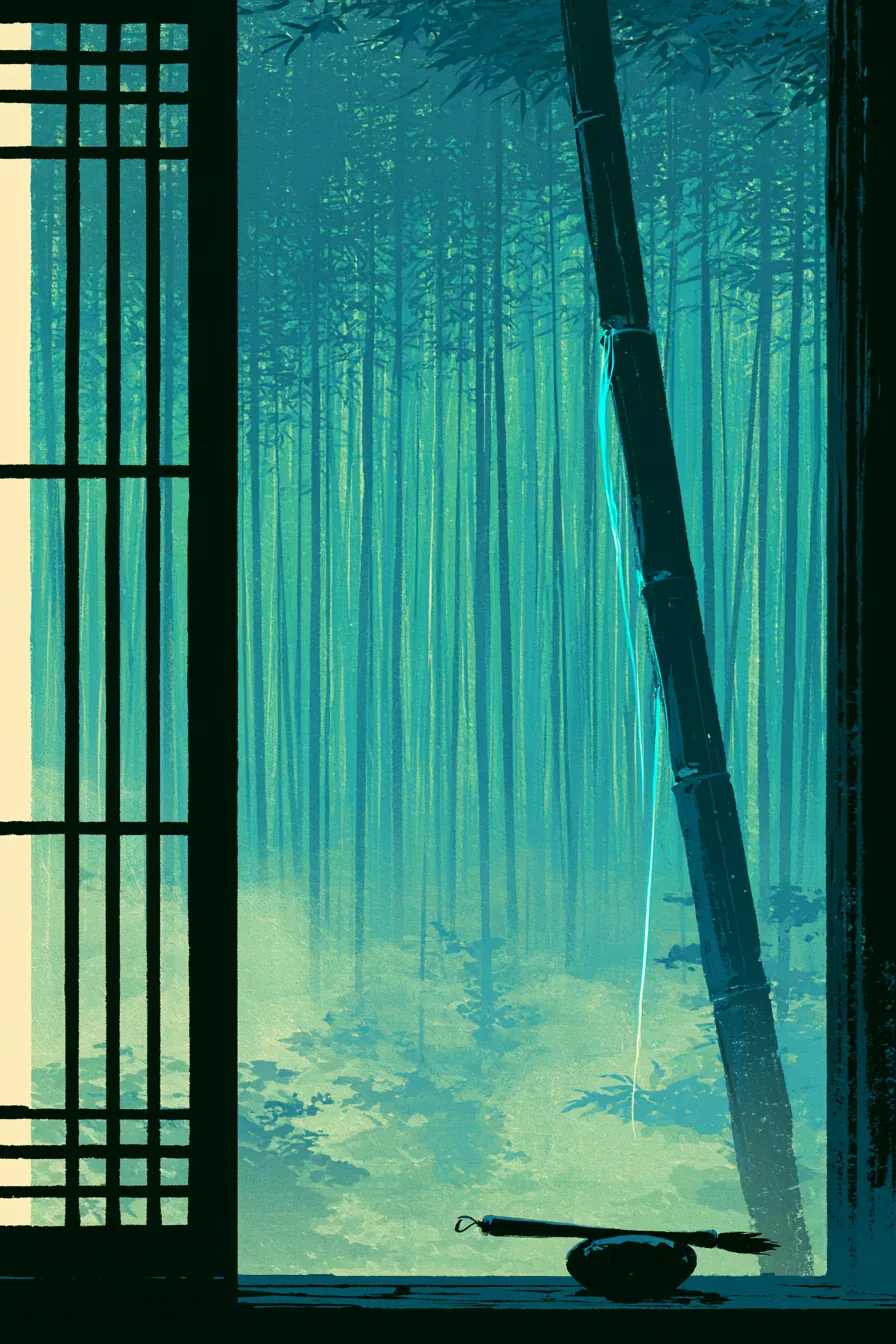
Outside the Copyhouse, the bamboo grove was beginning to hum.
It always hummed at dawn. The sect had been built into the grove three centuries ago for exactly that reason — the kilometer-tall stalks of Cloudreed bamboo were natural qi-conduits, and the morning resonance bathed the disciples in a soft tide of green-keyed energy that, if you were lucky enough to have meridians that could hold a tone, refilled your reserves while you slept. The fortunate woke up stronger. The unfortunate woke up the same.
Lin Wei had stopped waking up, in any meaningful sense, sometime in his twelfth year.
He set the brush down. Flexed the four fingers of his left hand inside the splint. The pinky had set crooked. He would learn to live with the pinky. He had a list of things he had learned to live with, and it was getting long enough that he had begun to suspect the list was the wrong unit of measurement, and the right unit was how few things he had not learned to live with. A short list, that one. Three items.
The brush. The ink. The hum.
The door to the Copyhouse banged open.
"Cracked one," said Han Yi.
Han Yi was beautiful, the way a knife is beautiful before it has done anything in particular. He was sixteen, tall, with the long-boned grace of a boy who had eaten meat at every meal of his life. His robes were inner-disciple blue with the green piping that meant Foundation Layer 5. He had stepped into the Copyhouse with three of his circle behind him — Bao, Wen, and the small one whose name Lin Wei had never bothered to learn because he hit at the same angle as Bao and there was no diagnostic value in telling them apart.
The senior elder was with them. That was new. Han Yi's bullying ran during the Copyhouse off-hours when no elder was present; that was the whole point of bullying, in Lin Wei's analysis — you needed witnesses but not authority. If the elder had come along, Han Yi wanted something on the record.
Lin Wei stood. He bowed at exactly the angle that was too low to be punished and too high to be respect. The elder did not notice. They never did.
"Finish your transcription?" Han Yi asked, conversational. As if they had ever in their lives held a conversation.
"Yes, Senior Brother." Lin Wei kept his voice flat. Flat was the voice that gave the smallest surface area for grip.
"Good. Then you have time."
"For what, Senior Brother?"
"A lesson."
Lin Wei did not allow his face to do anything. He had practiced not allowing his face to do anything in a polished bronze mirror for two of the three years he had been in the Copyhouse, and he was good at it now. He had practiced because Han Yi was good at reading faces, and the only resource Lin Wei had left was the small territory behind his own.
"The elder," Han Yi said, opening his hand toward the senior elder as if the man were a piece of furniture being introduced, "has graciously agreed to review the practical retention of disciples not yet at Body Tempering. He has a quota. I told him there was a candidate in the Copyhouse who, in his fourth year of remedial copying, must surely be ready for re-evaluation. He agreed."
Lin Wei's stomach did something quiet and cold.
There was no remedial copying. There was no re-evaluation. There was the Copyhouse, and there was the road out the gate, and there was nothing in between. Han Yi was not introducing a procedure. He was introducing a performance.
The senior elder coughed. He was a man named Pei, with a yellow-brown beard he had clearly been letting grow toward dignity without quite reaching it, and he was the third-most-junior elder in the sect, which meant he had been on quota duty for at least a decade and was bored to the point of grievance. He pulled out a spirit stone from his sleeve — a fingertip-sized green crystal in a wire frame — and clicked it absently against the desk.
"This is the boy," he said, to nobody.
"Yes, Elder Pei," Han Yi said. "This is the boy."
"Marginal, last time." Elder Pei consulted no record. He was remembering, which somehow felt worse than checking.
"Three years ago," Han Yi said. "Three years on the brush."
"Mm." Pei held the spirit stone out at chest height. "Touch."
Lin Wei touched.
He had touched a spirit stone exactly once before. He had been eleven years old. He had stood in a sun-warmed courtyard with forty other boys and girls from his fishing village. He had pressed his palm to the stone and it had flickered. Not the dead silence of a mortal child. Not the steady green glow of the talented. A flicker — on, off, on, off — like a candle in a draft that wasn't there. The recruiting elder had looked over his shoulder at the line of forty waiting children, sighed, written MARGINAL on Lin Wei's slip, and waved him into the Copyhouse cart.
Three years.
The stone, under Lin Wei's right hand, did the same thing it had done when he was eleven. It flickered. Green-on, green-off, green-on, green-off. The light fluttered in the elder's wire frame like a small frightened bird.
Lin Wei watched the elder's face. He had practiced watching faces too.
Pei's expression did not change. It did not even consider changing. He had seen the flicker before; he had a category for the flicker; the category was MARGINAL and the procedure was send back to the Copyhouse and stop wasting Elder Pei's time. Lin Wei withdrew his hand. The stone went out. Pei tucked it back into his sleeve.
"Marginal," he said, exactly as before. "Continue copying."
It would have ended there. It would have been three minutes of his morning lost and three weeks of Han Yi smug and Lin Wei would have written six hundred more characters before noon and the day would have closed quietly over the small wound the way the days always did.
But Han Yi said: "Elder Pei. With respect."
Pei paused with the spirit stone halfway into his sleeve.
"With respect," Han Yi said again, "the boy has not been demonstrated. The flicker could indicate cracked meridians, which is bad fortune. Or it could indicate a stubborn refusal to attempt cultivation, which is a disciplinary matter." He smiled the polite smile he used for elders. "I think the sect would benefit from clarity."
Pei's face moved a small distance toward irritation, which on Pei looked indistinguishable from his expression of mild interest, and Han Yi knew his audience. He had stopped on exactly the word that obliged the elder to either contradict him or proceed.
Pei proceeded. "Demonstrate, then."
"Of course." Han Yi half-turned to the bamboo grove visible through the Copyhouse's east window — a vertical green wall, soft in the early light. "Greenreed First Breath."
He did not move with any visible effort. His chest filled. His mouth shaped itself, very slightly, as if he were about to whistle and had thought better of it. The air in front of him tightened. A thread of pale green qi unspooled from somewhere between his shoulder blades and ran down his right arm and out into the room and into the bamboo at the window's edge, and the nearest stalk — five meters away through old wood lattice — began to sing.
It was a clean tone. A single sustained note in the upper-middle of human hearing. Lin Wei had heard the sect doctors compare it to a bronze bell struck once and held; he had thought, even then, that the comparison was wrong. A bell decayed. This did not. The tone simply was, for as long as Han Yi was being. The bamboo and the cultivator were, for the duration of the breath, a single instrument.
Elder Pei nodded with the small approving nod of a man watching a competent apprentice and not a prodigy. To Pei this was nothing. To everyone in the room not actively engaged in casting it, it was everything.
Han Yi held the tone for a count of ten. Released it. The bamboo, after a half-second, fell silent.
"That," he said pleasantly, "was the Greenreed First Breath. Layer Five." He smiled at Lin Wei. "The senior brother demonstrates. The junior brother attempts. That is how a sect works."
He gestured at the bamboo. Your turn.
Lin Wei looked at the bamboo.
He looked at Han Yi.
He looked at Elder Pei.
He said, "I can't."
Han Yi's smile did not move. "Try."
"My meridians are cracked, Senior Brother. Three doctors have confirmed it. I cannot hold a tone."
"That is what the marginal find say," Han Yi agreed. He had stopped looking at Lin Wei and was looking at Elder Pei, who was looking neither here nor there. "But Elder Pei is here to confirm. So. Try."
Bao, behind him, smiled. Wen smiled. The small one whose name Lin Wei had never bothered to learn smiled.
Lin Wei had two choices.
He could refuse. Refusing meant disciplinary matter, and disciplinary meant cane, and the cane meant he would lose the use of his right hand for a month and would fall behind on his transcription quota and would be reassigned to latrines, which had happened to two other cracked Copyhouse boys before him and had not ended well for either of them.
Or he could try.
Trying meant nothing would happen and Pei would write MARGINAL again on a different slip and Han Yi would have his small public confirmation, and Lin Wei would go back to copying and the bamboo would keep humming and the day would close over the small wound.
Trying was the small choice. He took the small choice. He had been taking the small choice for three years.
He turned to face the bamboo.
He filled his chest the way the manual described — and he knew the manual, he had transcribed the Greenreed First Breath eleven times in the last year because Elder Pei's department kept losing it. He had transcribed it. He had never tried it. The doctors had been very clear about what trying it would do to the inside of his ribcage.
He filled his chest. He let the breath settle, three-fingers below the navel, the way the manual said. He shaped his mouth, very slightly, as if to whistle. He reached, inside himself, for the place the manual called the first meridian.
He felt it.
His first meridian was there. It had always been there. The doctors said it was cracked, and they were right, and a cracked pipe could not hold a clean tone, and so the first meridian was not what hurt — what hurt was reaching for the green. The green-key qi in the room was all around him; it lay against his skin the way a tide lies against a swimmer. It wanted in. It had wanted in for three years. He reached for it the way the manual said —
— and the meridian buzzed.
Buzzed wrong. Not the clean ring of a struck bell, the way Han Yi's had a minute ago. A buzz. The sound a wasp makes inside a glass jar. The qi tried to enter. The crack in his pipe fluttered. The fluttering did not match the green-key qi's frequency. The qi sheared against the crack. Pain — small, sharp, very specific — bloomed in his back below the right shoulder blade, where his first meridian ran.
He let the breath out. He had held the failed shape for perhaps two seconds. It felt like a great deal longer.
He looked at the bamboo. The bamboo had not sung. Nothing in the room had sung. Elder Pei was already half-turning toward the door. Han Yi was already smiling the wider smile, the one he used when a thing had gone how he wanted.
"Marginal," Pei said. "Continue copying."
That was supposed to be the end.
The bamboo, five meters away through the lattice, hummed.
It was not a hum like Han Yi's. Han Yi's tone had ended thirty seconds ago. The grove had fallen silent. The bamboo was supposed to be silent.
It hummed at a tone that was not the tone Han Yi had cast.
It was close. It was very close. Lin Wei stood very still and listened, the way he had taught himself to listen at the very back of stack three when there was nothing else in the world but his cracked first meridian and the brush and the manual that someone wanted him not to read.
It was close to the green-keyed tone of Han Yi's First Breath. It was not the same. It was — he reached, mentally, for the word — it was below. A sliver below. The bamboo was singing a note he did not have a name for, in the small interval between the tone Han Yi had cast and the next tone down the scale.
He had transcribed the chart of the 81 tones two hundred and four times. He could recite them in his sleep. He had once recited them in his sleep — Master Yuan had caught him doing it and had not punished him, which was strange of Yuan and which he had filed for later study. The 81 tones were the bones of the world. There was nothing between them.
The bamboo, five meters from him, was singing in the place where nothing should be.
He did not, of course, say any of this. He bowed to Elder Pei. He bowed to Han Yi. He bowed to the small one whose name he had not bothered to learn. He went back to the desk. He picked up the brush in his right hand. He dipped it in ink. He wrote.
The character was harmony. Six strokes.
He left a seventh stroke off the page.
He watched Han Yi and the elder leave through the front door of the Copyhouse. He watched Bao linger in the doorway, looking for whether there was anything to add to the morning's lesson. He gave Bao the very small bowed shoulders Bao expected. Bao made an unimpressed noise and left.
Lin Wei finished harmony. He moved to resonance. He copied forty more characters.
The bamboo, five meters away, kept humming.
It hummed past the time Han Yi's tone should have decayed. It hummed past the moment the morning grove-tide finished swelling and settled. It hummed steadily, sustained, the way Han Yi's First Breath had been sustained for ten breaths and no more. The bamboo did not have lungs. The bamboo was not a cultivator. It was supposed to ring on the cast frequency and decay. It was decaying — yes — but it was decaying into the wrong tone. As if the cast had struck it and the strike had revealed, by reflex, what the bamboo actually wanted to sound like, given a chance.
Lin Wei copied. His right hand kept moving. His ears kept listening.
When the noon bell rang and the bamboo was finally silent — when Old Pei's afternoon walk passed through the courtyard and his footsteps were the loudest thing in the world — Lin Wei stood up, stretched the long lean ache that had settled into his back below the right shoulder blade, and walked very deliberately past the brush table to the small north window that faced the grove.
He pressed his right palm flat against the wooden lattice.
He listened.
The bamboo, in the long noon hush, hummed. Very faint. Just a thread.
Below the standard.
He had no name for the tone. He had no name for the interval, either, because the manual had never named what was not on the chart. He stood there with his cracked first meridian aching small and steady in his back. He had no idea what he was listening to. He had every idea that what he was listening to was not what he had been told existed.
He thought, before he could stop himself: the manual is wrong.
He thought it again, more slowly: the manual is wrong.
He took his hand off the lattice. He went back to the desk. He picked up the brush. He wrote two more characters of the day's transcription, very neatly, because anything less neat would have been a tell.
Then he set the brush down and walked, through the side door, into the alley between the Copyhouse and the disciples' privy. The alley was empty. It was always empty at noon, because the disciples ate at the long benches at the south wall and the elders ate in the elder hall and the privy was a place you visited briefly and then left.
He stood in the alley. He looked up at the strip of green sky between the Copyhouse roof and the privy roof. The bamboo was beyond the privy wall. He could hear it humming, faint as a pulse in a wrist.
He tapped his ribcage with the knuckle of his right thumb.
Once. Tok.
He had heard Old Fu do it — Old Fu, the teahouse man in Yan City, who used to slip him buns when his father sent him on errands as a child. Old Fu's hand on the side of a tea bowl. Tok. The bowl ringing. A bowl that rings when you tap it is more useful than a bowl that doesn't.
Lin Wei tapped himself once more, harder. Tok.
He had a cracked first meridian. He had a buzz where other people had a tone. He had transcribed nine hundred and twelve copies of harmony and counted seven strokes in two of them. He had stood in front of Elder Pei and Han Yi and three sycophants and failed, in the agreed-upon way, to cast a single clean note.
And five meters past him, through a lattice and a wall, the world's instrument was singing in an interval that did not exist.
The small cold something in his stomach uncurled a little, and Lin Wei recognized it, with some surprise, as the first warm thing he had felt in three years.
He walked back into the Copyhouse. He picked up the brush. He wrote one more character — truth, four strokes by the elder's lineage, five strokes in the old box at the back of stack three — and very carefully, very precisely, left both versions out of the page entirely.
The brush moved on to the next character.
His ears, in the long noon hush, kept listening.
Somewhere in the grove, the bamboo hummed. Below the standard. Below the chart. Below the world.
He had thirty-eight thousand characters to transcribe before sundown.
He had, for the first time in his life, somewhere to put them.