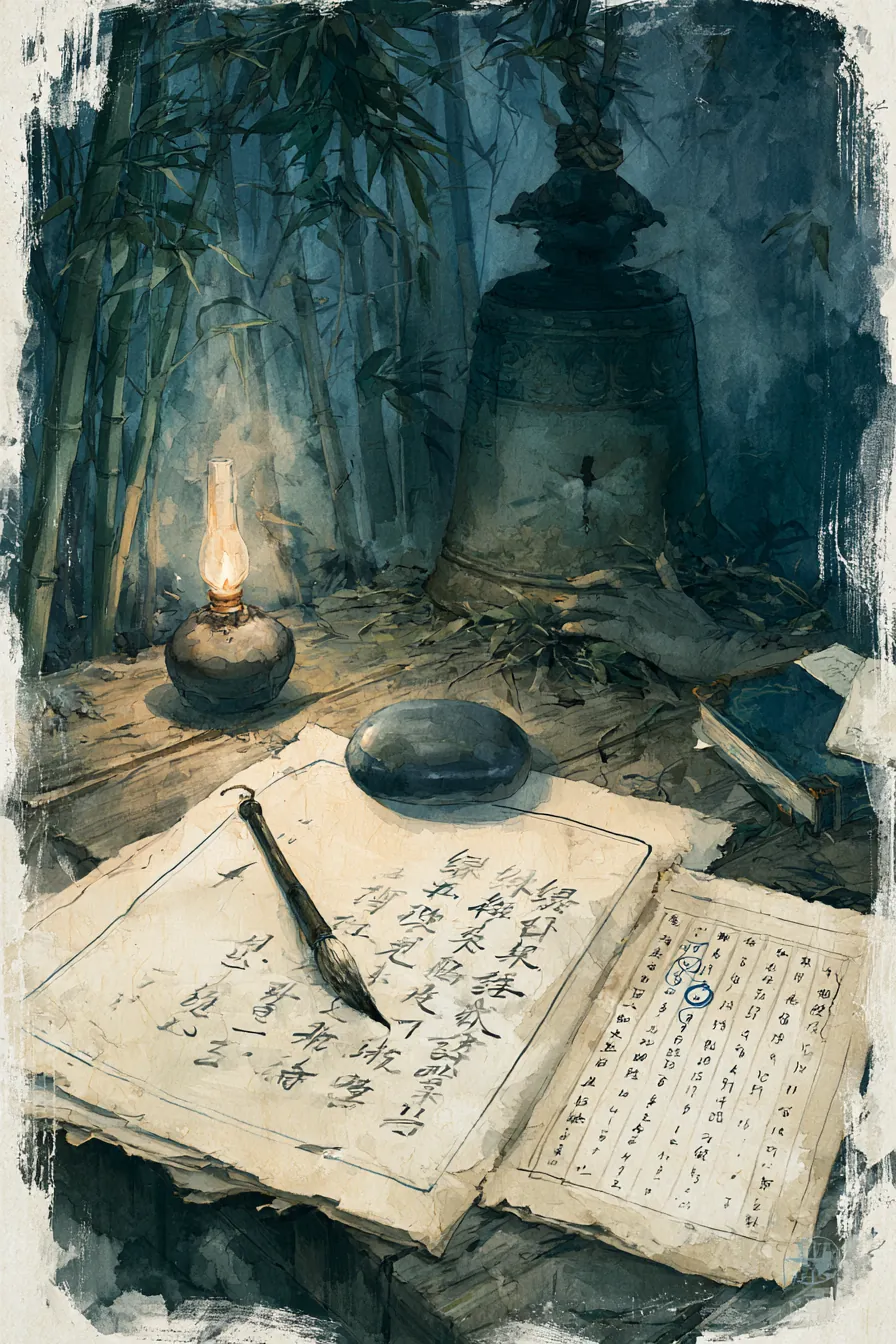
Chapter 2 — Tones I Was Not Taught
Lin Wei's cell was the size of a coffin laid on its side, and he had been grateful for it every night for three years because the door had a bolt and the bolt was on the inside.
He bolted it now.
The grove had gone quiet at last. The disciples had retired. The third-watch bell had rung from the outer wall, the watchman had walked past the Copyhouse with his lantern, the lantern had passed his small window high in the south wall, and the slat-light had drawn its slow yellow bar across his floor and then climbed the opposite wall and gone out. The dormitory above him was making the small thumps and coughs of forty boys settling.
He sat on the pallet. He took the manual out of his sleeve.
He was not supposed to have it. He had taken it from stack four, the working stack, where it lay under three other Foundation manuals that the senior elder rotated for the inner disciples. He had taken it because he had transcribed it eleven times in the last year and because his right hand had developed the habit of putting things in his sleeve while his face did something else. He would put it back at dawn. Old Pei would not notice. Old Pei never noticed.
The Greenreed First Breath, Sublimated Edition, Eighth Compilation.
He set the manual on his knees. He did not open it.
He closed his eyes instead, and he listened.
The bamboo was still humming.
He had spent the rest of his afternoon listening, in the alley, on his bench, by the privy wall, with one ear pressed to the wood-and-clay seam between the Copyhouse and the grove. The hum had not stopped. It had decayed — yes — through the long noon and the long afternoon, the way an iron bell decays after a strike. But where Han Yi's cast had decayed to nothing inside ten breaths, this had decayed only most of the way, and then the decay had settled. The bamboo was holding a tone at the very edge of audibility, sustained, the way a man with good lungs holds the last note of a sad song.
Wrong song.
He had transcribed the chart of the 81 tones two hundred and four times. He could place any tone he heard against the chart in his head — green-one, green-two, green-three. The standard greens. The bamboo of the Cloudreed grove was supposed to ring at green-three when struck by a green-keyed technique. That was in the manual. That was in three manuals. That was in the teaching diagram nailed to the wall of the outer disciples' lecture hall, painted by some long-dead elder in fading lacquer, with the bamboo stalk above the green-three character and the character of resonance below it.
The hum, in his ears, was not green-three.
It was lower. It was lower by an interval he could not name.
He opened his eyes.
He could not name the interval because the chart did not name what was between the tones. Between green-three and green-four was the next tone — green-three was green-three and green-four was green-four and there was nothing between them, the way there was nothing between the number three and the number four. That was the chart's logic. That was the world's logic. The 81 tones were the bones of the world. The world was carpentry. You did not put your tongue between two bricks.
But the bamboo was singing in the place where there was nothing.
He filed carpentry in the part of his mind he used for working metaphors. He picked up the manual.
He had a candle stub. He lit it from the dish of seed oil he was permitted, by Old Pei, to keep for "warming his ink in winter." He set the candle on the floor between his feet so the light could not be seen under the door. He opened the manual.
He had transcribed this manual eleven times. He knew it the way some men knew their wife's face. He turned to the page that mattered.
To draw the First Breath, fill the chest in four counts from the soft of the belly. Settle the qi three fingers below the navel. Reach inward, with the will of the second mind, to the first meridian, which runs from the sole of the right foot to the soft of the right ear. Allow the first meridian to ring at the standard pitch. Allow the green of the grove to enter. Allow the green of the grove to pass through the first meridian and out the right palm. Sustain.
He had transcribed this passage eleven times. He had never tried it. Today, in front of Elder Pei and Han Yi, he had tried it for the first time, and the second sentence was the one that had buzzed wrong.
Allow the first meridian to ring at the standard pitch.
That was the line.
The doctors had said his meridians were cracked. Cracked was the word. The word came with images: a clay pipe split lengthwise, leaking; a porcelain bowl with a hairline fissure; a string on a qin that had unraveled. The doctors had pressed two fingers to the small of his back, three fingers behind his right ear, one to the heel of his right foot, and they had hummed the standard pitch, and they had listened, and they had said cracked because his meridian, when prodded, had not rung clean. It had buzzed.
He had accepted cracked the way a fish accepts water. It had been the first thing about him that the world had agreed on.
But now he sat in his cell with the candle between his feet and he thought, slowly: a cracked pipe leaks. A buzz is not a leak. A buzz is a different note.
He filed leak vs. note with the carpentry, because both of them were now metaphors that wanted attention.
He turned the page.
The next section of the manual was Common Causes of Failure and Their Remedies. He had transcribed it as many times as the first. The list of causes ran:
One. Insufficient breath capacity. Remedy: chest-opening exercises.
>
Two. Insufficient stillness. Remedy: meditation, ninety days.
>
Three. Cracked meridians. Remedy: none. Discontinue practice. Reassign disciple to non-cultivating duty.
He read three again. He read it a third time.
The remedy was none. There was no remedy. Cracked was the end. Three years ago Elder Pei had read this line, in essence, off the back of Lin Wei's recruitment slip, and the Copyhouse cart had taken Lin Wei away from his father and his fishing village and the open sky and given him this cell instead.
Cracked.
He set the manual on the pallet beside him. He pressed his right hand to the small of his back, behind the kidney. The first meridian, the doctors had said, ran through here.
He hummed, very softly, just under his breath, the standard green-three of the grove. The pitch he had heard ten thousand times. The pitch that had decayed off Han Yi's cast that morning before the bamboo had answered with something else.
He hummed it.
His back, under his palm, did nothing. The meridian was asleep. Hum at a meridian and you got nothing; you had to push qi at it, and pushing qi was something he could not do.
He hummed it again, lower. A whisker lower. A fraction. He did not know what fraction.
He felt — perhaps — the faintest twitch under his palm. Or perhaps he had imagined it. The candle flicker, the late hour, the long afternoon spent listening.
He let his hand fall.
This was the part where, in the manuals' little parables, the unfortunate disciple gave up and the fortunate disciple discovered something new. The manuals were stories. The Copyhouse was not. Three years had taught him very precisely what the Copyhouse did to disciples who started listening too hard.
He picked up the manual again. He read Common Causes of Failure one more time.
Cracked meridians. Remedy: none.
He thought, the manual is wrong.
He had thought it that afternoon, in the alley. He had thought it sitting at the brush table copying truth and refusing to copy either version. He had thought it at the evening rice. He thought it now and the thinking did not get easier, because the thought had teeth, and the teeth were these: if the manual was wrong, then everyone who had told him he was broken was wrong. If everyone who had told him he was broken was wrong, then he had spent three years copying nine hundred and twelve harmonies and breaking his left hand and learning not to allow his face to do anything because a senior elder had been bored on the day Lin Wei was eleven.
It was a thought that hurt to think.
He thought it again, and he made himself not flinch.
Then he reached into the front of his robe and took out the second thing.
The second thing was a wood scrap as long as his finger and as wide as two. He had picked it up that afternoon from the splinters at the base of the bamboo lattice, where the south side of the Copyhouse leaned against the grove and one of the older stalks had shed a curl of skin. He had pocketed it without thinking. He took it out now.
He held it close to the candle. Cloudreed bamboo skin: pale green on the inner face, silver-white on the outer, hard as old horn. He pressed his thumbnail to it. The skin gave a small dry creak. He pressed his ear to the splinter.
He hummed at it, very softly. The standard green-three.
The splinter did nothing.
He hummed lower. A whisker lower. The fraction.
The splinter — and he stilled himself absolutely, because if this were nothing he wanted to know it was nothing and not be fooled by a wishful ear — the splinter did, very faintly, hum back. Just for a breath. Just a thread of a sound, the way a quiet room has a sound if you listen long enough.
He sat with the splinter pressed to his ear. The candle made small wet sounds in the seed oil. His back, under his palm, was doing nothing he could be sure of.
But the splinter was humming.
He took the splinter from his ear. He looked at it. He set it on the manual, on the page that read Cracked meridians. Remedy: none.
He looked at the splinter and the page together.
The splinter was as long as his finger and as wide as two and it was humming back at him at a frequency the manual said did not exist. It was humming at the frequency of a buzz the doctors had called cracked.
Lin Wei filed this, very carefully, in the part of his mind he had learned not to speak from. Then he filed it again, in a different part, the part he had spent three years not knowing he had — the part that the small warm thing in his stomach lived in, the part that had said thank you to Old Fu in Yan City five years ago when Old Fu had pressed a sweet bun into his eight-year-old hands and said —
The memory rose without permission.
Old Fu had been older than Lin Wei could conceive of age being. White hair, hands like rope. He had run the small teahouse on the back lane of Yan City where Lin Wei's father went on the rare market days when the catch was good enough to sell. Lin Wei, age eight, had been allowed to come along. Lin Wei had been allowed, that day, to sit on a stool and watch.
Old Fu had been setting out bowls. The bowls were clay. Some of them rang and some of them didn't. Old Fu had a way: he would lift each bowl by the rim, give it a small tap with his middle knuckle, and listen. The ones that rang clean he set on the front shelf, where customers chose them. The ones that didn't ring he set on the back shelf, where the teahouse boys used them to take dregs out to the alley pig.
Why? Lin Wei had asked.
A bowl that rings when you tap it is more useful than a bowl that doesn't, Old Fu had said, in the slow patient way of a man explaining a thing he had explained a thousand times. If the bowl rings, the bowl is whole. If the bowl doesn't ring, there's a crack in it somewhere, and someday hot tea will find the crack and find your customer's hand.
What about the ones that ring funny? Lin Wei had asked, because two of the bowls had rung in a way that wasn't the clean ring of the front shelf but wasn't the dull thud of the back shelf either.
Old Fu had paused.
Those, Old Fu had said, are bowls that ring at a different note than the rest. Some potters make them on purpose. Some make them by accident. A bowl that rings at its own note — he had picked one up, tapped it. It had given a soft sweet tok, low and round. — is a bowl that knows what it is.
Is that good? Lin Wei had asked.
It's not good or bad, Old Fu had said. It's just rare. He had set the bowl on the middle shelf, alone. A bowl that rings at its own note can't go on the front shelf because it won't match the others, and the customer will think the set is broken. It can't go on the back shelf because it isn't broken. It goes on the middle shelf and it waits for the customer who'll hear it.
Has the customer come? Lin Wei had asked.
Not yet, Old Fu had said.
Then he had given Lin Wei a sweet bun and sent him to play in the alley while the men talked.
Lin Wei opened his eyes.
The candle had guttered some. The splinter lay on the page. The manual lay on the pallet. The cell smelled of seed oil and the slow damp the walls held all year round.
He had been eight years old. Six years ago. He had not thought about the bowls in six years.
He had thought, when he was eight, that Old Fu was talking about pottery. He understood now, sitting in the candle dark with a splinter that hummed at the wrong note, that Old Fu had not been talking about pottery. Old Fu had been a clever man who had watched a boy come into his teahouse with his fisherman father year after year and had seen, in the small bow Lin Wei made and the small things Lin Wei said, a bowl that rang at its own note, and had stocked a piece of advice the way a teahouse man stocks tea — against the day a customer might need it.
The customer had been the boy.
The day had been now.
Lin Wei tapped, gently, the side of his own ribcage. The right side, just under the floating rib. The first meridian ran near there.
Tok.
He could not have said whether the sound came from inside him or out, from the rib or the splinter or the bamboo wall or the candle wick. But there was a sound. It was small. It was at the wrong note. It was at the same wrong note the bamboo five meters past the lattice had been holding all afternoon and was holding still.
He set the manual down. He set the splinter beside it. He did not move for a long time.
A bowl that knows what it is.
The brush was on the pallet too — his second-best brush, the one he was allowed to take to his cell for ink-stick prep. He picked it up. He had no paper. He had nothing to write on.
He turned the manual over. The back cover was blank. Eighth Compilation, the binder had used a thicker board than usual, and the inside of the back cover was a clean grey-white surface.
He should not write on a sect manual.
He did not write on it. Not yet. He set the brush down. He sat with his knees together and the candle between his feet and he made himself think.
He thought:
One. The bamboo is humming at a tone not on the chart.
Two. The splinter, which is bamboo, hums at that same tone.
Three. I, when I tap my own ribs, hear a tone. Possibly imagined. Possibly the same.
Four. The manual says my meridians are cracked and that there is no remedy.
Five. If the manual is correct on point four, points one through three are coincidence or hallucination. If the manual is incorrect on point four, points one through three are evidence.
Six. The manual could be incorrect.
He sat with six for a long while. He let himself hold it. The candle ate its wick down a quarter of a finger.
He thought:
Seven. If the manual is incorrect, then the manual was made incorrect — either by accident, over many copyings, or on purpose, by someone with a reason.
Eight. The Copyhouse is the place where manuals are made. The senior elder dictates which strokes are correct. Two of the older manuals in the back of stack three contain a stroke the senior elder removed. Therefore strokes are removed on purpose. Therefore tones could be removed on purpose. Therefore the manual could have been made incorrect on purpose.
He stopped.
He felt, distantly, the small cold thing in his stomach uncurl another notch, and he felt the small warm thing replace it.
He thought:
Nine. If a tone has been removed from the chart on purpose, then someone, somewhere, removed it. That someone or that someone's descendants knows what was removed. The Copyhouse has every manual the sect has copied in three centuries. If a removed tone exists in any old fragment, it would be here.
Ten. I have access to the Copyhouse at all hours.
He looked down at the splinter on the manual cover. The candle had nearly guttered. He would have to put it out soon or he would smell of seed oil at dawn, which Old Pei did not like, and Old Pei's not-liking ran into write-ups, and write-ups ran into the cane.
He blew the candle out.
In the dark, with the splinter cool against his palm, he made himself say it out loud. Whispered. Once. The shape of it in his mouth, so he could not pretend later that it had only been a thought.
"The manual," he said, "is wrong."
He waited. He waited the way a man waits to see if the floor will fall through. The floor did not fall through. The bamboo, in the grove, hummed faintly through the wall.
He whispered, just to be sure:
"I am not a cracked bowl. I am a bowl that rings at its own note."
He felt his face do something. It was small. It was the first thing his face had done in three years that was not a calculation. He let it. There was no one to see, and Old Fu was nine days' walk away in Yan City, and his father was further than that and might already be dead. There was no one. He let his face do the small thing for the time it took the bamboo's hum to fade by another notch, and then he made it stop, and he lay down on the pallet with the splinter in his right palm and the manual under his right cheek and his bolted door three handspans away.
He did not sleep.
He thought, instead, about stack three.
Stack three was at the back of the Copyhouse, against the south wall, and it had been DISCARD-marked by the elder before Old Pei and the elder before him, which meant nobody had inventoried stack three in eighty years. He had counted forty-one boxes when he had counted last spring. He had only opened six. The other thirty-five contained, as far as he knew, water-damaged manuals from the Sundered Era — the time three centuries past when half the sect's holdings had been lost in some calamity that nobody talked about.
Sundered Era. Sundered. The word sat on his tongue and tasted like old paper.
He had not opened the boxes because there was no reason to. The water-damaged manuals were not even legible. Old Pei walked past stack three the way a man walks past a grave.
Lin Wei lay in the dark with the splinter humming faintly in his palm and thought: thirty-five boxes. Sundered. Old Pei walks past.
He thought: the chart was always 81. I was always taught 81.
He thought: what if, before the Sundered Era, there were more?
The thought did not have teeth. The thought had a key.
He turned the key in his mind. The bamboo, faint past the wall, hummed at its tone. The splinter, in his palm, was warming with the heat of his hand. He listened to both of them — the wall-tone and the palm-tone — and they were the same, the wall and the palm singing the same note across five meters of damp old timber, and the note was not on the chart, and the chart was wrong, and the wrongness was not an accident.
Lin Wei, age fourteen, lying on a pallet the size of a coffin laid on its side, smiled very slightly in the dark.
He stopped smiling almost immediately. Smiling, he filed, is for when no one can see. Practice. He waited until his face was still. He turned the splinter over in his palm once, twice, three times.
Tomorrow, he thought. Stack three. Box one. The smallest box. Old Pei does not walk past stack three until the afternoon shift. I will be in stack three at the first watch. I will be back at the brush table before the bell.
He set the splinter inside the manual. He bolted his door tighter. He laid his right hand against the small of his back, where the first meridian was, and he hummed under his breath — once, softly — the not-quite-green-three of the bamboo.
His meridian, under his palm, twitched.
It was not imagined. It was not the candle. The candle was out. He had no breath left to mistake. The first meridian, the cracked one, twitched once under his palm like a string that had been still for a very long time and had finally remembered what it was for.
Lin Wei did not move.
Outside the door, very far away, the watchman's lantern was passing again. The fifth watch already. He had thought a long time. He would need to be at the brush table in three hours.
He lay in the dark. He hummed the tone again, softer. The meridian twitched again.
He had three years of practice keeping his face from doing anything. He used all of it. He did not let his face do anything. He did not let his hand shake. He did not let himself say the thing he wanted to say.
He thought it instead, very precisely, so he would remember it tomorrow in the bright light of the Copyhouse desk:
The first meridian is not cracked. The first meridian is tuned.
To something the chart does not know.
He hummed the tone one more time. The meridian, under his palm, hummed back — for a single breath, a small clear answering buzz that was not a buzz at all but a note, the way Old Fu's middle-shelf bowl had given a soft sweet tok and Old Fu had said a bowl that knows what it is.
Lin Wei lay still in the dark with the splinter cooling in his other hand and his door bolted three handspans away and the bamboo humming through the wall and his first meridian, after fourteen years of silence, ringing under his palm at last.
He thought, I have something to put them in.
He thought, thirty-five boxes.
He thought, very precisely, tomorrow.
The brush, on the pallet beside him, lay where he had set it down. He would need it at dawn. He turned, very slowly, so as not to wake the boys in the dormitory above, and he closed his hand around the splinter, and he waited for the first watch bell.
In the grove, five meters past the lattice and the wall and the breath of a sleeping sect, the bamboo sang on at the wrong note — Lin Wei's note, the note the chart did not know, the note that was about to become a hammer.