Chapter 3 — The Sundered Fragment
The first-watch bell rang at the hour when the air went from cold to colder. Lin Wei was already standing.
He had not slept. He had filed not sleeping under acceptable costs. The list of acceptable costs was a list he updated rarely. He updated it now.
He bolted his cell door behind him from the outside — sliding the small iron pin into the bracket so the door read occupied to anyone walking past. He stepped down the corridor in his soft-soled cloth shoes. Three years of carrying ink-pots had taught him exactly where the floorboards complained, and his weight settled between the complaining places the way a cat's weight settles. He passed the senior boys' dormitory. He passed the latrine. He came down the short stairs to the main floor of the Copyhouse and into the working hall.
The working hall, at first watch, was a long room of cold ink and colder lacquer. The brush tables stood in two rows like coffins on legs. The stacks rose along the east wall, west wall, and the back wall — three deep. The north end was the elder's desk, dark. The south end was the door to the printing block storage and, beyond that, to the alley.
Stack three was the third from the back wall, south corner. Lin Wei had walked past stack three eight hundred times in three years. He had never stopped at it.
He walked toward stack three.
He did not light a candle. The shutters of the north windows let in the false grey before dawn — enough to see the shapes of boxes if you knew already where the boxes were. He knew. He had inventoried them last spring under cover of re-sorting the discard pile and had been beaten for spending too long on a useless task and had finished the inventory anyway because he had been bored.
Forty-one boxes. He had a layout of stack three in his head the way another disciple had a layout of Han Yi's circle: who stood where, who could hit, who could not.
He stopped at the corner. He listened.
The Copyhouse was quiet. The grove, past the lattice, was beginning the dawn hum — a slow soft swell that would peak around sunrise and then settle. Up in the dormitory, someone coughed and rolled over. The watchman, on his rotation, was at the east wall. Lin Wei had four watches between him and discovery — at most, three quarters of an hour.
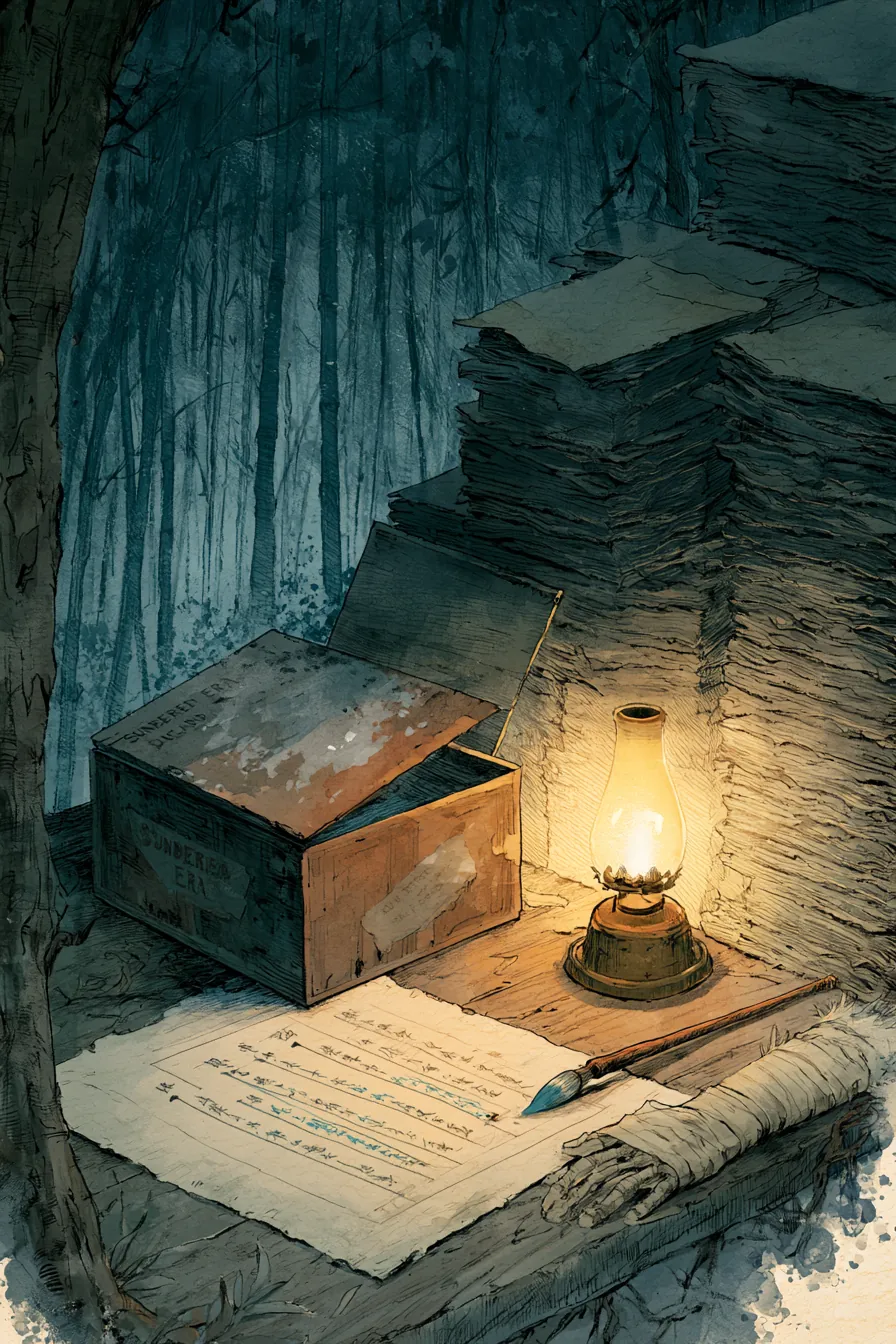
He knelt at stack three. The smallest box was the second from the bottom, on the east face, marked in faded brush with what might have been Sundered Era or might have been Discard 47 depending on whether you read the third character as era or as a slash. He had read it both ways at different times. He had no preference. The point was that the box was small and the lid was loose and the loose lid meant he could open it without lifting it down and the not-lifting meant the dust on top would not move and Old Pei, who walked stack three on the afternoon round, would not see that the dust had moved.
He set his fingers under the lid. He lifted.
The lid came up. The smell came out.
Old paper. Old paper of the particular kind that has been wet and dried and wet and dried — that has lived inside a Copyhouse box through three centuries of grove humidity. The smell was not unpleasant. It was the smell of the back of the working stacks in summer. It was the smell of harmony copied nine hundred and twelve times.
He had not, before this moment, fully understood that the smell was the smell of what had survived.
He filed the thought. He looked inside.
The box held seven manuscripts. He could count them by the spines, stacked one atop another. All seven had been water-damaged at one corner — the top corner; whatever water had gotten in had gotten in from above, splashed once, soaked. Five of them were gone — the paper had turned to clay-colored pulp and re-dried in a brick shape that could not be opened without shattering. Two of them were not.
The top one of the two was a thin pamphlet, palm-sized, sewn at the spine with what had been red thread and was now brown. It had a single character on the cover — a character Lin Wei did not recognize, which was a thing he had thought himself past. Truth had eight strokes in the elder lineage, four in the standard, five in the back-of-stack-three lineage; he knew the variants. This character had nine strokes and he could not name it.
He lifted the pamphlet very slowly. The paper of it shed a fine fawn-colored dust onto his sleeve.
He set the pamphlet on top of the box and very carefully opened it.
Three pages. Forty-seven characters.
The hand was not the elder's. The hand was not Old Pei's. The hand was not any hand Lin Wei had seen in three years of copying. It was older — and the ink was a brown that came from age, not from a brown ink. Black ink turns to brown over centuries. He had seen this before in the older manuals that lay in the working stacks. But the strokes —
He looked at the strokes.
Half the characters he could read. The other half were variants — strokes added, strokes pruned, brushwork that moved through the page in a slightly different rhythm. The character he had read on the cover as truth appeared in the body twice, and in both places it had its nine strokes, and reading it among the other characters Lin Wei could finally fit it together: this was an older form. Truth with the honest tongue radical inside it. Truth before the senior elder's lineage had pruned it down to the spoken word alone.
He could read the manual. Mostly.
He read it.
The First Breath of Greenreed, it began, for the disciple of the green key. Fill the chest in four counts from the soft of the belly. Settle the qi three fingers below the navel. Reach inward, with the will of the second mind, to the first meridian, which runs from the sole of the right foot to the soft of the right ear. Allow the first meridian to ring —
Lin Wei's eyes stopped. The line of the passage stopped. The next character was not on the chart.
Allow the first meridian to ring at the half-green pitch — the pitch between green-three and green-four, found by closing the third interval and opening to the second harmonic; the tone that has no name in mortal song; the tone the bamboo holds for the listener.
He held the pamphlet very still.
He read the sentence again.
The half-green pitch.
It was a tone. It had a name. It had a place. The name was a description rather than a number, and the description was the thing he had been doing since the candle the night before: closing the third interval and opening to the second harmonic. He did not know what those words meant, but the shape of them, the verb-arrangement of them, was the shape of the thing he had been doing involuntarily when he had hummed the splinter and felt his meridian twitch.
He read on.
Allow the half-green pitch to enter from the grove. Allow it to pass through the first meridian and out the right palm. Sustain.
That was the entire passage. It was the Greenreed First Breath, the same technique he had transcribed eleven times, only the manual he had transcribed eleven times said standard pitch and this manual said half-green pitch and the half-green pitch was the tone the bamboo had been humming since yesterday morning.
He turned the page.
Common Causes of Failure and Their Remedies, the next page read.
One. Insufficient breath capacity. Remedy: chest-opening exercises.
Two. Insufficient stillness. Remedy: meditation, ninety days.
Three.
He read three.
Three. Use of a smooth-meridian body. The Greenreed First Breath in its true pitch cannot be cast by the smooth-meridian. The smooth-meridian must learn an adjacent technique. The fluted-meridian disciple, alone, may cast this manual unmodified. The fluted-meridian disciple is rare and is to be cherished, for the half-green is the breath of the grove itself.
Lin Wei sat back on his heels.
He sat back, and he made himself read it again.
The smooth-meridian must learn an adjacent technique. The fluted-meridian disciple, alone, may cast this manual unmodified.
He understood, with a clarity that hit him in the back of the skull, that he had been reading two manuals for three years and had not noticed.
There were two manuals. There had always been two manuals. One was for smooth meridians — the ordinary disciple, the Han Yis of the world, who had wide round meridians like clay pipes and could be tuned to any of the 81 standard tones. That manual was modified. It had been written for the smooth-meridian. The original manual — this manual, the one in his hands — was for the fluted-meridian.
The fluted-meridian.
Fluted was not cracked.
Fluted was a shape. A flute had grooves in it on purpose. A flute that buzzed was a flute doing what a flute did. A flute that rang clean would not be a flute, it would be a pipe.
His meridians were not cracked. They were fluted.
He had been told for three years that he was a broken pipe. He had been a flute the whole time.
He set the pamphlet very precisely on top of the box. He sat with his back against the side of the stack and the dust of three centuries on his sleeve and his hands flat on his knees, palms up.
He did not let his face do anything.
He let, instead, his mind catalogue.
One. The original manual exists.
Two. The original manual names my body type. The doctors who diagnosed me were either ignorant of this name or were lying. Either is possible. Both are possible.
Three. The original manual specifies a pitch — the half-green — which lies between the standard tones. The standard chart of 81 tones does not contain this pitch. Therefore the standard chart is incomplete.
Four. If the standard chart is incomplete, then the 81 are not the bones of the world. There are more.
Five. He stopped on five. He did not finish the thought because the thought was who decided to leave them out, and why, and that thought was for later, in a place with a bolted door.
He let five sit. He went back to one.
He opened the pamphlet again. Three pages. Forty-seven characters. He had read the first page. The second page was the failures-and-remedies list. The third page was —
He turned to the third page.
The third page was a diagram.
He had transcribed diagrams. The standard chart of 81 tones was a diagram he could draw in his sleep. The diagram on the third page was not the standard chart. It was the standard chart with extra lines.
He stared at it.
It was a chart of tones between the tones.
The standard 81 sat on the page as their familiar columns. Between each adjacent pair of standard tones, in finer brush, sat a smaller column — half the height, in a different brown ink, marked with a name in the older form. Half-green. Half-red. Half-blue. All the way around the wheel. Between each standard tone and the next, a half-tone.
He counted, because counting was the thing his mind did when his mind needed to walk in circles. Eighty-one standard tones. Eighty-one half-tones if you placed one between each adjacent pair. The total was —
He did the arithmetic.
A hundred and sixty-two.
He sat with a hundred and sixty-two for a long moment. The number was twice eighty-one plus zero. Twice the bones of the world. The world had twice as many bones as he had been told the world had.
He did not move.
He read the diagram's caption, lettered in the same older brushwork, very small:
The 81 are the strong tones. The 81 between them are the soft tones. To cast a strong tone is to strike the bell. To cast a soft tone is to make the bell sing of its own accord. The strong cultivator casts strong. The soft cultivator casts soft. The disciple who hears both casts both.
Beneath the caption, in a different hand — fainter, in pencil-grey lacquer — someone had written, much later: and one above, and one below.
He looked at the small annotation. One above, and one below. He did not understand it. He filed it.
The dawn was getting on. The bamboo, past the lattice, had begun its real morning swell. He had perhaps a quarter-hour before the second-watch bell, after which the first of the boys would come down for water, after which Old Pei would be in his office, after which the day would begin and Lin Wei would have to be at the brush table.
He looked at the pamphlet. He looked at the box.
He could not take the pamphlet. Old Pei walked the stacks. If the pamphlet were not in the box when Old Pei walked, the box would be discovered moved, and Old Pei would not need to read the pamphlet to write Lin Wei up for being in the back stacks at dawn; the moved dust would be enough.
He could not leave the pamphlet and come back. He had felt, just now, the small clean satisfaction of having read it; he knew himself well enough to know that having read it once was a fact his mind would chew at all day, and the chewing would show in his face, and Han Yi was a boy who read faces. He needed to have it.
He could copy it. He had the brush in his sleeve.
He had no paper.
Three handspans from his knee was a discard pile of trimmed margins — the small sliver-strips that came off the bottom of every page after a copyist had transcribed it. The slivers were burned at week's end. The slivers were also, today, paper. He pulled three slivers from the pile, the longest ones, each about a finger wide and four fingers long. He had four fingers' worth of writing surface.
He had forty-seven characters to copy.
He could not copy them all. He could not even copy half. He had — he eyeballed it — perhaps room for twenty characters at his smallest brush.
He chose.
The twenty characters of the first passage, edited down: first meridian. Half-green. Between green-three and green-four. Third interval closed. Second harmonic opened. Fluted-meridian disciple. Half-green is the breath of the grove.
He counted: twenty-three characters. He pruned: first meridian. Half-green. Closed third, opened second. Fluted. Half-green grove. Fifteen. He had room.
He picked up his brush. He uncapped the small ink stub he kept in his sleeve. He inked. He wrote.
He wrote fast. He wrote small. He wrote in the back-of-stack-three lineage, which used four strokes for truth and not five, because the back-of-stack-three lineage was the lineage the senior elder did not read.
He wrote first meridian on the first sliver. Half-green on the same. Closed third, opened second on the second sliver. Fluted. Half-green grove on the third.
He blew the ink. He folded each sliver four times. He tucked them inside the seam of his right sleeve, in the small pocket where copyists kept their ink stubs. He capped the stub.
He set the pamphlet back inside the box, in the exact position he had taken it from. He lowered the lid. He pressed his thumb lightly against the dust on top so that the slight disturbance from lifting the lid looked, instead, like a thumb-print Old Pei would attribute to himself.
He stood. He walked to the brush table by the most-used route. He sat. He laid out his ink-stick. He laid out his brush — his second brush, the one he used at the desk, because the first brush was in his sleeve. He poured a thumbnail of water on the stone and began to grind ink.
The second-watch bell rang.
He kept grinding.
He had, in his sleeve, forty-seven characters of a manual that should not exist, condensed to fifteen characters of enough. He had, in the splinter still in his inner pocket, a piece of bamboo that had hummed at the half-green pitch. He had, under his right shoulder blade, a meridian that the doctors had called cracked and that the older manual had called fluted and that, last night, had twitched under his hum.
He had, walking down the stairs from the senior boys' dormitory, the soft tread of Old Pei.
He kept grinding.
Old Pei came down the corridor. Old Pei did not stop. Old Pei walked through the hall without looking at Lin Wei, because Lin Wei was always there at second watch — Lin Wei was the boy who started early, the industrious cracked one, Old Pei's small testimony to his own decency.
Old Pei walked into his office and shut the door.
Lin Wei kept grinding. He did not let his hand shake. He did not let his face do anything. He waited until Old Pei's chair creaked under Old Pei's weight, and then he set the ink-stick down, picked up the brush, dipped it, and wrote the first character of the day's transcription.
Harmony.
Six strokes. He wrote it six-stroked because Old Pei would later glance at the page and need to see harmony in six strokes.
In the margin, on a slip he would later burn, he wrote — very fast, in the smallest hand he could — the words half-green.
He folded the slip. He put it inside the splinter, which had a small split down the center where a knife edge had once entered the bamboo. He put the splinter in the breast of his robe. He drew his next breath very carefully.
He had transcribed nine hundred and twelve copies of the corrupted version. He had now, in his sleeve, a fragment of the uncorrupted version. The fragment was small. The fragment was incomplete. The fragment was, for the morning at least, his.
He copied. He copied for an hour. He copied because copying was the safest thing he could be seen doing.
The morning grove hum peaked. Past the lattice, somewhere in the green wall, a stalk of bamboo five meters away kept singing at the half-green pitch — the tone Lin Wei now had a name for.
At the third-watch bell he set down his brush. He stood. He walked to the rear of the working hall, where the privy was. He went into the privy. He bolted the privy door — a habit so unusual that for half a second he did not recognize the small click as his own hand making it.
He sat. He took out the three folded slivers. He laid them on his knee.
First meridian. Half-green. Closed third, opened second. Fluted. Half-green grove.
He whispered it to himself once, the way Old Fu used to whisper a recipe to make sure he had it.
He closed his eyes. He filled his chest in four counts, from the soft of the belly. He settled the qi — what qi, he did not know; whatever qi he had — three fingers below the navel, because that was what every manual he had ever copied had said. He reached inward, with the will of the second mind — he did not know exactly what the second mind was, but he had a theory; the second mind was the mind that watched the first mind think, the mind that filed thoughts in the part of him he had learned not to speak from — he reached inward with the second mind to the first meridian. The cracked first meridian. The fluted first meridian.
He sang, in his throat — silent, mouthed only, no breath out — the half-green pitch.
Closed third. Opened second.
He did not know what closing the third interval meant. He guessed: a third away from the standard. He pushed the half-step down from green-three. He felt — and he was sure now, he could not pretend now — his meridian wake up.
It did not ring. Not yet. It answered. It buzzed, the small buzz the doctors had called cracked, and the buzz this time was not pain. It was the buzz of a string that has been tuned to a frequency at last and is waiting for the bow.
He held the half-green in his mind. He held it for a count of three. The buzz settled — it cleared, just a hair, the way a muddy stream clears when something filters it.
He felt — and the feeling was so small he almost did not register it, but he had been waiting to register it for fourteen years — he felt the qi of the grove move.
Just a thread. Just a thread of green light — green-and-grey light, a half-green, the in-between color of the in-between tone — touched the outside of his first meridian. It did not enter. He had not opened the meridian. He did not know how to open the meridian. But it touched. It had been refused, for fourteen years, by a body it could not match. The body had matched, for one heartbeat, and the qi of the world had brushed his skin like a curious animal and then moved on.
He let the breath out. He opened his eyes. He sat in the privy on a wooden bench with three folded paper slivers on his knee and a half-burned candle wick somewhere in his memory and his first meridian humming, faint but distinct, in the small of his back.
He whispered, to no one, the words he had not let himself say last night in his cell:
"The manuals are wrong."
He did not whisper it loud. The privy was a wooden room in a wooden building with thirty-five disciples within shouting distance. He whispered it the way a man whispers a name in a tomb — not for anyone alive to hear, but for the dead to mark.
He folded the slivers. He hid them in the splinter. He hid the splinter against his ribs. He unbolted the privy. He walked back to his brush table.
He sat. He picked up his brush.
He wrote harmony.
Six strokes. He wrote them very precisely. In the margin, on a clean strip he would later turn into a sliver of his own, he wrote — in the smallest hand, in the back-of-stack-three lineage — a single character.
Not harmony. Not the standard. The character was not on the chart of the standard.
The character was the older form of truth. The form with the honest tongue radical, the one with nine strokes.
He looked at it. He let himself, for half a breath, feel pleased.
Then he inked over it carefully, blacked it out completely, until the strip was a black bar with nothing legible left. He laid the strip on his discard pile. He moved on.
The morning grove hum settled into noon. Past the lattice, the bamboo at five meters' range was humming the half-green still, and now, faintly — and he could not be sure, because he was beginning to be a person whose ears wanted things, and a person whose ears wanted things was a person who would soon hear things — but he thought, very tentatively, the bamboo three stalks over was humming the half-green too.
The grove was answering him.
He kept copying. He kept his face still. He kept his breath even. He had transcribed nine hundred and twelve copies of harmony; he transcribed his nine hundred and thirteenth.
In the splinter against his ribs, the slivers waited. In his pocket, his ink stub waited. In his head, the diagram of 81 strong tones and 81 soft tones waited. In the box at the back of stack three, the pamphlet waited, with its small annotation in pencil-grey lacquer that he had not understood: and one above, and one below.
In the grove, the bamboo waited.
In his back, just beneath the right shoulder blade where the first meridian ran, the fluted pipe waited. It had waited fourteen years. It could wait another day. It could wait another year. It could wait until Lin Wei knew what closed third, opened second meant well enough to push the half-green through it the way Han Yi had pushed the green-three through his clean smooth pipe yesterday morning.
Lin Wei finished harmony. He started resonance.
His hand was steady. His face was still.
The manuals were wrong.
He had thirty-five boxes left to read.