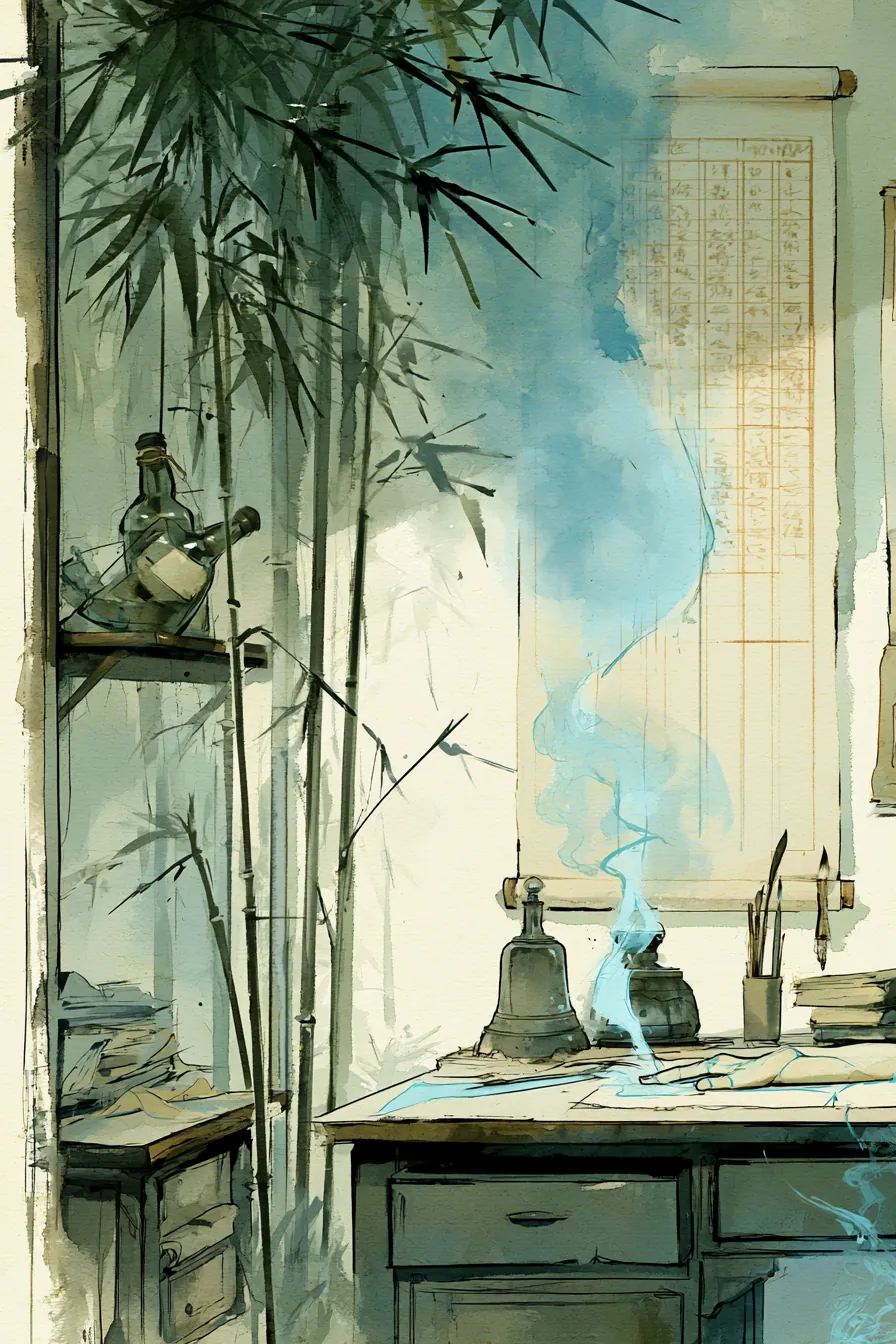
Chapter 8 — The Yellow Attendant
The yellow attendant said Elder Hai sends his concern the way another man might have said I am here to inquire about the weather.
Eldress Kang did not look up from her herbs.
"There is no marginal boy here," she said.
"There is a marginal boy here," the attendant said. "I can smell him. So can you."
He took two steps into the infirmary. He did not look at Lin Wei. He looked, instead, at the wall above Lin Wei's cot, the way a man looks at the wall above a thing he wishes to inspect without seeming to. His footfall, Lin Wei noticed, did not raise dust from the swept floor. The qi at his throat carried his weight. Lin Wei filed Foundation 6 carries weight off the heel under tier-marker, write down, and then he stopped filing because he could not afford the brain-room.
He had, in the breath between the door opening and the attendant's second step, banked.
He had banked harder than he had banked in the yard. He had pulled the qi all the way back from the meridian wall to the meridian root — what he understood the root to be, three fingers below the navel — and let the hum dim until he could no longer hear the bamboo past the south fence at all. The half-green pitch in the air, which had been holding him through the rib-pain for the last quarter-watch, went out. The pain came back. He sat with it. He kept his face flat.
The attendant turned his head. He turned it to the boy in the splint cot, who was asleep. He turned it to the boy with the fever, who was sweating. He turned it, finally, to Lin Wei.
He looked at Lin Wei for two breaths.
He looked away.
"This boy is not the boy," he said, to Kang's back. "This boy is dampered. There is no tone in him."
Lin Wei did not move.
He did not, in the second after the attendant said no tone in him, allow his face to do the thing the face wants to do when it has just gotten away with something. He kept it flat. He kept his hand on the cot beside his hip. He did not look at the attendant. He looked, instead, at the small chip in the rim of the clay pot of gray pills on the long table — a small dim chip, oval, the size of his thumbnail — and he made the chip the only thing in his world for a count of four.
Behind his back, the meridian, banked all the way to the root, did not hum. The rib, untended by the meridian's masking, ached in the slow loud way of a cracked rib without a salve. He let the ache take the room of his attention. The attendant, if the attendant was reading him, would read pain and pain only.
Eldress Kang did not turn from the table.
"I told you," she said. "There is no marginal boy here."
"Master Bo's report said the marginal had been sent here a watch ago."
"Master Bo's reports," Kang said, "are not famous for their accuracy."
"You are insulting an outer captain, Eldress."
"I am stating a fact, attendant. Master Bo writes in the margin of the day's roster with a stub of charcoal. He has done this for nineteen years. Today he wrote marginal, infirmary, sparring on the roster. The boy from the sparring came in. I have set his rib. I have given him a gray pill, because I am out of white. He is not, in my judgment, the boy Elder Hai is concerned about. He smells of bamboo dust and the kitchen rice he ate at noon."
"He smells of fox."
"The kitchen had fox-rat dumplings yesterday. Half the Copyhouse smells of fox."
The attendant did not laugh. Lin Wei, with his eyes on the chipped pot, felt the attendant's qi at the throat brighten — a small steady increase in the heat. It was, he understood, the heat of a man weighing whether to push the contest.
The infirmary door opened a second time.
Master Yuan came in.
Yuan came in the way Yuan went anywhere — limping faintly, smelling of liquor he had not drunk, his right sleeve marked with the small ink-spot from the last card he had written. He did not look at Lin Wei. He did not look at the attendant. He went to Eldress Kang at the long table, and said, very mildly, "Eldress, the new copy of the Greenreed Compendium you ordered has come in. I have brought you the requisition slip. Sign here, please."
He held a paper out to her.
Kang dried her hands on her apron. She took the paper. She signed.
The attendant said: "Master Yuan."
Yuan turned. He bowed. The bow was the exact bow Lin Wei had seen Yuan execute to senior elders for three years — a clean half-inch too low, a small habit of self-erasure that Lin Wei had once filed as cowardice and now filed, more accurately, as forty years of survival.
"Attendant," Yuan said. "May I assist?"
"I am looking for a marginal boy who smells of fox."
"Half the Copyhouse smells of fox, attendant. The kitchen had fox-rat dumplings yesterday."
"Eldress Kang has already used that line."
"Then Eldress Kang and I are in agreement on the question of smell."
Yuan said this so flatly that the attendant — who, Lin Wei understood, had been expecting either capitulation or insult — did not, for a count, have a thing to do with his face. Yuan watched him with the small patience of an old librarian watching a young scribe blot a page.
"Whose marginal boy," Yuan said, "is Elder Hai concerned about, exactly."
"That is not your concern, Master Yuan."
"The Copyhouse roster is my concern. I am the master of the Copyhouse. If a boy of my Copyhouse is the subject of Elder Hai's concern, I must know which boy, in order that I may produce him."
The attendant's qi brightened again. The room, with that brightness, became — Lin Wei could not name it any other way — louder. The heat in the attendant's throat had moved up to his ear, the way a fire fed an extra log makes a low sigh you cannot un-hear. Lin Wei kept his eyes on the chipped pot. He did not let his ear lean. The meridian at the root stayed dark.
"You have a boy in your Copyhouse," the attendant said, "named Lin Wei."
"I have a boy in my Copyhouse named Lin Wei," Yuan said. "Lin Wei is sixteen. He has been my marginal for three years. He has the cracked meridian. He has been beaten in spar an hour ago by Han Yi of the green-three. He is currently in this infirmary." Yuan did not look at the cot. "I assume Elder Hai's concern is for this boy."
"Elder Hai's concern is for any boy who, in the last twelve days, has begun to smell of grove and fox."
Yuan looked, very briefly, at the chipped pot Lin Wei had been staring at. The look lasted half a breath. Lin Wei did not see it. He felt it. He kept his face flat.
"Then Elder Hai's concern," Yuan said, "is not for my marginal. My marginal smells of bamboo dust because he sleeps four paces from a grove with bad ventilation. He smells of kitchen because he is fed by Old Pei. He has never been seen near the fox-girl. Eldress Kang and I will both attest to it."
Kang, at the table, said nothing — which was, Lin Wei understood, attestation.
The attendant looked at Yuan for three breaths. He looked at Kang for two. He looked at Lin Wei for one.
The qi at his throat dimmed. The room got quieter.
"Elder Hai," he said, "is a careful man. He is also a tired man. He has been chasing kitchen rumors for three weeks. The fox-girl is" — he made the gesture of a man waving away a fly — "a recurring nuisance in his correspondence."
"Of course," Yuan said.
"My apologies, Master Yuan, for the intrusion."
"No apology is needed."
The attendant bowed. The bow was, Lin Wei filed, exactly an inch too shallow. He turned. He walked out of the infirmary. The door closed behind him.
The room held its breath.
Lin Wei held his.
Yuan crossed to the cot. He did not, immediately, speak. He sat down on the cot next to Lin Wei. He took, from his sleeve, a small lacquered card — green, Lin Wei's color — and laid it on Lin Wei's knee.
The card had, in Yuan's hand, three characters on it. They read: unbank slowly.
Lin Wei looked at him.
He unbanked slowly.
He let the qi come up from the root the way a man lets warm water come up the spout of a kettle — three counts to the lower meridian, four to the wall, five to the surface, six to the hum. The half-green pitch returned faint at his ear. The rib, with the meridian's return, dimmed in its loudness. The bamboo past the south fence resumed humming inside him. He breathed.
Yuan watched him. Yuan's hand was on Lin Wei's wrist. Lin Wei had not noticed Yuan taking it. Yuan, with two fingers, was reading the pulse at the wrist the way the pamphlet had described an elder reading a pulse — qi-perception through skin. Lin Wei understood, with the part of his mind that did not stop filing even now, that Yuan was performing the diagnostic touch the bible had called Qi Condensation 7 perception, and he understood, in the next breath, that this was the closest a Foundation 0 boy and a Qi Condensation 7 elder could come to a real conversation in a room where Eldress Kang had her back turned.
Yuan held the wrist for ten breaths.
He let it go.
He picked the green card back up. He turned it over. On the back, in his hand, were three more characters: you live.
He put the card back in his sleeve.
"Eldress," he said, aloud, to Kang's back. "I will take the marginal back to the Copyhouse. He can mend on a pallet as well as on a cot. You have boys who need the bed."
"He needs the bed," Kang said, without turning. "He has a cracked rib."
"He has a Copyhouse pallet."
"He will not sleep on the pallet. He will sleep on the cot until tomorrow's evening bell. Eldress' order."
"Eldress' order," Yuan said.
Yuan stood. He paused at the foot of the cot. Then, very quietly, in the voice he had once used to whisper that his master had died of being right, he said, "Boy."
Lin Wei said: "Master."
"Stay here until tomorrow's evening bell, on Eldress Kang's order."
"Yes, master."
"And then," Yuan said, "I am taking you to the kitchen at sundown the day after tomorrow. There is a smith east of the kitchen who owes a favor to a person we both know. You will need a knife. We will go together. I will explain on the way."
Lin Wei said: "Yes, master."
Yuan did not say anything else. He bowed to Kang's back. He left.
The door closed behind him.
In the cot, Lin Wei breathed for a count of four. His rib, in the dim warmth of the half-banked meridian, settled into something that was not pleasant but was no longer the only thing.
Kang, at the table, said without turning: "He did well. Both of them. The boy did well."
She did not say it to anyone in particular.
Lin Wei filed Kang knows Yuan under the count is five and Kang has been in it longer than I have been alive, and he closed his eyes.
He did not sleep.
He could not, with a cracked rib and three years of practice against sleeping in unfamiliar rooms, sleep in the infirmary. He lay on the cot. He breathed at the half-bank. He let the meridian hum at thread-width and the bamboo past the south fence hum at thread-width and the rib mask itself, and he thought, in the small precise way he had been thinking for twelve days, about everything that had happened in the last quarter watch.
The attendant had said dampered. The attendant had said no tone in him. The attendant had said this from six paces. Mei Qi had said that Stillness, held at the root, made a man unhearable beyond five. The attendant had stood at six. The math had been Lin Wei's by exactly one pace. Had the attendant stood at four, the bank at the root would not have been deep enough. Had the attendant been Foundation 7 instead of Foundation 6, the bank at the root would not have been deep enough. He had survived by two narrowness'es of margin he had not earned. The next attendant, if there was a next attendant, would stand at four paces and would be Foundation 7. He could not, twice, count on the margin.
He filed next attendant will stand at four paces and be Foundation 7 under plan accordingly.
He thought of the chipped pot. He had stared at the chipped pot the way a copyist stares at a corrupted character — eyes wide, mind narrow. The trick of holding the face flat under a probe, he understood now, was not to hold the face. The face would betray a held face. The trick was to give the mind something to hold so that the face would forget itself. The chipped pot had been an anchor. He had had, by accident, an anchor. He filed anchor-object under probe under technique-to-develop.
He thought of the rib. The rib was a small cracked thing. It would heal in four weeks. It would heal in three weeks if he kept the meridian half-banked over it. He filed meridian half-bank accelerates rib healing — verify with Yuan under to-investigate, although he suspected it would be true. He suspected it because the meridian, at half-bank, had drawn his body's attention to itself and away from the rib — and a body, undistracted, knits cleanly.
He thought of the knife.
Yuan had said the smith east of the kitchen owes a favor to a person we both know. The person was Mei Qi's mother. He had been told this in the privy garden. Yuan, in the infirmary, had spoken Mei Qi's name as far as Yuan had been willing to speak it — a person we both know — and Lin Wei understood, with the small precise part of his mind, that we in that sentence had not been Yuan and Lin Wei. It had been Yuan and Mei Qi. Yuan had known Mei Qi. Yuan had known Mei Qi was working on Lin Wei. Yuan had said nothing to Lin Wei about it for eleven days.
He filed Yuan rationed Mei Qi from me under to ask Yuan, and immediately, in the same breath, filed do not ask in anger. Yuan had rationed. Mei Qi had said Yuan rations himself. It is the only way he has stayed alive. Yuan had rationed Mei Qi from Lin Wei the way Yuan rationed liquor from his own throat — to stay alive. Lin Wei could ask. Lin Wei could not, at sixteen, in a cot with a cracked rib, ask in anger.
He filed no anger at Yuan under not for a year, and was — for the count of one breath — angry anyway.
He let the anger pass through him the way Yuan had let the bow pass through him in the infirmary doorway. He let it land, and slip, and go.
He lay on the cot.
After perhaps a watch he heard, very faintly, the small soft sound he had been waiting for: rice paper at the cot's foot.
He opened his eyes.
There was a dumpling on the cot's foot, on a square of paper.
The paper was red.
He took the dumpling. He looked at the paper. The paper was a strip of the cheap kitchen wrap-rice they used for fox-rat skewers, and Mei Qi had folded it in a small triple crease the way she folded everything she had taken from her mother's hands. He could not see her — she had left while his eyes had been closed — and Ash was not in the room. The paper was warm. The dumpling was warm. He ate the dumpling slowly, in small pieces, around the cracked rib, and the meridian under his back hummed half-banked at the half-green, and he thought, the way he had been thinking for an hour: red paper. Three nights. Privy garden. Bring Stillness. Bring the splinter. Bring the tooth.
He thought: and the day after tomorrow, the smith.
He thought: Hai sent an attendant.
He thought: Hai sent an attendant because Hai is hunting fox-smell, not me. Not yet. The smell, not the name.
He thought: but the smell led to me. And the next attendant will not go away on Yuan's word.
He thought, finally, with the part of his mind that filed cost: Han Yi cracked my rib at fourth bell. By dusk the attendant came. The attendant came because Bao got a name from the kitchen — fox-girl. The fox-girl led to a marginal who smells of fox. The chain is four hours long. The chain is shorter than I planned.
He set the rice paper down.
In the doorway of the infirmary, the door opened a third time — quietly, the way Mei Qi opened a door.
It was not Mei Qi.
It was the small one. The small one whose name Lin Wei had not bothered to learn, because the small one hit at the same angle as Bao and had no diagnostic value.
The small one stood in the doorway. He was holding his cap in his hands. He was looking at his feet. He was very pale.
"What," Lin Wei said.
The small one swallowed.
"Han Yi sent me," the small one said. "He says he is sorry about the rib. He says he wants to apologize in person at second bell tomorrow morning at the Copyhouse south wall."
Lin Wei looked at him.
The small one would not meet his eye. The small one was lying about the apology. The small one had been sent because Han Yi had not been able to come himself — Han Yi was on latrine duty for a week, and could not be seen at the infirmary — and the small one was being used because the small one was disposable. The small one had not been told, Lin Wei suspected, what Han Yi was actually planning at second bell at the south wall.
"South wall, second bell," Lin Wei said. "Tell him yes."
The small one nodded.
He did not move.
Lin Wei said: "What is your name."
The small one looked up. He was, Lin Wei understood for the first time, perhaps fourteen — younger than Lin Wei had thought.
"Bing," the small one said. "Bing of the upper kitchens. Han Yi's third cousin."
"Bing," Lin Wei said. "Thank you for telling me about second bell."
Bing looked at him. Bing's face did the small bewildered thing the face does when it has been thanked by a boy whose rib it watched its cousin crack.
"You — you're welcome."
"Bing. Go and tell Han Yi I will be at the south wall at second bell."
Bing nodded. Bing left.
The door closed.
Lin Wei filed Bing — fourteen — Han Yi's third cousin — kitchen under to-be-developed. He had, half a watch ago, not known Bing's name. He had, in the next watch, learned a name from a boy who had hit him in the back for a year. Bing had not, in three years, ever spoken his own name to Lin Wei. Bing had spoken it tonight because Lin Wei had asked, and Lin Wei had asked because the small one was, on a ladder Lin Wei was now building hourly, the rung directly below him. Lin Wei had spent three years being the boy at the bottom of a ladder. Lin Wei was beginning, today, to be the boy on a rung above someone.
He filed I am no longer at the bottom under evidence, and he did not, in the small private part of his mind, allow himself to like the feeling.
He lay back on the cot.
The meridian, at half-bank, hummed half-green.
He thought: second bell, south wall.
He thought: Han Yi has not finished. Han Yi has scheduled the rest of it for tomorrow.
He thought: Han Yi sent a fourteen-year-old to deliver the appointment because Han Yi has noticed, today, that I did not bleed.
He thought, with the small clean part of his mind that had spent the day being measured: Han Yi has noticed something is different. Han Yi cannot name it. Han Yi will, at second bell, attempt to make me name it for him.
He closed his eyes.
In his ribs, the meridian held. In his sleeve, the tooth was warm. In the paper at the foot of the cot, three nights from now waited.
And on the path beyond the infirmary, with a slow steady tread Lin Wei had not banked enough to hear, the yellow attendant — who had not gone home, who had not left the sect grounds, who was paid by Hai to be careful and to be tired and to be patient — walked back to the Copyhouse south wall, and stood, and waited for second bell.