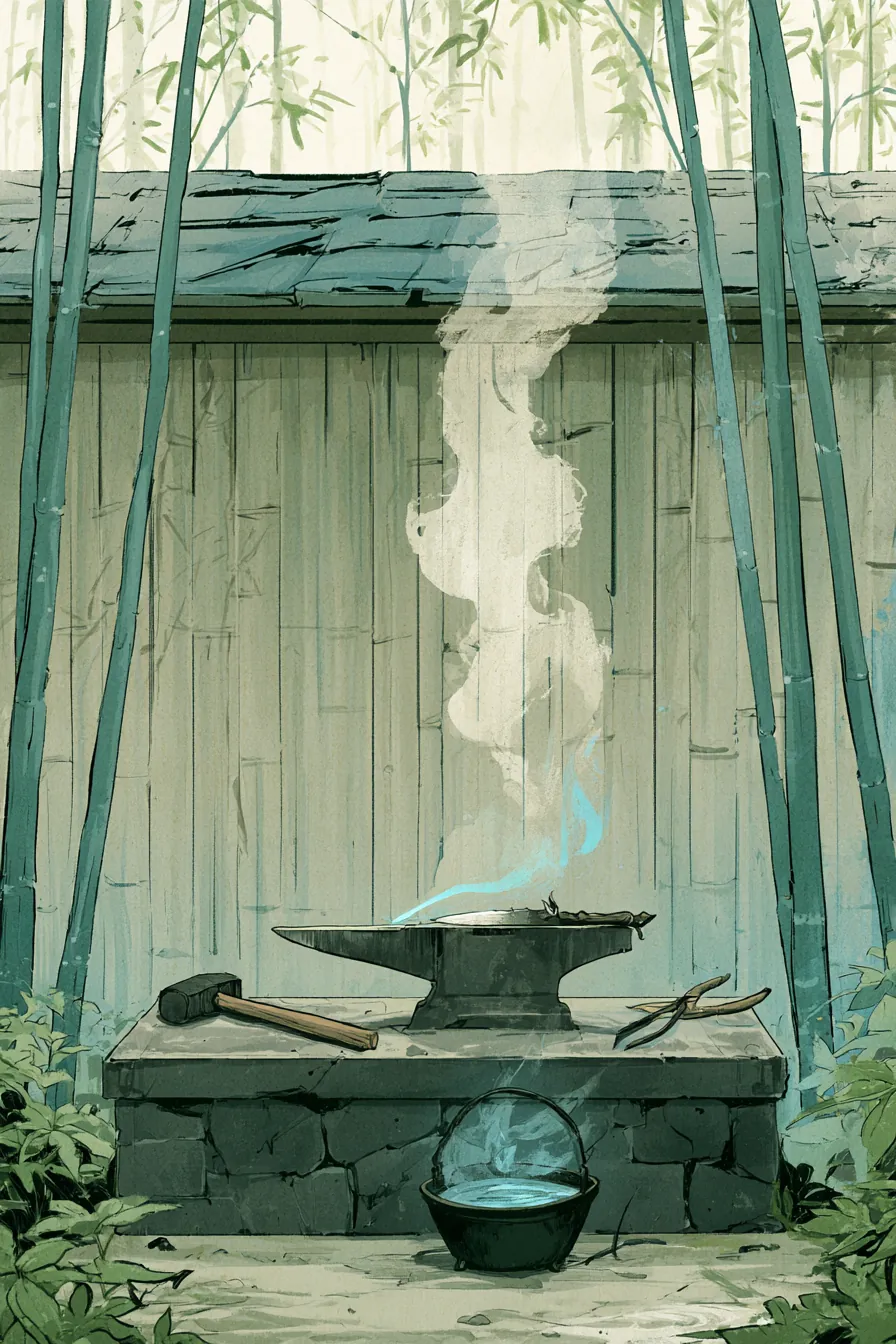
Chapter 10 — The Smith East of the Kitchen
Yuan came for him at the seventh bell of the second day.
He came in his outer robe and the small lacquered satchel he carried to requisition cards, and he did not, in the doorway of the infirmary, look at Lin Wei. He looked at Eldress Kang. He said, "Eldress, I am taking the marginal to the kitchen. He has been ordered to sweep the back yard tonight for his sparring offense. The captain has signed."
"The captain has signed nothing," Kang said, without turning.
"The captain has signed by the time we reach the kitchen."
Kang did not laugh. She did not turn. She said, "Bring him back at the night watch. He has a rib."
"I will bring him back," Yuan said, "at the night watch."
Lin Wei put on his outer robe.
He took, from beneath the pallet, the splinter. The splinter was warm now in a way it had not been at second bell — the warmth had stepped up half a degree in the watch since Mei Qi had stood at the corner of the swept path. He filed splinter warms further in proximity to a person who has read its tone under to-think-about, and put it in his left sleeve. The tooth, in his right sleeve, was still cold. He had not, in the watch, taken it out. He had decided he would not take it out at the smith's. He had decided the smith was for the splinter, and the privy garden three nights from now was for the tooth.
He had also decided, at the count of one breath after Mei Qi had walked away that morning, that he was not going to tell Yuan about the second slip of red rice paper or the hand at the back of it.
He did not know, yet, why he had decided this.
He filed I am keeping a thing from Yuan and I do not know why under to-watch, and walked out of the infirmary behind his master.
The path from the infirmary to the kitchen was the swept path along the north Copyhouse wall. The path ran past the orchard. Lin Wei did not look at the orchard. He banked to hairline at the root. He kept the bank steady. He let the rib carry the room of his attention, and at hairline he could not — even now, with the meridian dim enough to fool a Foundation 6 attendant at four paces — feel the orchard's pear trees humming. The bamboo past the south fence was gone too. The world, at hairline, was a small flat thing. He understood, walking, that this was what Mei Qi had meant when she had said the bank costs. The bank cost the world. The bank cost the half-green pitch he had been learning, for twelve days, to live inside. The bank cost the hum of the chipped pot and the warmth of the splinter and the rib's small tuning self-knit, and he paid the cost because he had no other coin.
He filed bank is a kind of poverty under technique, and kept his face flat.
At the kitchen's back gate Yuan turned right where the swept path turned left. The right turn was not a path. It was a footworn track between the kitchen wall and the woodshed, two paces wide, and it smelled of grease-trap and pine ash and the cold metal smell that came off a smith's chimney when the smith had banked his coals for the evening. The track ran for fifty paces. Yuan walked it at the limp he walked at when he wished to be read as old. Lin Wei walked behind him at the pace of a boy with a cracked rib.
At pace forty Yuan said, without turning his head, "Boy."
"Master."
"The smith's name is Tao Bing. He is forty-one. He failed Foundation Layer 4 eight years ago and has not tried again. He is a red-key cultivator. He hits iron with his hand and the iron knows. He is illiterate. He is not stupid. He has been told you are a marginal who needs a knife for sweeping the orchard at night. He has not been told anything else." Yuan paused. "He will ask you no questions you cannot answer. He will, while he works, talk. Let him talk. Answer when you must. Do not, under any circumstance, ring the iron with your meridian."
"Master."
"He will key the knife by sound. He will strike a tone-bar of gray steel at the anvil, and the steel will key the iron. You will not, in the room, contribute a tone. You will be a body with a rib and a face. Do you understand."
"Yes."
"There is one more thing."
"Master."
"If the smith asks you, at any point in the next hour, why the iron should be keyed to gray-two rather than to green-three or to any other tone, you will tell him this: the elder Yuan said gray-two. You will not explain. You will not extend. You will not have an opinion. Yuan said it. That is all."
"Yes."
Yuan slowed at pace forty-seven.
"And one more."
"Master."
"After we leave the forge, we will not return along this track. We will return along the kitchen's east wall, around the latrine, and through the orchard's north gate. The orchard's north gate is closer to the infirmary by twelve paces. The twelve paces are why we are going through it."
"Yes."
"Do not ask me what the twelve paces buy."
"No, master."
Yuan stopped.
He looked, for the first time since the infirmary, at Lin Wei. He looked the way a man looks at a tool he is about to use for a thing the tool has not yet been used for. He did not, in the look, do the small mouth-corner Lin Wei had seen Yuan do in the closet office. He held the look flat.
"Boy."
"Master."
"You did well at second bell. Eldress Kang told me. Mei Qi told me. The attendant filed throat soft from water, and Hai will read that line at sundown and will not, for the next watch, send a second man. The watch is a window. The window is the size of one knife. We are going to use the window to put the knife in your hand. Do you understand what I am telling you."
"Yes."
"Tell me what I am telling you."
Lin Wei said: "We have a watch. The knife is the watch."
Yuan's mouth-corner moved, this time. A hairline. It was the closest Yuan came to praise.
"Walk," he said.
The smith's forge was a low shed against the kitchen's east wall, roofed in old tile, with one window the size of a copyist's hand. The chimney was banked. The coals were red-orange the way coals were when a smith had been holding a fire for three hours waiting for a thing. The anvil was at the room's center. The tone-bars hung on the wall the way a Copyhouse hung rulers — eight of them, in a row, dull gray to bright silver, each as long as a forearm, each with a hammered notch at one end so the smith could lift it without a glove. Above the bars, on a peg, hung a single small hammer. Lin Wei filed eight bars in a row from gray to silver — tier-marker, write down under tier-marker, write down, and stopped filing because Yuan had bowed at the doorway and the smith had bowed back, and the bow was a long bow on both sides, and Lin Wei understood in the half-breath of the bows that Yuan and the smith had not met in twenty years.
"Yuan," the smith said.
"Tao Bing."
"You are old."
"You are not."
The smith laughed. It was a short, dry laugh, the laugh of a man who had not laughed at a thing he meant for nineteen years and had decided, this evening, to laugh anyway. He looked at Lin Wei.
"This is the boy."
"This is the boy."
The smith looked Lin Wei up and down. He did not look at his face. He looked at his hands. He looked at his feet. He looked, very briefly, at the hairline gather of cloth where Lin Wei's left sleeve held the splinter against the wrist, and his eye, in the look, did the small flat thing the eye does when a smith reads a thing he is going to pretend he has not read.
"He has the splinter," the smith said.
"He has the splinter."
"I will key the knife to it."
"You will key the knife to it."
The smith nodded. He turned to the wall. He took down, from the row of eight, the third bar from the gray end — gray, dull, with a small blue cast at one notch where the steel had cooled unevenly. He laid the bar on the anvil. He took the hammer from its peg. He did not, in any of this, look at Lin Wei.
He said, "Boy. Stand at the door. Do not, for the next quarter watch, move. You will know the knife is ready when the bar stops ringing."
Lin Wei stood at the door.
He banked at hairline.
The smith struck the bar.
The bar rang — a small clean ring at gray-2, the same tone Mei Qi had said Lin Wei was, the same tone Ash was, the same tone the tooth in his right sleeve was, the same tone the splinter in his left sleeve answered at a hairline. The ring was, in the small banked world Lin Wei was standing in, the only sound. It did not pass through him because at hairline nothing passed through him. It passed around him — the way wind goes around a stone — and the splinter, in his sleeve, did not move, and the tooth, in his sleeve, did not move, and his meridian at the root, banked to hairline, did not move either. He filed the bank holds against gray-2 at three paces under evidence, and the cold lift between his shoulders, which had been there for half a watch, eased.
The smith struck the bar a second time.
The bar rang at gray-2 again, and the smith, with the small precise care of a man who had keyed iron for twenty-five years, set the bar against a length of rough-forged iron on the anvil and pressed the iron against the bar with the flat of his bare palm, and the iron, in contact, took the tone. The iron did not ring — iron of that grade did not ring — but the iron did, Lin Wei observed, the small flat thing a piece of iron did when it had been keyed: it dimmed at the edge where it met the bar, the way a candle wick dims when a draft passes near it. The smith held the contact for the count of seven. He let go. He lifted the iron with his bare hand. The iron was not, by then, hot enough to burn. It was warm. The smith laid the iron at the far end of the anvil.
He picked up his shaping hammer.
He began to forge.
He worked for the next three quarter-watches at a steady, unflashy rhythm Lin Wei had only ever read described in Methods of the Foundry, and had never seen done by a man. The smith hammered. The iron took shape. The shape became, by halfway through, the shape of a blade no longer than a boy's forearm, single-edged, with a tang for a wooden grip and a flat back the width of a brush. The iron did not, while it shaped, ring. The smith kept his face flat. He talked, exactly as Yuan had said he would talk, at the steady pace of a man who could not stop himself.
"Yuan and I knew each other at the inner forge when he was thirty-one and I was nineteen. He copied for me. I did not read. He taught me to read enough to read a stamp. He stamped his seal on the first knife I forged that was not embarrassing. I keep the knife. It is on the shelf above the door. Do not look at it."
Lin Wei did not look.
"Yuan failed his breakthrough at Layer 9 the year I failed mine at Layer 4. He failed in the bamboo grove east of the inner gate. I failed in this forge. He came down from the grove and walked past this forge at evening bell and did not, in three years, walk past it again. He walked past it tonight. That is the second thing I am noting in nineteen years."
Lin Wei did not speak.
"There is a woman in the Verdant Reach whom we both know. She has a daughter in this sect. The daughter is your friend. I have not seen the daughter. I will not see her tonight. But I will, in the next quarter watch, key the knife to her fox's tone, because the woman asked, because the woman has not asked me for a thing in nineteen years, and because the woman does not ask for a thing she does not need."
Lin Wei did not move.
"That is all I will say, boy."
The smith hammered.
The blade thinned. The blade took an edge. The smith, three-quarters through, lifted the bar from the wall a second time and laid it against the blade and held the contact for the count of seven, and the blade dimmed at the back edge the way the iron had dimmed at the start, and the bar, this time, did not ring. The bar did not ring because the blade was now the bar — the blade had taken gray-2 the way a tuning fork takes a struck tone, and the bar, against it, had nothing left to give.
The smith filed the blade is keyed into his own face with a small flat satisfaction, and set the blade in a quench of brine and tallow, and pulled it, and laid it on the anvil to cool.
He set the hammer back on its peg.
He turned to Lin Wei.
"Come here, boy."
Lin Wei came.
The smith took Lin Wei's left wrist. He turned the wrist. He shook the splinter out of the sleeve onto the anvil. The splinter, against the cooling blade, did the thing Lin Wei had not expected and Yuan, at the door, had — Lin Wei understood, looking at Yuan's face, with the small precise part of his mind — expected: the splinter, against the keyed iron, brightened. It went, in the count of one breath, from the warm of a thing held against a wrist to the small steady glow of a thing that had recognized a thing.
Lin Wei filed splinter and keyed iron recognize each other at three breaths under evidence, and then he filed something else, harder. He filed I have been carrying a thing in my sleeve that glows for three days, and beside it, in the same column, he filed Han Yi did not see the glow because Han Yi did not look. The attendant did not see the glow because the splinter was, at second bell, banked under the meridian's hairline. If the attendant had looked at my left sleeve and I had not been banked, the attendant would have seen it.
He filed the splinter is a tell under to-bank-around, and his cold lift between the shoulders came back.
The smith, watching Lin Wei's face do nothing, nodded once.
"Take the blade," he said. "It is cool enough. Mind the tang. I have wrapped it in linen. The grip you will fit yourself, with the help of a master who knows wood. Yuan will know one. He used to."
Lin Wei took the blade.
The blade was warm in the way the tooth was cold — the steady warm of a tuned object, not the warm of a hand. He held it. His meridian, at hairline at the root, did not move. But the splinter, in his sleeve, against the wrist, leaned faintly toward the blade — the way a tuning fork leans toward a struck bell — and Lin Wei understood, in the next breath, that the splinter was the teacher and the blade was the student and he, the boy carrying both, was going to spend the next year of his life learning to hear what they had to say to each other.
He bowed to the smith.
The smith bowed back.
Yuan said, at the door, "Tao Bing."
"Yuan."
"In a year, or two, or perhaps three, the boy will come back. He will bring a different splinter and a different price. You will not, in those years, mention to anyone that he was here tonight."
"I will not."
"Even if asked."
"Especially if asked."
"Tao Bing."
"Yuan."
Yuan said, very quietly, in the voice he had used in the infirmary doorway to whisper unbank slowly: "The bowl is on the shelf above the door. I noted it. I will not, in the next twenty years, walk past this forge again either. The next time you see me I will be a different man, or I will be dead. Take the seal off the knife."
The smith looked at Yuan for two breaths.
He went to the shelf above the door. He took down the knife — the old knife, the first knife he had not been embarrassed by, the one Yuan had stamped — and he scraped the stamp off the spine with the edge of his thumbnail in three motions, and the stamp came off in a small curl of dark wax, and the smith put the curl in his apron pocket, and the knife went back on the shelf.
He turned back.
"Done, Yuan."
"Done, Tao Bing."
Yuan bowed. The smith bowed. Lin Wei bowed.
They left.
In the track outside, the air was cold. The kitchen chimney smoked across the moon. Yuan walked, at the limp of a man twenty years past Lin Wei's age, along the kitchen's east wall, around the latrine, and toward the orchard's north gate — the gate that, Yuan had said, bought twelve paces.
At pace eleven from the gate, Yuan stopped.
He did not say anything.
He had stopped because, at the orchard's north gate, standing in the half-shadow of the third pear tree — the same pear tree the yellow attendant had crouched behind at second bell — was a second man.
The second man was not the yellow attendant. The second man wore a clean dark robe with no stitch at the shoulder. He was perhaps fifty. He was, Lin Wei observed in the count of one breath, banked deep enough that Lin Wei could not feel a single thread of qi at his throat. The man was Foundation 9 at minimum, possibly Qi Condensation 1. The man was, in the way he stood, of a different rung of the world ladder from the yellow attendant entirely — the ladder Lin Wei had been filing the smith's tone-bars by, eight bars from gray to silver — and the man at the gate was, by the eye, three bars up from the attendant. The attendant had been a yellow-2 thread. The man at the gate had no thread at all.
The man at the gate was not, by his face, looking at Yuan.
The man at the gate was looking at Lin Wei's left sleeve, where the splinter, against the new keyed blade wrapped under Lin Wei's outer robe, glowed faintly through the cloth.
Yuan, beside Lin Wei, said — without moving his mouth, in the voice he had used in the infirmary doorway — "Bank to the root, boy. Now. All the way. Do not breathe."
Lin Wei banked.
He banked past hairline. He banked past the root. He banked the way Mei Qi had said only a Foundation 2 could bank and he was, at most, Body Tempering 0.4, and he banked anyway because Yuan had said now, and because the man at the gate was already three paces closer than he had been a breath ago, and because the splinter in his sleeve had not stopped glowing and was not, at this depth of bank, going to stop.
The man at the gate smiled.
The smile was the small clean smile a man smiles when he has, after some years of looking, found a thing he was beginning to think did not exist.
"Master Yuan," the man said. "I do not believe we have met. My name is Hai."