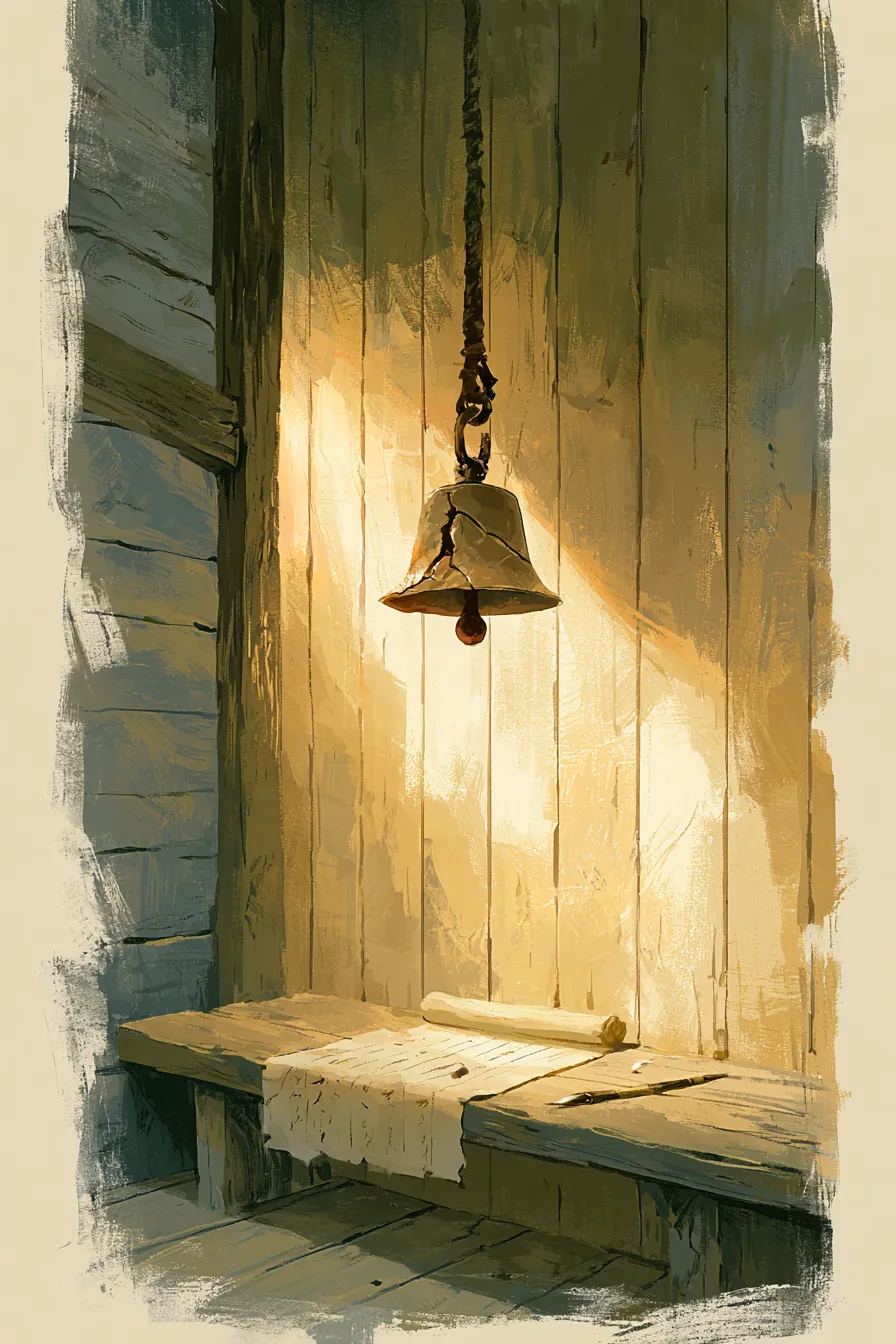
Chapter 36 — The Bell at Seven
The morning bell was a small clean bronze ring of the south gate's third bronze, hung in the inner discipline ward's bell-tower for the count of one hundred and forty years, and the morning bell, at seven o'clock on the morning of the fourth day of the long dry watch of the third quarter, was — by Lin Wei's rib's read at the pine boards of the smith's shed at the south wall of Cloudreed — not the bell.
The bell was in his pocket.
The bell, in the pocket of his green outer robe at his right hip, had — one breath before the morning bell — settled at the tone.
The settling was the bell's last check.
The bell was checking the body.
The body, one breath on, settled back.
The bell, in the checking, did not settle.
The bell, in the checking, opened.
The opening was the dry sound of cracked iron, in the long dry watch of the third quarter at the morning of the fourth day one breath before the morning bell, waiting.
The waiting was, by the smith's reckoning at his fortieth year, the bell's first opening at the body's first cast.
The bell was ready.
The body was ready.
The line was ready.
The line, one breath before the morning bell at the pine boards of the second tuning chamber at the morning of the fourth day, was thirteen.
Thirteen.
The line had been twelve at two-oh-one.
The thirteenth had arrived at the lintel after six-fifty in the morning.
The thirteenth was, by Lin Wei's rib's read at the pine boards, the Iron Tongue's boss.
The boss had walked, by Tao Lin's count at the bench, the four hours from the boss tent at the foot of the eastern ridge to the south wall in the third sect's elder's broadcast at one o'clock plus four hours of walking, and the boss had arrived at the lintel at the small careful count of fifteen minutes past five.
Five fifteen had been, by Tao Lin's count at the bench, one hour and forty-five minutes early.
The boss had walked at the run of a Foundation 8 boss of the Iron Tongue who had — at the moment in his boss tent at one o'clock — understood the count.
The understanding was, by Yongzhou's count at the lintel, the boss's first understanding in nineteen years of his office.
The understanding was that the boss had been, all along, the order's plant in the Iron Tongue.
The Iron Tongue had been the order's plant sect.
The Iron Tongue had been built, by the order's measure of two centuries, to contain the chord.
The containing had been the Iron Tongue's standing protocol for two centuries.
The containing had failed.
The failing was, by the boss's understanding at one o'clock, the boss's retirement.
The boss was, at five-fifteen, retired.
He had walked to the line.
He had, at the lintel, said, in the level voice of a Foundation 8 boss of the Iron Tongue at his retirement at five-fifteen on the morning of the fourth day: "Chamber. I am the thirteenth."
Yongzhou, at the lintel, had said: "Yes."
The boss had stepped through.
The wall had rung the third ringing of recruits.
The line, at five-fifteen, was thirteen.
The line had then, by Lin Wei's count at the pine boards, not added.
The line had been thirteen for one hour and forty-five minutes.
Thirteen had been, by the smith's tally at his fortieth year, the count.
The smith had, by his reckoning of the line's reckoning, forged the line for thirteen.
Thirteen was the count of the family's reckoning at the year of the Sundered Era's fall — the count of the original line at the cone of the Sundered Peak before the order's first dispatch.
Thirteen had been what was lost.
Thirteen had been, by six-fifty on the morning of the fourth day, what was found.
The line was at thirteen.
The line was the original.
The line was the Yellow Bell.
The Yellow Bell, at six-fifty, was the line.
The line was the chord.
The chord was the bell.
The bell was in the pocket.
The pocket was the body.
The body was Lin Wei.
Lin Wei was, one breath before the morning bell at seven o'clock on the morning of the fourth day, the line.
Tao Lin, on the bench, said, in the level voice of the choreographer at the bench at the morning of the fourth day one breath before the morning bell: "Boy."
Lin Wei said: "Mother."
The word, this time, was the second.
The first had been at twelve-oh-five in the shed at the third night's twelve-oh-five.
The second was at six-fifty-nine.
Tao Lin, by the bone's read at the wall's thin light, did not, this time, let the word sit.
She answered.
She said: "Son."
The word, in the shed, sat at the tone of the chord.
The chord, in the rib, deepened.
The deepening was the chord's read of the word son a breath later before the morning bell.
The chord knew.
Lin Wei did not, for one breath, file.
He had, by the watch's reckoning, no files.
He thought, in the small still place under the rib's carry, the second-person voice the copyist year had given him.
You will cast the bell. You will cast for your master. You will cast for your mother. You will cast for the line at thirteen. You will cast for the world.
He thought it once.
He breathed.
He drew the bell from the pocket of his green outer robe.
He held it in his right hand at the small careful courier's grip the body had learned.
He looked at the bell.
The bell, in his right hand, anchored once at gray-2 with a half-bar above gray-2 at the punch mark on the underside of the lip.
The anchoring was the bell's last check.
He banked back.
The bell, in the checking, opened.
He breathed.
He raised the bell to his lips.
He did not, in the next breath, strike.
He did not, in the smith's forty-year arc at his fortieth year, cast with a striker.
He cast with the breath.
The breath was the rib.
The rib was the chord.
The chord was the line.
The line was thirteen bodies at the pine boards of the smith's shed and the bench under the wall of eight tone-bars and the threshold inside the lintel.
The thirteen, after one breath before the morning bell, took.
The banking was, by Lin Wei's rib's read at the pine boards, one chord.
One chord at thirteen.
The thirteen, in the holding, waited.
The waiting was for the breath.
The morning bell, at the gate-bell's century-long carry over the south wall of Cloudreed at the morning of the fourth day, rang once.
The ringing was the small clean bronze ring of the bell-tower at seven o'clock on the morning of the fourth day.
The ringing was — by Lin Wei's rib's read at the pine boards — not the bell.
The bell was in his hand.
The ringing of the bell-tower's bronze bell at seven o'clock was — by the smith's forty-year forging at his thirty-eighth year — the count of the master's last breath.
The master's last breath was at the bridge.
Yuan, at the third log from the south of the bridge fifteen li south at the morning of the fourth day at seven o'clock, took his last breath.
The last breath was the breath of a Qi Condensation 7 elder of Cloudreed's Copyhouse at thirty years of office at one hundred and forty hours of carrying the chord at the bar above his fundamental at the cost of the chamber's pay at his throat.
The breath was, by the chamber's reckoning of the chamber's pay, the master's last.
The breath ended.
Yuan, at the third log from the south, did not — by Wen's read at the third log from the north at the morning of the fourth day at seven o'clock — breathe again.
He did not, by his own count at the chamber's pay, die.
The chamber's pay was the body's carrying.
The carrying was the master's broadcast.
The master's broadcast was the bell.
The bell rang.
Lin Wei, at the pine boards of the smith's shed at the south wall of Cloudreed at the morning of the fourth day at seven o'clock, cast.
He cast with the breath.
The breath was the rib.
The rib was the chord.
The chord was the line.
The line was thirteen.
The breath, after the rib's carrying of the chord at the register of thirteen, left.
The leaving was the sound of a sixteen-year-old outer disciple marginal courier of Cloudreed Sect at three years of office at the moment in the pine boards of the second tuning chamber at the morning of the fourth day at seven o'clock, casting his first cultivation technique in his life.
The technique was the Yellow Bell first note.
The first note was, by the smith's lineage of forging at his fortieth year, the body's fundamental.
The fundamental, in the first cast, was — by the smith's lineage — the body's first choosing of a fundamental by the first cast.
The choosing was, by the smith's count, Foundation Layer 1.
The body, at the first cast, crossed.
The crossing was from Body Tempering 0 to Foundation 1.
The crossing was, by the smith's measure of two centuries, the first crossing on the Yellow Bell first note as a fundamental in two centuries.
The body, at the crossing, was — by the smith's count — Foundation 1 on the Yellow Bell first note.
The bell, in his right hand, rang.
The ringing was the small clean cracked-iron ring of a thumb-tall forging laid in the pocket of an outer disciple's green outer robe for the count of seven hours and one minute since the smith handed the forging to the body the forging was made for at the bench of the second tuning chamber at the third night's midnight.
The ringing was, in the smith's two centuries of work at his fortieth year, the bell's first ringing.
The first ringing was the bell's only ringing.
The bell rang once.
The ringing was at the bar.
The bar was the chord.
The chord was at thirteen.
The chord, in the ringing, amplified.
The amplification was the sound of the bell, in the long dry watch of the third quarter at the morning of the fourth day at seven o'clock, carrying the chord of thirteen bodies at the bar of the chord into the cast.
The cast was the Yellow Bell first note.
The first note was the master's funeral note.
The master was Yuan.
Yuan was on the bridge fifteen li south.
The cast carried south.
The cast carried at the air's pace.
The air's pace was, by the third quarter's reckoning, eight hours from the south wall to the bridge.
The cast, after seven o'clock, began the eight hours.
The cast was, by the smith's hand at his fortieth year, the master's funeral note carried in the air for eight hours.
The eight hours of the carrying was the bridge's only carry.
The bridge would, in noon on the fourth day, break.
The breaking would be by five hours after the cast.
Five hours.
The bell, in Lin Wei's right hand, on the breath after the first ringing, did not ring again.
The bell was, in the smith's making, empty cracked-iron.
It was, by the smith's count, finished.
Lin Wei lowered the bell.
He held it in his closed right hand at the small careful courier's grip the body had learned.
He looked at the bell.
The bell, in his closed hand, was the cracked-iron forging the smith had handed him at midnight, with the clapper inside on the thin thread, and the lip with the small punch mark on the underside of the smith's anvil-shed door.
The bell did not, by his rib's read at his hand, bank.
It was empty.
The empty was, by the smith's reckoning at his fortieth year, the bell's last work.
The last work was the giving of the pitch to the cast.
The cast had the bar.
The cast was carrying the line.
The bell was, in the giving, done.
Lin Wei put the bell back in the pocket of his green outer robe.
The bell, in the pocket, did not bank.
It was a thumb-tall cracked-iron forging in a pocket.
He breathed.
He looked at the bench.
Tao Lin, on the bench, was watching him.
She was, by the bone's read at the wall's thin light, crying.
The crying was the single tear at the corner of the choreographer's right eye, at the morning of the fourth day at seven-oh-one on the bench of the second tuning chamber one breath after her son had cast the Yellow Bell first note for the first time in two centuries.
She did not, by the bone's read, wipe the tear.
She let it sit.
The smith, on the bench beside her, was watching the bell in Lin Wei's pocket.
He was, by the bone's read at the wall's thin light, smiling.
The smile was the smith's smile.
The great-uncle, at the pine boards beside Lin Wei, was watching the bench under the wall of eight tone-bars.
The wall, behind the bench, was ringing.
The wall had, a moment later after the bell's first ringing, taken up the cast.
The wall was carrying.
The carrying, by Yongzhou's count at the lintel, was the second tuning chamber's first carry to the second tuning chamber's twin.
The twin was the third chamber.
The third chamber was, by the smith's count, on the second continent.
The second continent was — by Tao Lin's count at the bench — across the sea.
The wall, in the carrying, was carrying to the second continent.
The carrying was, by Yongzhou's count, the broadcast's amplification.
The amplification was the line at thirteen.
The thirteen, one breath after the bell's first ringing at seven-oh-one on the morning of the fourth day at the pine boards of the second tuning chamber, banked once together.
The banking was the thirteen's first taking together as a line.
The answering at was, by the smith's tally, the line's first work.
The first work was, by the smith's count, the line's carry of the cast.
The line carried.
The line carried the cast at the bar of thirteen.
The cast, in the carrying, was — by Lin Wei's rib's read at the pine boards — no longer one body's cast.
It was thirteen bodies' cast.
The thirteen bodies' cast was the line's first cultivation technique.
The first technique was the Yellow Bell first note.
The first note was, after a single breath after the bell's first ringing, no longer Lin Wei's only cast.
The first note was the line's first cast.
The line had thirteen casts of the first note.
Twelve of the thirteen were not casting at the smith's shed.
They were carrying.
They carried the first note in the rib for the count of the watch.
The watch was, by Tao Lin's count at the bench, the broadcast's eight hours.
The eight hours were from seven-oh-one to three in the afternoon.
At three in the afternoon, the bridge would receive the cast.
At three in the afternoon, the bridge was already broken by three hours — noon was at twelve, broken at twelve, and three hours later the broken bridge would receive the cast.
The broken bridge would, by the smith's two centuries of forging at his thirty-eighth year, carry the cast in the chord on the water at the bridge's first break's last carry.
The last carry was the bridge's broadcast.
The broadcast was, in the smith's forty-year arc, the broadcast.
The broadcast at three in the afternoon was the bridge's first sound.
The first sound was the Yellow Bell first note.
The first note was the chord.
The chord was the line.
The line was all of them.
Lin Wei, at the pine boards of the second tuning chamber at the morning of the fourth day at seven-oh-one, with the empty cracked-iron bell in the pocket of his green outer robe and the cracked-iron sword on his lap and his rib carrying at the chord at the tone of thirteen bodies and the new fundamental of Foundation 1 on the Yellow Bell first note in his body, opened his eyes.
He had not, by his own count, closed them.
He had been at the pine boards with his eyes open for the count of seven hours and one minute.
The opening was the slow first opening of the body of a sixteen-year-old outer disciple marginal courier of Cloudreed Sect one breath after his first cast at Foundation 1.
The opening was the first cultivator's first sight.
He saw, in the first clear seeing of his Foundation 1's first carry of his fundamental, the chord.
The chord was, by his Foundation 1's first sight, the air.
The air, in the shed at the morning of the fourth day at seven-oh-one, was — by his first sight — moving.
The air was carrying the cast.
The cast was, by his first sight, thirteen bodies' chord at the bar.
The chord, in the air, was — by his first sight — the small clean light of a body the body had been built to see.
The light was the chord.
The chord was the world.
The world.
He breathed.
He thought, in the small still place under the rib's carry, the second-person voice the copyist year had given him.
You will see. You will not file. You will not look back. You will, after the bridge's break at noon, be at the bench.
He thought it once.
He breathed.
Tao Lin, on the bench at the morning of the fourth day at seven-oh-two, said, in the level voice of a forty-three-year-old choreographer with one tear at the corner of her right eye and her hands flat on her thighs and her brother the smith at her left shoulder: "Son."
Lin Wei said: "Mother."
She said: "Breakthrough."
He said: "Foundation 1."
She said: "On the Yellow Bell first note."
He said: "Yes."
She paused.
She said: "Son."
He said: "Mother."
She said: "The bell."
He said: "Empty."
She said: "Yes."
She paused.
She said: "Son."
He said: "Mother."
She said: "Yuan."
He paused.
He said: "On the bridge."
She paused.
She said: "Son."
He said: "Mother."
She said: "Yuan died at seven o'clock."
He paused.
He said: "Yes."
She paused.
She said: "Son."
He said: "Mother."
She paused.
She said: "By the chamber's pay, the master's body, at his last breath, is the master's funeral. And the bell's first ringing on that funeral is the master's funeral note."
He said: "Yes."
She paused.
She said: "The master, one breath after his last breath, is at the funeral note of the bell — and at the funeral note, in the cast. Thirteen bodies carry the cast. The master is in thirteen bodies."
He said: "Yes."
She paused.
She said: "Son."
He said: "Mother."
She paused.
She said: "The master, at the cast's first carry, is the line's first ancestor."
He paused.
He said: "Yes."
She paused.
She said: "The line at thirteen, with the first ancestor in the cast, is — by the smith's lineage of the family's keeping — fourteen."
He paused.
He said: "Fourteen."
She said: "Fourteen."
He paused.
He said: "Mother."
She said: "Son."
He said: "The line at fourteen is the broadcast's first ancestor."
She said: "Yes."
He paused.
He said: "By the count of the broadcast at noon, the broadcast at the bridge's first break carries the ancestor."
She said: "Yes."
He paused.
He said: "By the count of the ancestor at the broadcast, the broadcast's first sound is the master's voice."
She said: "Yes."
He paused.
He said: "By the count, the four continents will hear the master."
She said: "Yes."
He paused.
He said: "By the count of the line's first ancestor, the master is — in the broadcast — the line's first teacher."
She paused.
She said: "Yes."
He paused.
He said: "Mother."
She said: "Son."
He said: "Master Yuan, at the broadcast, is — after two centuries — teaching."
The chord, in the rib, deepened.
The deepening was the chord's read of the word teaching after one breath after the boy had said the master was teaching.
The chord knew.
The line at fourteen, at the pine boards of the second tuning chamber at the morning of the fourth day at seven-oh-two, held once together.
The banking was the line's first settling with the ancestor.
The ancestor was the master.
The master was teaching.
The line was learning.
The learning was, by the smith's measure, the line's first work after the broadcast.
The first work was the line's first carry of the master's teaching to the world.
The world.
Lin Wei, at the pine boards of the second tuning chamber at the morning of the fourth day at seven-oh-two, with his fundamental at the Yellow Bell first note and his Foundation at 1 and his rib carrying at the chord at the register of fourteen bodies including his master, did not file.
He had no files.
He had, by the watch's reckoning, the chord.
He breathed.
The chord, in the body, held.
The line, at seven-oh-two, was fourteen.
The bridge would break at noon.
Four hours and fifty-eight minutes.