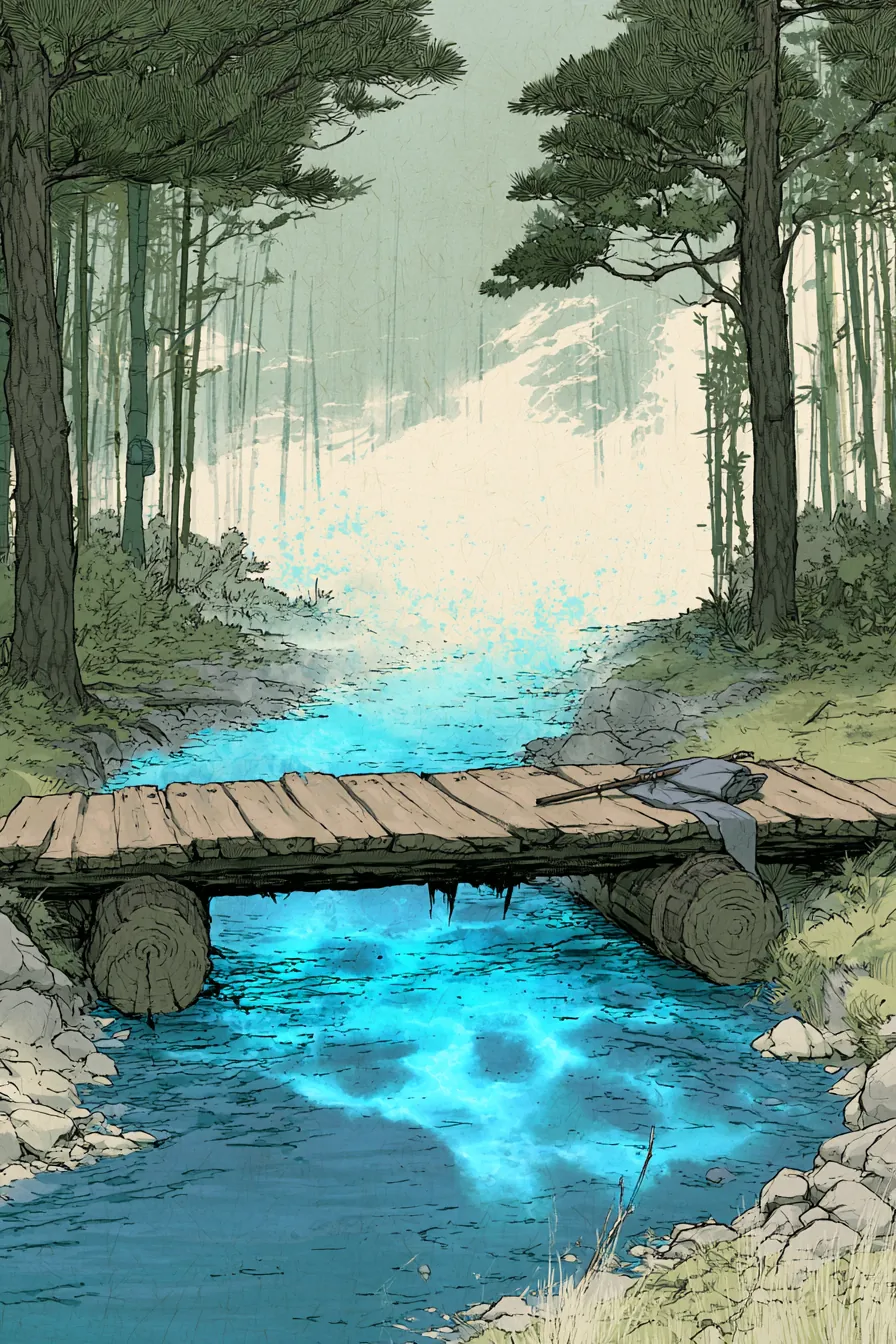
Chapter 37 — The Bridge at Noon
The bridge, at the morning of the fourth day at seven-oh-two, was a guild bridge of three pine logs laid lengthwise on two oak crossbeams set into the creek's banks at the worn stones the guild had laid for the bridges in the year of the second re-mapping, with the planking laid crosswise over the logs and the railings of two-handed pine on either side of the planking at the small careful height a courier with a load could rest a hand on without breaking pace.
The bridge was, at seven-oh-two, carrying.
On the bridge sat four bodies.
Yuan, at the third log from the south of the bridge with his back to the railing on the bridge's east side and his folded knees on the planking and his hand on his hip, did not — at the morning bell — breathe.
He had not breathed for the count of one breath.
He had not, by his own count at the chamber's pay's throat, died.
He had, by the bell's forty-year forging of the bridge's chord on the water, been carried.
The carrying was the dry sound of the bridge one breath after seven o'clock, holding the master in the chord on the water.
The chord, on the water, held the master.
The master was — by Wen's read at the third log from the north of the bridge with her back to the railing on the bridge's west side and her folded knees on the planking and her gray robe at her shins — not on the third log.
The master was in the water.
The water was the chord.
The chord was the master's body.
The master was, a breath after seven o'clock, the chord on the water.
The body, on the third log from the south, was a spare forty-eight-year-old body of a Qi Condensation 7 elder of Cloudreed's Copyhouse at thirty years of office that — by the bell's ringing at seven o'clock — no longer carried the master.
The body was, by Wen's read at the third log from the north, empty.
The empty body was the bridge's seat.
The seat was, by the smith's lineage of forging at his thirty-eighth year, the bridge's last work.
The bridge had, in the working, taken the master.
The bridge had not killed the master.
The bridge had carried the master.
The carrying was the bridge's first carry of a body in fifteen years of the bridge's standing.
The first carry was the bridge's broadcast.
The broadcast was the master.
The master was, by Wen's read at the third log from the north, the bridge.
The bridge was the broadcast.
The broadcast was the chord on the water.
The chord on the water was, after seven-oh-two on the morning of the fourth day, carrying.
It carried at the tone of fourteen bodies, with the master as the bridge's first body and the line at thirteen bodies as the bridge's second through fourteenth.
The bridge had, in the next breath after seven o'clock, received the cast.
The cast was, by Wen's read at the third log from the north, the Yellow Bell first note carried from the pine boards of the second tuning chamber at the south wall of Cloudreed in the air at the air's pace.
The air's pace was, by the third quarter's reckoning, eight hours from the south wall to the bridge.
The cast had not, in seven-oh-two, arrived.
The cast was on the air.
The cast would arrive at three in the afternoon.
The bridge would, by Tao Lin's count at the bench, break at noon.
Between seven-oh-two and noon was four hours and fifty-eight minutes.
Between noon and three in the afternoon was three hours.
The bridge would break before the cast arrived.
The broken bridge would, by the smith's two centuries of forging at his thirty-eighth year, receive the cast in the broken chord on the water.
The broken chord on the water would, by the smith's count at his fortieth year, carry the cast at the bar of fourteen.
The carrying was, by the smith's count, the bridge's last carry.
The last carry was the bridge's broadcast to the four continents.
The four continents would hear the cast by the bridge's last carry.
The hearing was the broadcast.
The broadcast was, by Wen's count at the third log from the north of the bridge at the morning of the fourth day at seven-oh-two, five hours and fifty-eight minutes from the bridge's first break.
Wen breathed.
She breathed at the slow breath of a senior of an older order at thirty-one years of post at the third log from the north of the bridge at the morning of the fourth day at seven-oh-two, who had — at the moment in the cold rising of the dawn over the eastern ridge of the southern foothills — let go of the post.
The post had, by her own count at the third log, closed at noon of the third day.
She had walked off at noon.
She had sat on the bridge at the third day's sundown.
She was, at seven-oh-two, no longer of the order.
She was of the line.
The line was at fourteen.
She was the eighth.
She breathed.
The two Iron Tongue hunters at the third log from the south of the bridge, after one breath after the morning bell at seven o'clock, had not moved from the planking.
They had, by Wen's count at the third log from the north, fallen at one-sixteen on the third night.
They had, at three breaths of fundamental against the bridge's chord at three paces, fallen to Foundation 4.
They had sat on the planking for the count of five hours and forty-six minutes.
They had, in the five hours and forty-six minutes, watched.
They had watched Yuan.
They had watched Wen.
They had watched the chord on the water.
At seven o'clock, the bell-tower's bronze bell had rung at the south gate fifteen li north.
The two hunters had, on the breath after the ringing, understood.
The understanding was, by Wen's read at the third log from the north, the two hunters' first reading of the bell-tower's bronze bell at fifteen years of the Iron Tongue's standing protocol of bell-tower-bronze-bell readings on the inner roster.
The reading was the inner roster's understanding that the bridge was holding for a body the boss had been hunting for fifteen years.
The two hunters were, a moment later after the reading, no longer of the Iron Tongue.
They were, by Wen's read at the third log from the north at seven-oh-three on the morning of the fourth day, the line's fifteenth and sixteenth.
The line was, at seven-oh-three, sixteen.
The two hunters stood.
They walked.
They walked north on the bridge at the small careful pace of two Foundation 4 cultivators after the line's recruitment.
They walked past Yuan's body at the third log from the south.
They stopped at the third log from the north.
They bowed to Wen.
The bow was the small careful bow of two Foundation 4 cultivators of the line's fifteenth and sixteenth seats at the bow of the line's eighth seat.
Wen, at the third log from the north, did not — by the bone's read at the third log — check.
She nodded once.
The two hunters walked past her.
They walked off the bridge at the northern bank in seven-oh-five.
They stood on the bare flat of the northern bank.
They walked north along the trail.
They would, by the courier's count of four hours and forty minutes from the bridge to the south wall, arrive at the smith's shed at eleven forty-five.
Eleven forty-five was, by Tao Lin's count at the bench, fifteen minutes before noon.
The two would, at eleven forty-five, be at the lintel.
The line, at eleven forty-five, would be sixteen at the shed plus the master in the chord on the water for the count of one breath after the morning bell, which was, four hours and forty-three minutes after the morning bell, an ancestor.
The line would be seventeen.
Seventeen was, by the smith's reckoning at his fortieth year, the count of the chamber's twin.
The chamber's twin was the third chamber.
The third chamber was on the second continent.
The line at seventeen would, by the third chamber's standing protocol at the year of the Sundered Era's fall, match the third chamber's reckoning.
The third chamber would, by the line at seventeen, be the line.
The line, in the matching, would be the third chamber.
The two would be one.
The two and the second tuning chamber would be one.
The three chambers and the line would be one.
The one was, by the smith's tally, the Yellow Bell.
The Yellow Bell, at the line at seventeen at eleven forty-five on the morning of the fourth day, would be the Yellow Bell.
The Yellow Bell was the chord.
The chord was the line.
The line was the broadcast.
The broadcast was, at noon of the fourth day, the world.
The world.
Mei Qi, at the pine boards of the second tuning chamber two paces from Lin Wei at the morning of the fourth day at seven-oh-five, sat with her folded knees on the boards and the fox at her heel and her hands flat on her thighs and the slip Tao Lin had handed her at six-fifty in her collar.
The slip was the witness's slip.
The slip read — by the choreographer's brush at the bench at six-fifty — Mei Qi, witness of the line at fourteen after the master's funeral note, will in the bridge's break at noon read the witness's first record of the line's first broadcast.
The slip was the witness's office.
The witness's office was, by the family's reckoning of the line's reckoning, the witness's first office in two centuries.
The witness's first office was the historian.
Mei Qi was the historian.
She would write the history of the broadcast.
The history would be, by the line's reckoning, the line's first record in two centuries.
The record would be, in the smith's forty-year arc, the line's first teaching.
The first teaching was the line's first work after the broadcast.
The first work was the line's carry of the master's teaching to the world.
The master was teaching.
Mei Qi was the historian.
She would carry the teaching.
The carrying was, by Tao Lin's count at the bench, the witness's reckoning.
Mei Qi, at the pine boards at seven-oh-five, breathed.
She did not for one breath, look at her mother.
She looked at the fox.
The fox, at her heel, settled once at gray-2.
The settling was the fox's first anchoring of the morning.
The morning was the morning of the line.
The fox knew.
Mei Qi knew the fox knew.
She said, in the small flat voice of the witness at the pine boards at the morning of the fourth day at seven-oh-five: "Lin Wei."
Lin Wei, beside her, said: "Mei Qi."
She said: "Foundation 1."
He said: "Foundation 1."
She said: "On the first note."
He said: "On the first note."
She paused.
She said: "Master Yuan."
He paused.
He said: "On the bridge."
She paused.
She said: "Lin Wei."
He said: "Mei Qi."
She paused.
She said: "I will, by the broadcast, write the history of the master."
He paused.
He said: "Yes."
She paused.
She said: "Lin Wei."
He said: "Mei Qi."
She paused.
She said: "I will, in the writing, make the master the line's first teacher."
He paused.
He said: "Yes."
She paused.
She said: "Lin Wei."
He said: "Mei Qi."
She said: "The master will be — in the writing — the master who was right."
He paused.
He said: "Yes."
She paused.
She said: "The master will be the master who, in the count of one moment at the closet office at the second bell two nights ago, guessed the line and did not tell."
He said: "Yes."
She paused.
She said: "The master will be the master who, in the thirty years of his sitting in the Copyhouse and not telling, kept the line."
He said: "Yes."
She paused.
She said: "The master will be the master who, in the count of one moment in the shed at his fortieth year, taught the boy."
He paused.
He said: "Yes."
She paused.
She said: "The master, in the writing, will be the master who, at one moment on the bridge at the third day's sundown, carried the bridge for the boy."
He said: "Yes."
She paused.
She said: "The master will be the master who, in the count of one moment at the third log from the south at the morning of the fourth day at seven o'clock, died for the broadcast."
He paused.
He said: "Yes."
She paused.
She said: "Lin Wei."
He said: "Mei Qi."
She said: "By the count of the writing, the master will be the master."
He paused.
He said: "Yes."
She paused.
She said: "Master Yuan."
He paused.
He said, in the small still voice: "Master Yuan."
The chord, in the rib at the pine boards at the morning of the fourth day at seven-oh-six, deepened a finger.
The deepening was the chord's read of the words Master Yuan after a single breath after the witness had said them.
The chord knew.
The chord, in the knowing, carried the master.
The line, at seven-oh-six, anchored once together.
The banking was the line's first holding with the master after the master's name.
The line was fourteen.
The line was, in the banking, fifteen.
Mei Qi, at the pine boards, said: "Lin Wei."
He said: "Mei Qi."
She paused.
She said: "Master Yuan."
He paused.
He said: "Master Yuan."
The witness, in the dry voice of a sister-friend at the pine boards at the morning of the fourth day at seven-oh-six, said, in the second-person voice of the witness's office: "You will, in the count of the writing, not let the master be forgotten."
He paused.
He said: "Yes."
The chord, in the rib, deepened.
He thought, in the small still place under the rib's carry, the second-person voice the copyist year had given him.
You will, in the count of the writing, carry your master.
He thought it once.
He breathed.
The bell-tower's bronze bell, after one breath past noon on the morning of the fourth day, rang.
The ringing was the noon bell.
The noon bell was, by the smith's years of forging at his thirty-eighth year, the bridge's first break.
The bridge, one breath after the noon bell, broke.
The breaking was, by Wen's read at the third log from the north of the bridge one breath after noon, the dry sound of three pine logs at the bridge's year-on-year forging at his thirty-eighth year, releasing the chord on the water.
The chord on the water, in the releasing, carried.
The carrying was the bridge's last carry.
The last carry was the broadcast.
The broadcast was, by the smith's lineage, the master.
The master, in the carrying, spoke.
The speaking was a small clean sound at the register of fourteen bodies and the master and the witness's record and the historian's slip in the witness's collar at the pine boards of the second tuning chamber at the south wall of Cloudreed at the morning of the fourth day at noon.
The speaking was, at fifteen bodies' first carry of the master, the master's first teaching to the world.
The first teaching was, by the smith's measure, one sentence.
The sentence was — by Lin Wei's rib's read at the pine boards a breath after the bridge's first break at noon on the morning of the fourth day — the voice of Master Yuan at the closet office at the second bell two nights ago, saying, in the voice of a master at thirty years of office at the moment in the closet office: "Boy. The manuals are wrong."
The sentence carried.
The sentence carried at the bar.
The bar was the chord.
The chord was the line.
The line was fifteen.
The line carried.
The line carried the sentence to the four continents.
The four continents heard.
The hearing was, in the smith's two centuries of work at his fortieth year, the broadcast's first arrival.
The first arrival was the master's voice in the rib of every cultivator in the four continents at the moment in the noon bell of the fourth day of the long dry watch of the third quarter at the bridge fifteen li south of Cloudreed Sect.
The first arrival was one sentence.
Boy. The manuals are wrong.
The sentence sat in the rib of every cultivator in the four continents.
The sentence, after two centuries of the cultivators' standing protocols of corrupted manuals, was — after one breath — the cultivators' first reading of the master's voice.
The reading was the cultivators' first knowing of the line.
The knowing was, by the smith's hand, the broadcast.
The broadcast was done.
The chord on the water, in the next breath after the carrying of the sentence, broke.
The breaking was the dry sound of the chord, in the long dry watch of the third quarter at noon on the fourth day at the bridge fifteen li south of Cloudreed Sect, releasing the chord to the air.
The releasing was the bridge's last work.
The last work was, in the smith's making, the bridge's freeing of the bar.
The freeing was the chord's first freedom in two centuries.
The chord was free.
The bridge, on the breath after the freeing, was a guild bridge.
It was, by the bridge's reckoning, three pine logs laid lengthwise on two oak crossbeams.
It was not, by the bridge's measure, a chamber.
It was a bridge.
Wen, at the third log from the north, breathed.
She did not, by her own count at the third log, fall.
She had been told, by Yuan at the third log from the south at twelve-fifteen on the third night, that she would die at the envoy's second cast in the noon of tomorrow.
The envoy had not, by one o'clock on the third night, cast.
The envoy had become the ninth.
The ninth had become twelfth, fifteenth, sixteenth.
The line had become seventeen at eleven forty-five.
The line had become fifteen at the master's joining at seven-oh-six.
The line at seventeen at eleven forty-five and the line at fifteen at seven-oh-six were the same line at different counts.
The line was the line.
The line had grown.
The line had grown past Wen's death.
Wen was, a moment later after the bridge's break at noon, alive.
She was, by the line at seventeen plus the master, the line's eighth.
She was, by her own count at the third log, the senior of the older order at thirty-one years of post who had walked off the post at noon yesterday and was, after one breath after the bridge's break at noon today, the line's eighth seat at the bridge.
She was Wen.
She breathed.
The bridge, under her folded knees on the planking, was the bridge.
It was no longer a chamber.
It was a guild bridge.
Wen stood.
She stood at the small careful standing of a senior of an older order at thirty-one years of post at the moment at the third log from the north of a guild bridge at noon on the morning of the fourth day, with her gray robe at her shins and her hands at her sides and the dry sound of the southern creek running at a thin watery half-pace under the bridge's logs.
She walked.
She walked the three logs north to the bridge's edge.
She stepped off the bridge onto the bare flat of the northern bank.
She stood at the bare flat for the count of one breath.
She looked, for one count, south at Yuan's body at the third log from the south of the bridge.
Yuan's body was, by Wen's read at one count, empty.
The body was the guild bridge's first body.
The bridge would, by the bridge's in standing record of two centuries of guild bridges, carry the body in the chord on the water of the south creek's running for the count of the body's first carrying by the creek's current.
The body would carry south to the sea.
The sea was, by the southern creek's course, the second continent's shore.
The body would arrive at the second continent.
The second continent was, by the smith's reckoning at his fortieth year, the third tuning chamber's lintel.
The body would arrive at the third chamber.
The third chamber would, by the line at seventeen, receive the master.
The master would be the third chamber's first ancestor.
The third chamber would, in the receiving, open.
The opening was, by the smith's tally, the third chamber's first opening in two centuries.
The opening was the next book.
Wen, on the bare flat of the northern bank, said, in the dry voice of a senior of an older order at thirty-one years of post at the moment in the bare flat of the northern bank of a guild bridge at noon on the morning of the fourth day: "Yuan."
The body, on the third log from the south, did not — by Wen's read at one count — answer.
Wen said: "Thank you."
She turned.
She walked north on the trail.
She walked, by her own count at the measured walking of a senior of an older order at thirty-one years of post on a trail south of the south wall of Cloudreed at noon on the morning of the fourth day, to the smith's shed.
She walked, by the courier's count, four hours and forty minutes.
She arrived at the lintel at four forty in the afternoon.
The wall of eight tone-bars, at her arrival, rang once.
The line, at four forty in the afternoon, was eighteen.
Eighteen was, in the smith's forty-year arc at his fortieth year, the count of the second tuning chamber's outer ring.
The outer ring was, by the smith's count, the line's first defense.
The first defense was complete.
The line, at four forty in the afternoon of the fourth day, was defended.
The broadcast was done.
The world had heard.
The master had taught.
The line had carried.
The chord, in the rib of every cultivator in the four continents at one moment in the noon bell of the fourth day, was — one breath later — no longer the family's reckoning's secret.
The chord was the world's question.
The world's question was, by the smith's lineage, the next book.