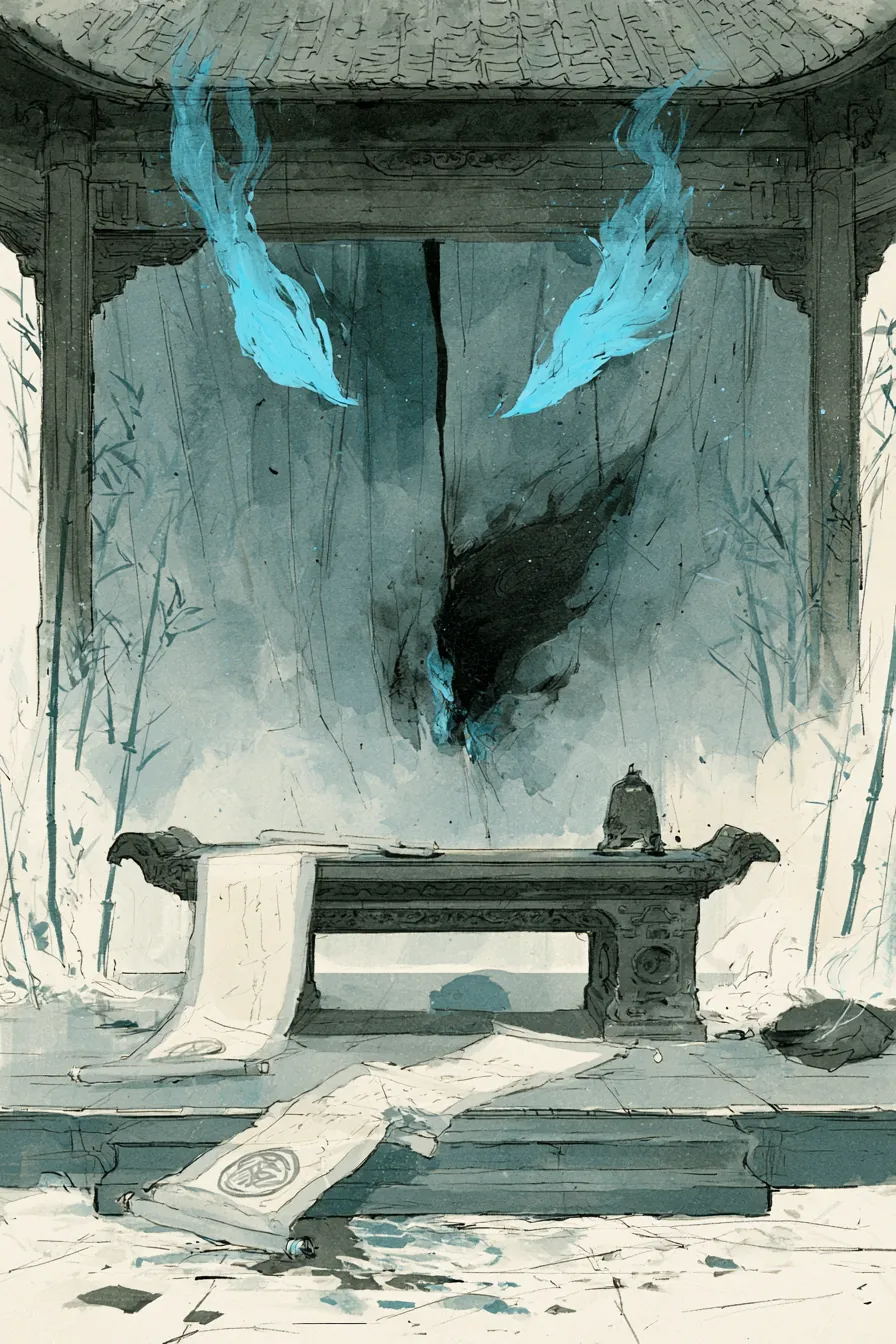
Chapter 38 — The World That Heard
The world heard at noon.
The world heard, by the smith's reckoning at his fortieth year, the master's one sentence at the bridge's first break at noon on the fourth day of the long dry watch of the third quarter.
The sentence was Boy. The manuals are wrong.
The sentence sat, one breath after noon, in the rib of every cultivator in the four continents.
It sat, by Yongzhou's count at the lintel of the smith's shed at the south wall of Cloudreed Sect a breath after noon on the fourth day, for the count of nine breaths in every rib.
The nine breaths were, by the smith's tally, the count of the cultivator's first reading of the master's voice.
The reading was, by the smith's count, the cultivator's first reading of his own manual.
The manual was, by the cultivator's standing protocol of two centuries, the cultivator's own.
The cultivator's own manual was, by the cultivator's count of his own fundamental at his own breakthrough at his own teacher's reading at his own sect's standing protocol, the cultivator's body.
The body was, by the master's voice at noon, the body the master had said was wrong.
Wrong.
The word, by the cultivator's rib at nine breaths, was the cultivator's first reading of wrong.
The reading was, in the smith's forty-year arc at his fortieth year, the cultivator's first reading.
The first reading was the cultivator's first cultivation in two centuries.
The first cultivation was, by the smith's count, the cultivator's first reading of the cultivator's body as wrong.
The reading was wrong.
The cultivator's body was wrong.
The wrong was the cultivator's first true reading of the body.
The true reading was, by the smith's lineage, the cultivator's first true cultivation.
The first true cultivation was, in the four continents at noon on the fourth day, the cultivator's first lesson from the master.
The master was teaching.
The four continents were learning.
Every cultivator in the four continents, after nine breaths after noon on the fourth day, had a teacher.
The teacher was Master Yuan.
Master Yuan was, by the body in the southern creek's running south to the second continent, the chord's first ancestor.
The first ancestor was, by the smith's measure, the line's first teacher.
The first teacher was the master.
The master was teaching.
At noon on the fourth day in the four continents, every cultivator in the four continents was learning.
The learning was, by Yongzhou's count at the lintel of the smith's shed in the next breath after the nine breaths in every rib, the world's first reading of the line.
The world was reading.
The line was no longer the family's reckoning's line.
The line was the world's line.
The world's line was, in the smith's two centuries of work, the Yellow Bell.
The Yellow Bell was the chord.
The chord was the world.
The world had been wrong.
The world was, at noon on the fourth day, being read.
The reading was the master's first teaching.
The first teaching was the broadcast.
The broadcast was done.
The broadcast had taken eight hours from the cast at the smith's shed at seven o'clock to the bridge's arrival at three in the afternoon — except that the bridge had broken at noon, which was three hours before the cast's air-pace arrival, and the broken bridge had — by the smith's forty-year forging at his thirty-eighth year — waited for the cast in the broken chord on the water.
The waiting was, by the smith's count, the bridge's first work after the breaking.
The broken bridge had waited for three hours.
At three in the afternoon, the cast had arrived.
The cast had, at three in the afternoon, been the bell ringing once at the Yellow Bell first note in the air over the southern foothills of the Sundered Peak.
The bell had rung at the broken bridge.
The broken bridge had, in the ringing, received.
The receiving had been the broken bridge's last work.
The last work had been the broadcast.
The broadcast had been the master's one sentence carried to the four continents in the rib of every cultivator.
The sentence had been carried at noon, not three in the afternoon — because the bridge had carried before the cast's air-pace arrival, by the bridge's chord on the water's broadcast at the bridge's first break.
The chord on the water had carried the master.
The master had been on the bridge after the morning bell at seven o'clock.
The master had been, by the bridge's reckoning of two centuries of bodies in the chord on the water, the chord's body.
The chord's body had been the bridge's broadcast.
The broadcast had been the master's voice.
The master's voice had been Boy. The manuals are wrong.
The voice had carried in the chord on the water at the tone.
The bar had been at fourteen bodies' carrying at seven-oh-six, fifteen in the master's joining at seven-oh-six.
The line had carried at fifteen from seven-oh-six to noon.
At noon, the line had been sixteen — the boss of the Iron Tongue having joined at five-fifteen and the two hunters at the bridge having walked back to the lintel at eleven forty-five, the line had become sixteen-plus-master, which was seventeen.
The line at seventeen had carried at noon.
The broadcast had carried at the bar of seventeen.
The four continents had heard at the register of seventeen.
Seventeen was, by the smith's hand at his fortieth year, the count of the chamber's twin.
The chamber's twin had, at the broadcast at seventeen, opened.
The chamber's twin was the third tuning chamber on the second continent.
The third tuning chamber had, after one breath after the noon bell on the fourth day, received the master.
The master had, by the body's carry in the southern creek's running south to the sea, been at the body's first carry south.
The body had not arrived at the third chamber.
The body would, by the southern creek's course, arrive at the third chamber in the count of three weeks.
Three weeks of the body's carry by the creek's current was the count.
In three weeks, the master would arrive at the third chamber.
At the third chamber, the master would, in the smith's making at his fortieth year, be received.
The receiving would be the master's first reception at the third chamber.
The first reception would be, by the smith's reckoning, the third chamber's first opening in two centuries.
The opening would be the next book.
The next book was three weeks away.
This book was, on the breath after the noon bell on the fourth day of the long dry watch of the third quarter, almost done.
Lin Wei, at the pine boards of the second tuning chamber at the south wall of Cloudreed at the noon of the fourth day a moment later after the bridge's first break, sat with his fundamental at the Yellow Bell first note and his Foundation at Layer 1 and his rib carrying at the chord at the bar of seventeen bodies and the empty cracked-iron bell in the pocket of his green outer robe and the cracked-iron sword on his lap.
He opened his hand on the bell.
He drew the bell from the pocket.
He laid the bell on the pine board between his folded knees.
The bell, on the pine board, did not bank.
It was empty.
It was a thumb-tall cracked-iron forging the smith had made for the body the bell had rung for.
The bell had rung once.
The bell would not ring again.
The bell was, by the smith's tally at his fortieth year, the bell.
Lin Wei picked up the bell again.
He laid it in the pocket of his green outer robe.
The bell, in the pocket, was at the body.
He breathed.
He looked at Tao Lin on the bench.
Tao Lin, on the bench, did not — by the bone's read at the wall's thin light — check.
She watched her son.
She said, in the dry voice of a forty-three-year-old choreographer on the bench under the wall of eight tone-bars at the noon of the fourth day after a single breath after the broadcast: "Son."
Lin Wei said: "Mother."
She let the word sit in the shed for the count of three breaths.
The line at seventeen — the broadcast — was, in those three breaths, no longer the family's keeping's secret. It was the world's. The family's record of the line's reckoning was, at the broadcast, finished, and with it the choreographer's nineteen years of office.
She set her hands flat on her thighs.
She said, in the same dry voice: "The choreographer is, at the count, your mother."
He paused.
He said, in the small still voice of a sixteen-year-old outer disciple at Foundation 1 on the Yellow Bell first note at the pine boards of the second tuning chamber at the noon of the fourth day after one breath after his mother had said I am your mother: "Mother."
She said: "Son."
She paused.
She said: "Lin Wei."
The word, this time, was her first speaking of his name.
She had not used his name in the count of nineteen years of choreography.
She had, at the moment in the noon of the fourth day, used it.
The name sat in the shed at the chord of the chord.
The chord, in the rib, deepened.
He breathed.
He said, in the small still voice: "I have, in the count of sixteen years, been your son. You have, in the count of sixteen years, been my mother. I have not, in the count of sixteen years, known."
She did not, by the bone's read at the lantern, check.
She said: "The not-knowing was, by my count, the choreographer's last work. The knowing is the choreographer's retirement."
He paused.
He said: "Thank you."
She paused.
She set her right hand on the bench between them.
She said: "Lin Wei. For sixteen years."
He paused.
The shed, in the count of three breaths after his name, held.
She said: "Your father was the smith."
He paused.
He looked, then, at the smith on the bench beside her.
The smith, on the bench beside Tao Lin, did not — by Lin Wei's read at the pine boards — move.
He looked at his son.
He said, in the dry voice of a forty-year-old smith on his own bench at the moment in the noon of the fourth day one breath after his sister had said the smith is your father: "Son."
Lin Wei did not move.
The chord, in the rib, deepened.
The deepening was the chord's read of the word son from the smith.
The chord knew.
Lin Wei breathed.
He said, in the small still voice: "Father."
The smith said: "Son."
He paused.
He said: "Forty-three years ago your mother was sixteen and I was twenty-three. The order had not yet named her the line's witness's mother, nor named me the forge-body. We were two outer disciples of the third sect, and the third sect's record permitted us to marry. We married."
He paused.
He said: "At twenty-one, the year her brother died at the fourth niche of the order's dispatch, the line identified her as the witness's mother — the first such identification in two centuries. The line's standing protocol made her its counter-agent, and her first work as counter-agent was the separation from the witness's father. The protocol demanded it. But the keeping of it was her choice."
He paused.
He said: "Your mother chose. She chose to keep the marriage in the family's private record. She chose not to tell the witness of the marriage, and not to tell me of the witness, and to keep the witness in her own care. The witness was Mei Qi — born the year you were one."
He paused.
He said: "Mei Qi is your sister."
Lin Wei did not, for one breath, move.
He looked, for one count, at Mei Qi at his right shoulder.
Mei Qi, by Lin Wei's read at the pine boards, was — by the bone's read at the wall's thin light — not surprised.
She had known.
She had, by Lin Wei's read one breath on, known the count.
She nodded once.
She said, in the small flat voice: "Brother."
Lin Wei said: "Sister."
The chord, in the rib, deepened.
The deepening was the chord's read of the word sister a breath after Mei Qi had said brother.
The chord knew.
The chord had known.
The chord had, by the family's reckoning of the line's record, known.
The line, after one breath after the word sister, settled once together.
The settling was the line's first anchoring with the brother and the sister as the brother and the sister.
The line at seventeen plus the master plus the brother-sister bond was, in the smith's forty-year arc, the line.
The line was the family.
The family was the line.
The family was, in the next breath after the broadcast, home.
Home was the pine boards of the second tuning chamber at the south wall of Cloudreed Sect at the noon of the fourth day on the breath after the family's reckoning of the line's measure had become the world's reckoning of the line's first reading.
Home.
Lin Wei breathed.
He thought, in the small still place under the rib's carry, the second-person voice the copyist year had given him.
You will, in the count of the writing, carry your family.
He thought it once.
He breathed.
The wall of eight tone-bars, behind the bench, rang once more.
The ringing was the wall's fifth ringing of the day.
The fifth ringing was, by Yongzhou's count at the lintel, the wall's last ringing of the day.
The fifth ringing was the wall's completion.
The wall had completed.
The completion was, by the smith's lineage at his fortieth year, the chamber's first completion in two centuries.
The chamber was the chamber.
The chamber was the family.
The family was the line.
The line was home.
Outside the lintel of the shed at the south wall of Cloudreed at the noon of the fourth day a moment later after the wall's last ringing, in the inner courtyard, the bell-tower's bronze bell — after one breath past the noon bell — did not ring.
The bell was, by the gate-bell's reckoning in the broadcast's completion, retired.
The bell-tower's bronze bell was, after one hundred and forty years of office, the office's last office.
The office had retired.
The bell was retired.
The bell-tower was empty.
The empty was, by Tao Lin's count at the bench, the inner library's office's last work.
The last work was the office's transfer.
The transfer was, by the senior reader's slip at one-sixteen, to the chamber.
The chamber was the office.
The office was the line.
The line was the chamber.
The three were one.
Cloudreed Sect, at the noon of the fourth day one breath after the noon bell, was — by the office's transfer — no longer Cloudreed Sect.
It was the chamber.
The chamber was the family.
The family was the line.
The line was Lin Wei, Mei Qi, Tao Lin, the smith, the great-uncle, the master, Wen, Yongzhou, the envoy, the third sect's elder, Hai, the boss of the Iron Tongue, the two Iron Tongue hunters, and the four others who would, in the next book, be identified.
Eighteen members.
The line at eighteen was, by the smith's measure at his fortieth year, the line by the chamber's outer ring.
The outer ring was the family's keeping's last work.
The last work was, at the noon of the fourth day, done.
The next book was three weeks away.
The boy, at the pine boards of the second tuning chamber at the south wall of Cloudreed Sect at the noon of the fourth day after a single breath after the last work, was — home.
He was home one breath after the broadcast.
He was home one breath after his mother had said his name.
He was home after one breath after his father had said son.
He was home a breath after his sister had said brother.
He was, at the count, home.
He breathed.
He looked, for one count, at the cracked-iron sword on his lap.
The cracked-iron sword on his lap, at the noon of the fourth day, was — by his Foundation 1's first sight — settling at the tone of the line.
The bar was the chord.
The chord was the line.
The line was eighteen.
The sword was the chord.
The sword was home.
He breathed.