Chapter Twelve
The Boy at the Horse-Camp
The order came down at the fourth hour of the third night.
Bald Wei came along the squad-line in the small thin dark before second watch with his lamellar laced and his short helm in the crook of his arm, and he came to each man at the cot and put his hand once on the man's shoulder and said the same eight words: Mountain, Crow, Liu, Wang, Yansheng — up. He said them in the order of the wake-pattern he had used in the conscript-yard at Yulin, with two beats between the first three and one beat between the last two, and on the count of his foot at the doorflap of the lambing-felt I was already sitting up on the cot in my under-shirt with the binding-cloth in my hand and the lamellar at my knee.
He did not come into the felt.
He spoke from outside.
He said, "Yansheng. Horse-camp at the bend of the salt-pan. Forty riders. Half-strength. Outriders out at dawn. Squad Five — second wave, behind the Vermillion light cavalry, at the south side of the camp. Polearm and bow. Set off in a quarter."
"Yes, sir."
"Bow at the saddle. Quiver on the right. Knife on the left. No bell on the mare."
"Yes, sir."
"Boy."
He had not called me boy since the night of the wagons.
He said it, this time, the way Old Crow used it — as a small ritual lengthening of the address, the way a man calls a thing by a longer word when the work the thing is being called for is the kind of work the longer word is owed to. He said, into the felt at the doorflap, with no breath behind it, "There will be one of them younger than you have ever killed. Do not see his face. Do not see his hands. If you must see his hands, see the rein-knot. See the rein-knot until the rein-knot is the only thing about him you have looked at. Then come back to the mare. Yes."
I said, "Yes, sir."
He said, "Up."
I bound. I plated. I tied the journey-knot in the bay mare's mane tighter at the third loop because the cold had loosened it. I rolled the under-shirt down twice at the waist and folded the bamboo tube and the brown-paper slip flat against my belly inside the doubled waist. I put the kitchen-knife at the small of my back under the lamellar skirt. I took the bow off the rack at the lambing-felt's south wall. I took the quiver. I went to the picket-line.
The wolf was not at the picket-rope.
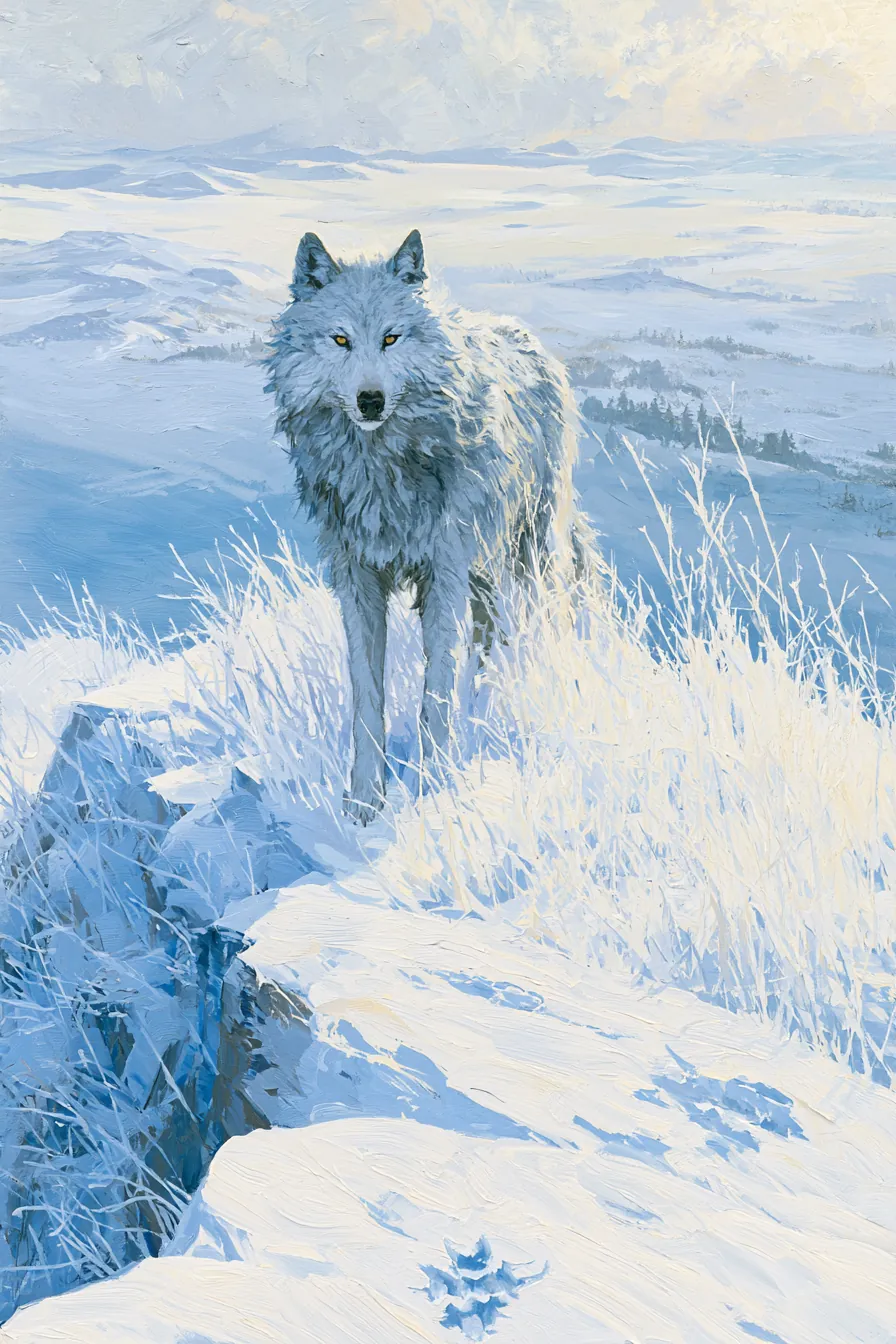
He was three lengths ahead of it, out past the smith's wagon at the edge of the white grass, standing four-square in the dark with his head up and his ears flat. He had begun to do this when there was work coming. He had begun it three nights ago when the secretary had crossed the trampled grass with the wax tablet. He had stood in the same place tonight before any man in the squad had been woken.
I did not look at him.
I felt him do it the way one feels a hand pressed flat between one's shoulder-blades from the back.
I mounted the bay mare.
I rode out behind Pock-faced Liu and ahead of Old Crow, with the squad in column under Wei at the head, and the Vermillion light cavalry ahead of us under their own captain at half a li, and we went out of the camp at the south gate on a small cold wind without bells, and the sky was the colour of the inside of a clay pot the second before it goes into the kiln.
The horse-camp was at the bend of the salt-pan.
It was a circle of five low felt-tents on the white grass with the picket-line at its centre and a small black pile of dung at the edge of the line, smoking in the cold, and a fire in a stone-ring on the windward side with three men around it in the open. The horses on the picket — about thirty — had their winter-coats up and their tails to the wind and were standing in three groups by which mare they followed. There was no banner. There was no wagon. There were no women.
The Vermillion light cavalry hit the south side at the third bird-call of the dawn-thrush.
Squad Five came in behind them at three lengths, with the bow up.
I rode third in the line.
I had been put third in the line by Wei. He had not said why. I had not asked. I had known why when he had said it: third in the line was where the squad-archer rode in a half-strength engagement against irregulars, because the squad-archer's bow was the squad's reach beyond Wei's polearm at first rank and Liu's at second, and the squad-archer could, if the line broke, take a man at thirty paces who was running for a picket-pony. Wei had not said and the squad-archer at thirty paces does not need to see the man's face, but he had meant it.
I took my first man at twenty-six paces.
He was a tall man with his hair in two braids down his back, running for the picket-line at full sprint with a short bow in his right hand and a quiver bouncing on the bound thong at his hip, and he was not looking at me. He was looking at the picket. He was looking at a roan gelding three down the line who must have been his, because the gelding had its head up and its ears toward him and was already pulling at the rope. I put the arrow through his upper left back, a hand's breadth below the shoulder-blade. He took two more steps. He went down on his right knee. He did not get up.
I did not look at him.
I took my second man at thirty-two paces. He was running across the line of the third tent with his head down. I put the arrow into the meat between his ribs and the hip and he fell sideways into the felt of the tent. I did not look at him.
I took my third man at eighteen paces.
He was at the rope. He had got a hand on the rope. He had got a hand on a small bay mare with a white star on her forehead and a mane that had not been combed in three days, and he was, in the same one motion, slashing the rope with the knife in his other hand and swinging up onto the mare's back without saddle or bridle, and he was — when I drew the bow back at the third draw of the morning — looking, for the first time, at me.
He was younger than Anshi.
He was younger than Anshi by — I would not, then, have been able to do the count, but I have done it many times since — perhaps a year. He had the small soft cheek a boy has at eleven before the bone of the jaw has begun to push out under it, and his eyes were the very pale grey-green of a steppe-boy whose mother had been bonded to a hawk and had passed the hawk's eye down, and his right hand had not let go of the rope, and his left hand had not let go of the knife.
His mouth opened.
He did not say anything. He did not have any tongue in his mouth that I would have understood, even if Toghrul had been at my elbow and the bond between Toghrul and me had been doing the work the bond at this hour did not yet know it was about to do. He only opened his mouth.
I saw the rein-knot.
I held my eye on the rein-knot.
I drew the bow.
I shot.
The arrow went through his throat just under the chin and out the back of his neck above the collar-bone, and his hand on the rope let go, and the small bay mare took two paces and stopped and looked at him going down, and he went down sideways across the picket-rope, and the back of his head hit the rope, and the rope took his weight for a count, and then his weight took the rope down, and he and the rope and the small bay mare's slack lead all went together into the white grass.
The mare did not run.
She put her head down to him.
She smelled at his hair.
She did not run.
I sat on the bay mare with the bow in my hand and my second-half-quiver still full, and I did not move.
Wei, three lengths to my left, called my name once. He called it the way a sergeant calls a name — without shape, only sound — and I turned the bay mare with my left heel and put her at the trot back to the line of the squad, and I came in at the rank, and I sat on her in the rank, and I did not look at the picket-line.
The Vermillion light cavalry took the rest of the camp in the small thin minutes of the dawn.
The whole engagement was, by the count of the relief-drum, less than a half.
I came back to camp on the bay mare at the fourth hour after sunrise, with Pock-faced Liu behind me at three lengths and his left shoulder packed with a strip of clean wrap and a sling at his right elbow because a Confederation outrider's arrow had taken him under the collar-bone in the second wave, and Liu was laughing through his teeth in the small barking way he laughed when a thing was not funny, and Wei was at his shoulder.
Liu said, when I rode in past the picket, "Fresh fish."
I said, "Pock-face."
"You alive."
"I am alive."
"Good. Good. Good." He elbowed me, lightly, in the right shoulder. He did not elbow with the left because the left was the one in the sling. He said, "I am also alive. So is Mountain. Crow. Wang. We are all alive, fresh fish. The squad is all alive on the third skirmish. Tell that to your mother in your next letter."
I did not say anything.
Wei looked at me from Liu's other side.
He said, "Yansheng. The bow back to the rack. The mare to the trough. Then the latrine. Then the lambing-felt. In that order. Yes."
I said, "Yes, sir."
He said, "Yansheng."
"Sir."
"Tonight you take the evening bowl."
I did not turn my head.
He said, into the small wind at his cheek, "Yes."
I said, "Yes, sir."
I racked the bow. I watered the mare. I went past the latrine. I went, instead of the latrine, behind the windbreak of the supply-wagons, and I knelt on my heels in the trampled snow, and I vomited into the lee of the wagon-wheel until there was nothing left to vomit, and I wiped my mouth on the back of my wrist, and I held the back of my wrist against my mouth for the count of three breaths, and I stood up.
I did not weep.
I had killed a boy younger than Anshi at the rein-knot of his mother's bay mare on the third hour of a dawn raid, and I had seen, even in the moment I had not been looking at his face, the small pale grey-green of his eye and the small soft round of his cheek, and the small bay mare had put her head down to him in the white grass, and I had not wept.
I went to the latrine. I did the business of the latrine.
I went to the lambing-felt. I sat on the cot. I took off the lamellar. I took off the binding-cloth, because the binding-cloth had taken sweat under the lamellar and the sweat was already cold and the cold against the chafe-ring at my left rib was, at this hour, more cost than the binding was saving me, and there was no one in the lambing-felt with me, and the slit in the seam at the south-east corner where my boots had been set sole-to-the-wind was small enough that no eye would come through it.
I sat in the under-shirt with the binding-cloth folded on the lamellar at my knee.
I held my hands in front of me.
They were the hands of the boy I had shot.
I do not know how to say this without saying it falsely. They were not, in any literal sense, the boy's hands. They were my own hands — narrow, with the small bow-burn at the inside of the right thumb where the gut had pulled hard at the third draw, and the chip in the small left index nail from the kitchen-knife at the second sowing of the third year — and I had known them all my life. But I held them in front of me, and I looked at them, and I did not know whose they were.
I had not, in any other morning of my life, not known whose my own hands were.
I closed them into fists. I opened them. I closed them again.
I sat that way for a long count.
I went to the prisoner-tent at first watch.
I went with the bowl of millet and the bowl of water and the small tin of bone-paste the orderly had pressed into my palm at the wagon — pressed it, did not hand it across the felt, pressed it into my palm with the flat of his own thumb at the back of my knuckle, the way a man passes a thing that has been promised by a third man — and I went under the flap.
He was awake.
He was sitting forward over his good knee in the posture I knew. He was not, tonight, leaning his head against the centre-pole. He had heard the squad come back in at the fourth hour. He had heard the squad go out at the fourth hour of the third night. He had counted, on the silence of the felt under his hand, what hour of the day they had come back in, and what hour of the camp it was now, and what the smell of the soldier coming through the flap was — the smell of a soldier who had vomited behind a supply-wagon at the fourth hour, the smell of a soldier who had taken three men with the bow at the third skirmish of a campaign, the smell of a soldier who had taken at least one of the three at a range under twenty paces, the smell of a soldier whose hands had begun, in the hour before she came under the flap, not to know whose they were.
He smelled it. I knew he smelled it. He did not lift his head.
He said, in the third voice, into the felt at the centre of the tent, "Sit."
I did not sit.
I crossed at the six paces. I set down the bowl of millet. I set down the bowl of water. I set down the tin of bone-paste at the chain-side.
He said, "Sit."
I knelt.
I knelt at four paces — not at six, which would have been the watch-position, and not at his good knee, which would have been the bandage-position, but at four paces on the felt where the lamp-light reached the edge of the chain-loop and stopped, and I sat back on my heels and put my hands palms-down flat on my own knees and looked at the felt between us.
He looked at the felt between us.
He did not look at my face. I did not look at his.
He said, after a count, "The wolf is not at the rope tonight."
I did not move.
He said, "He is at the south wall. He is on the side closest to this tent. He has been on the side closest to this tent for an hour. He is — by my reckoning of him through the felt — lying flat. He is not, tonight, watching the secretary's wagon. He is watching the lambing-felt at the east end of the squad-line."
He did not say because the boy in the lambing-felt has come back to it with a thing she has not yet learned how to carry.
He waited.
He said, "I do not know what you killed. I know you killed. I will not ask. I will say only what I have wanted to say in the four nights since you tied my bandage with your mother's knot. May I."
I held the count of eight.
I said, in the belly voice, into the felt, "You may."
He said, into the felt between us, "There is a place in the chest of a person who has carried another animal inside their chest for a long time where the animal lies down at the end of the day's work. The animal lies on its belly with its paws flat in front of it. The animal sleeps. The chest of the person is warm at that place. The warmth is the animal's. The warmth is not the person's. The person spends a long time, when they are young, not knowing it is not their own warmth — and then they spend a longer time, when they are older, learning to put a hand at the warmth and say, very quietly, in their own tongue, into the felt between them and no other person at all, "thank you for coming back to me today." When you come back from a day's work, soldier — from a day's work — that warmth is what you put your hand at. It is the only thing in the chest of a person like you and a person like me that does not, on a day like today, lie."
The pin behind my breastbone — the small wet pin Wei's tenth-morning thumbs-and-fingers cup had loosened by one quarter-turn — went two turns more.
I did not put my hand at the warmth.
I closed my left hand instead around my own right wrist where the back of my wrist had been under his thigh for the count of one on the bandage-night, and I held it, and I held it, and the second heartbeat in my chest opened the long slow opening it had been doing since the white grass and held itself open, and I did not, on any count, look at his face.
He said, "Good."
He did not say anything else.
We sat that way.
The lamp burned. The wind ticked at the seam. Outside, beyond the south wall of the camp where I had not yet seen with my eyes but knew with the warmth, my wolf was lying flat on his belly in the white grass with his head between his paws and his eye on the lambing-felt. The wolf was not watching me. The wolf had decided I was already watched.
I sat at four paces from a man chained to a centre-pole, and I held my own right wrist in my own left hand, and he sat at four paces from me, and neither of us moved for the length of half a watch.
When the changing of the watch came I rose.
I bowed at the small clipped angle a conscript bows to a prisoner of the empire. I gathered the empty bowls. I picked up the unused tin of bone-paste. I went under the flap.
I did not look back.
I crossed the trampled white grass to the squad-fire with the back of my own right wrist warm where my own left hand had been holding it, and the orderly at his wagon nodded at me once without looking up from his ledger, and Bald Wei at the fire did not ask any question at all.
He poured the cup. He gave it to me at the rim with the calluses of his right hand brushing the pads of my fingers for a count of one, as he had on the morning, and he took the cup back when I had drunk, and he said, "Sleep, Yansheng."
I said, "Yes, sir."
I went into the lambing-felt.
I lay down on the cot in the under-shirt and the trousers with the lamellar at the foot of the cot and the binding-cloth folded on the lamellar, and I put my left hand, very carefully, over the warm place in my chest where the wolf had lain down at the end of the day's work, and I held it there, and I did not sleep, and I did not wake, and the rein-knot of a small bay mare with a white star on her forehead held in the air between me and the felt above me at the height of my hand for the length of the night.