Chapter Eighteen
Belegt-Khan
The yurt was small.
It was a single hoop of bent willow at the height of a kneeling woman's head, with old felt smoked in the soot of forty winters of dung-fire and a door-flap of dehaired hide held to the willow by four leather thongs at four pegs, and Möngke-Dam had pitched the whole of it behind the lee of the supply-wagon at the eastern edge of the camp in the slow careful pace of an old woman who had pitched the same yurt at the same lee of forty wagons in forty hostings. The bear had carried the rolled felt and set it down at her left foot, and had stood beside her while she had cut the four leather thongs to the four lengths she wanted them in.
The bear was, this hour, lying on the snow at the side of the yurt.
He was on his right side. His muzzle was on his right forepaw. His left forepaw was over his belly. His eyes were closed. The rib-cage of him moved at the slow even count of a bear at the start of a watch he had decided to give to a thing he had decided was worth the giving, and Möngke-Dam's wolf-skin malgai lay across his shoulder — she had taken it off her own head at the changing of the third watch and laid it on the bear in the small slow gesture of a woman placing her own crown on the head of the second of the two animals she had walked with for sixty-two years.
My wolf was at the south side of the yurt.
He had got up at the changing of the second watch and walked, at three paces outside the line of my boots, from the smith's wagon to this lee, and he had sat on his haunches at the south side of the yurt at the place where the felt met the snow, and he had not, in the count of a hundred since I had come under the door-flap, lifted his eyes from mine.
He was watching the door at the inside.
I was at the felt at the centre.
I was in a wool-felt deel Möngke-Dam had given me at the door — cut at the size of a steppe woman's deel, wide at the shoulder, narrow at the wrist, long to the ankle. The binding-cloth was off. The lamellar was at the cot at the eastern end of the squad-line. The under-shirt was the thinnest wool I had worn since the morning of the kitchen-floor and the shears, and my chest was, for the first time in fifteen weeks, not flat.
Möngke-Dam was at the felt across from me with a drum the size of a roasting-pan.
She was not, yet, striking it.
She said, in steppe-tongue, in the small low voice that was the voice I had been hearing in the back of my throat for nineteen years —
"Daughter. Lie down."
I lay down on the felt at the centre.
The felt was warm. The bear had lain on it for half a watch. The warmth of his belly was, at the back of my own spine, the warmth of an animal whose hand was, in the bowl of his chest, sister to the hand of the old woman who was holding the drum at the rim with her left palm, and I felt it come up at the bone of my spine and at the back of my skull and at the inside of my elbows.
She said, "Close your eyes."
I closed them.
She struck the drum.
She struck it on the long careful interval of a heart unhurried — once at one, once at three, once at five — in the small low note of a drum-head buzzing at the bone-buttons sewn at six places at the back. The wolf at the south side of the yurt did not lift his head. The bear at the side did not open his eyes. The deel at my shoulders softened at the pressing of my back into the bear-warmed felt, and at the count of fifteen Möngke-Dam began to sing.
She sang in khoomei.
She sang in the deep voice at the bottom of her throat and the thin high voice at the roof of her mouth at once, in the two-voiced singing of the steppe-shamans her grandmother had taught her south-east of the river-fork at the white stone. The deep voice was the drum. The thin high voice was a wind I had not heard in any room — the wind of the white grass at the foot of the Iron Gates at the small hour before snow, the wind of an orchard south of the Yellow River at dusk in my eleventh year, the wind of a snow about to fall in the place I was being walked to.
I held the place under my own left hand at the inside of the under-shirt, and I did not, for the first time since the night of the wagons, close it.
I let it open all the way.
I was on snow.
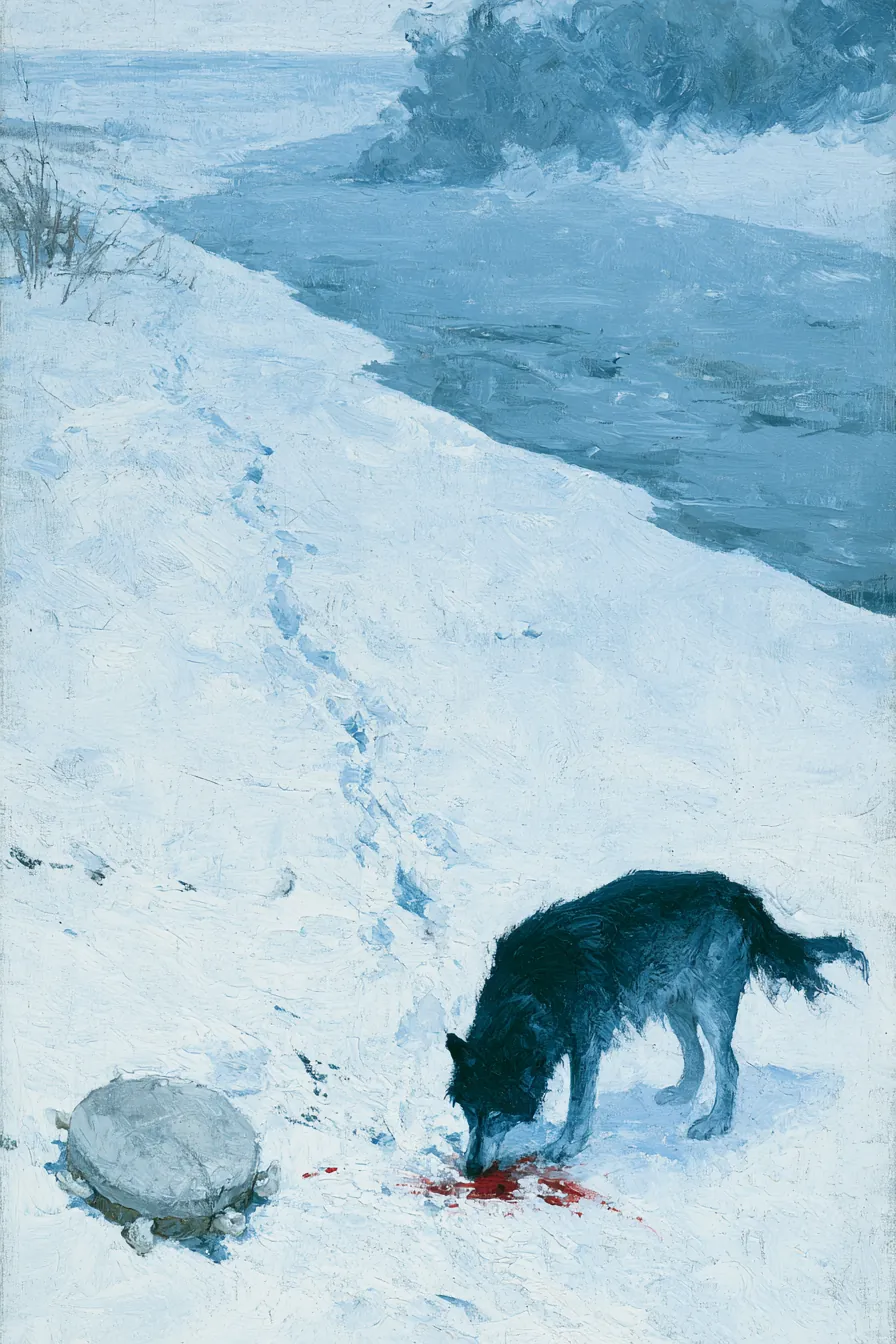
I was at the bottom of a sloped white plain that went up and to the north at the gentle angle of the inside of a tilted bowl, and the snow was blue.
It was the blue of the inside of a flame before the wick of the lamp takes. The blue of the broken edge of river-ice in the morning. The blue of the small round stone my grandmother had kept in the pouch at her belt and pressed into my mother's palm on the day my grandmother died — the stone on the bottom of my mother's wedding-box under three layers of cloth, the only blue thing I had ever owned by inheritance, and the snow at my bare feet was the colour of that stone.
I was barefoot. The deel hung at my ankles. The cold did not reach my feet.
I held my hands palms-down at the line of my thighs the way I had held them on the folding-stool in front of Möngke-Dam, and the small slow snow that was not snow yet in the room behind me was, on the blue snow at this side of the door, falling.
It fell at the size of a finger-joint, in the slow patient interval of the drum. The snow at my left hand did not melt.
I waited a long time — half a watch, perhaps, in the slow drift of the snow that did not melt.
He came out of the sloped white plain at the angle of the north-east.
He came at a slow lope on the blue snow with his ears flat to his skull and his eye on me at three hundred paces and his shoulder dropped at the gait of an animal who had come a long way and was, at the last two hundred of those paces, in no hurry to close them.
He was larger than I was.
He was larger than I was the way the bear was larger than Möngke-Dam, the way the orchard tree in the south-west corner of my father's field was larger than my brother. His fur was the grey of the inside of the cradle-blanket my grandmother had wrapped me in on the night of the lamp-oil and the juniper. His eyes were the eyes of the grandmother who had whispered the name over the cradle.
He stopped at four paces.
He sat.
He said —
He said it without the open-air word. He said it the way the warmth at the place under my hand had been saying it for nineteen years, the way the bear had said good to Möngke-Dam in the lifting of his head when she had laid the malgai across his shoulder — in the bowl of his chest, into the bowl of mine. The bowl of mine opened all the way, the way the door of the yurt opens to a soldier coming home in the slow careful gesture of the wife who has been waiting the season, and the warmth that had been under my left hand for nineteen years came up out of the bowl and stood between us on the blue snow at the size of the wolf at four paces, and the wolf reached his nose to it, and it was him.
He had been on this side of the door all along.
He had been waiting for me to walk to the door.
He said —
I am Belegt-Khan. I have been waiting for you nineteen years and four months and eleven days. I have been waiting for the way through. I am sorry it took so long.
He said it in the steppe-tongue, in the small low voice my grandmother had said Arsulan in over the cradle.
I knelt on the blue snow. I set the back of my left wrist on the snow, and the back of my right beside it, and my forehead in the small space between the two wrists; and I lifted my head, and the wolf came the four paces in.
He stopped at one pace.
He set his nose at the small space between my forehead and the blue snow.
He waited.
He said —
Tell me who you are.
I let the snow fall between us a moment.
I said it in the steppe-tongue, in the small low voice that was the voice of my grandmother and the voice of Möngke-Dam and the voice that had been in the back of my throat for nineteen years under the southern names —
"I am Arsulan, daughter of Yansheng of Qiaojia, and I will not hide what I am from you."
I said it once. He waited. I said it again.
"I am Arsulan, daughter of Yansheng of Qiaojia, and I will not hide what I am from you."
I said it the third time, into the cold pad of his nose at one pace, into the bowl of his chest at the angle his bowl opened to mine.
"I am Arsulan, daughter of Yansheng of Qiaojia, and I will not hide what I am from you."
He set his forehead against mine.
The bond knotted.
I did not feel it knot the way the bards in the orchard-songs of Qiaojia had sung it. I did not feel a snapping. I did not feel a tearing. I did not feel a falling. I felt the warmth that had been under my left hand for nineteen years come the rest of the way up out of the bowl and lie down at the inside of my whole rib-cage at the slow patient interval of the drum, and the warmth was no longer a warmth I was holding under a hand. The warmth was a wolf. The wolf was a body. The body was inside the bowl of my chest at the size the bowl had been keeping a place for him at for nineteen years, and the place fit, and Belegt-Khan lay down inside the bowl and put his head on his paws and let out the long slow breath of an animal who had walked a thousand li and had come, this hour, to the door of his own house.
He breathed out the breath into me.
I breathed it out into the small space between our foreheads.
He breathed it back.
We breathed it three times.
At the third time the snow on the blue plain stopped falling. The drum behind me in the yurt slowed to the slow patient interval of a heart at rest. The deep voice of the khoomei held one long note. The thin high voice fell silent. The bear at the side of the yurt breathed out one long breath, and breathed it out in the bowl of his own chest into the bowl of the old woman who had held the drum at the rim with her left palm, and the old woman breathed it out into the snow at the door of the yurt, and the door opened, and Belegt-Khan walked through.
He walked through on four legs — at the four-leg form of the wolf-shape that had been pacing the eastern edge of the camp at three paces along my line for four days — and the door closed, and Möngke-Dam set the drum down at her left knee.
She set it down without looking at me.
She looked, for the first time, old.
She looked old the way the four-ox plough at the end of the furrow in Little Mountain's village must have looked at the end of the fortieth furrow — the way a thing that has been holding a weight for a long count puts the weight down. Her hair, which had been iron-grey at the changing of the third watch, was the colour of the wool of the cradle-blanket. The bear at the side of the yurt had not opened his eyes. The malgai had slipped to the snow. The bear's muzzle was the colour of the cradle-blanket.
She said, in steppe-tongue, in the small low voice that was the voice of her own grandmother, "Daughter. He is yours."
I opened my eyes.
I opened them in the small dry tick of the salt-pan dawn that was no longer a dawn but the small hour before, and Belegt-Khan was across my ankles on the felt at the centre of the yurt with his head on his paws and his eyes on the door-flap. I was warm at the rib-cage in a way I had not been warm in nineteen years.
I sat up.
I put my hand on his head.
He did not lift it. He said — and this saying was already the saying of the new bond, the saying of an animal inside the bowl, not at four paces — Get up, daughter. The bird is at the rafter.
I looked up.
Khaghan-bürkii was at the rafter inside the yurt.
He was at the bend of the willow-hoop at the south-west, hooded, with the jess at his foot loose, the size of a goshawk with a wingspan I could not, from the felt at the centre, fully measure. He had come twenty li from the willow at the head of the frozen creek with Berke's thumb gone from his jess, and he had come in on the bond, through the smoke-hole of the yurt that had been open at the bear's breath.
I said, in steppe-tongue, into the rafter, "Khaghan-bürkii."
The bird did not move. He did not need to. His bowl reached.
The bowl of his bowl reached at the south-west angle of the willow-hoop and the bowl of mine opened at the new place Belegt-Khan was lying in, and the third bowl — the bowl that was, at the prisoner-tent eighteen paces away with the lamp at the third quarter and the iron at his ankle — opened back, and the three bowls were, at the small hour before the dawn-drum of the fifteenth morning, the same bowl.
He knew.
He had been praying.
He had been praying since the second watch when the door of the yurt at the lee had closed, in the steppe-tongue, into the felt at the centre-pole, in the small low voice my grandmother had said Arsulan in over the cradle, and the praying was, on the bond, a praying I heard.
Sky-mother. Let her come through. Sky-mother. Let the door open. Sky-mother. Let the wolf come into the bowl. Sky-mother. Let her say her name.
I had said it.
I had said it three times into the cold pad of Belegt-Khan's nose, and the bond had taken the saying at the third syllable and carried it on the bowl to the man at the centre-pole, and he had heard.
He breathed out.
He did not, on any breath of the praying after the hearing, ask the sky-mother for anything else.
He said it, on the bond, into the felt at the centre-pole at the third quarter of the lamp, into the bowl of mine —
Arsulan.
He said it once, and I held still, and he said it again — Arsulan — and a third time, Arsulan.
I felt the saying at the place the warmth had been for nineteen years, and the place was not the warmth's place any longer — it was the wolf's — and the wolf inside the bowl lifted his head and laid it back down on his paws and breathed out the long slow breath of a wolf who had heard, on the bond, the open-air name of his bonded said in the small low voice of a man at four paces in the room where the steppe-tongue did not cut.
The wolf approved.
The wolf approved of the man at the centre-pole.
I had not known, until the bond, that approval was a thing a bonded animal could give. I had not known, until this hour, that I would ask for it. I had asked for it. He had given it. He had given it on the third saying of my name in the steppe-tongue on the bond by the man chained to the pole at the prisoner-tent eighteen paces from the lee of the supply-wagon.
I looked at Möngke-Dam.
Möngke-Dam, at her place with the drum at her left knee, lifted her chin at the small clipped angle and said, in steppe-tongue, "He is the right man."
I said, quietly, "He is."
She said, "Good."
She said, "You will, at the second watch tonight, go to him."
I said, "Yes."
She said, "You will eat first. There is a bowl at the door."
She had had a bowl ready.
The bowl was warm at the size of a soldier's palm. The mutton was the mutton of the squad-ration the orderly had pressed into the wagon-master's hand at the second watch — I knew, because the bowl smelled of the small careful cardamom Wei put in the squad-pot — and the millet was the millet of Little Mountain's row, soaked at the third hour and steamed at the fourth, in the small precise hand of a man who had grown up watching a four-ox plough turn at the end of a furrow.
The squad had fed me.
The squad had fed me on the night of the bond.
I sat on the felt at the centre with Belegt-Khan across my ankles and Khaghan-bürkii at the rafter and the bear at the side and the old woman across from me with the drum at her left knee, and I ate the mutton-and-millet of Squad Five at the eastern end of the squad-line of the Tenth Legion at the lee of a supply-wagon at the foot of the Iron Gates pass on the morning of the fifteenth day of the prisoner-rotation in the small hour before the dawn-drum.
I ate it slowly.
I ate it the way Little Mountain had taught me — with the heat out of the bowl first, in even small mouthfuls — and Belegt-Khan watched me eat with the patient eye of a wolf at rest, and Khaghan-bürkii at the rafter set his hooded head at the small angle of the saying that was no saying in the open-air word, and the bear at the side of the yurt did not open his eyes.
I finished the bowl.
I set it down.
Möngke-Dam said, in steppe-tongue, "Go. The man at the centre-pole has been awake since the second watch. He has heard. He has, at this hour, eaten nothing of the bowl Liu set at the chain-side last night."
I said, "He has not."
She said, "Take the bowl with you. Eat with him. The lamp at the third quarter is a long lamp, daughter, and the man at the centre-pole has been waiting at the felt at the chain-side for fifteen nights for a soldier of Squad Five to sit across from him at the felt and eat at four paces."
She waited.
She said, "Eat at four paces. Tonight, daughter. Eat."
I stood up.
Belegt-Khan stood with me.
He stood at three paces outside my right shoulder, the way the wolf at the south line of the smith's wagon had walked beside me at three paces on the morning of I have come. He was smaller now — the size of a working dog at the height of my knee, with his shoulder at my hip and his head at the back of my own right wrist — the size that would, at the lee of the supply-wagon at the third quarter of the lamp in the small hour before the dawn-drum of the fifteenth morning, cross the trampled grass beside me to the prisoner-tent.
Möngke-Dam set the drum down. She did not get up.
She said, in steppe-tongue, "Daughter. Go. The bowl. The man. The lamp. Go."
I went under the door-flap.
The bear breathed out.
The old woman did not look up.
I crossed at the slow careful pace of an anda of nineteen years. I held the bowl of mutton-and-millet at my left forearm under the wool-felt deel. I held the place at the inside of my whole rib-cage that was no longer the place of a warmth under a hand and was, instead, the place of a wolf at rest. I held Arsulan at the place in the back of my throat where the small low voice had been holding it for nineteen years, and the place was no longer under any other name. I held it in open air.
I went under the flap of the prisoner-tent.
The lamp was at the third quarter.
The man at the centre-pole was sitting forward over his good knee.
He looked up.
He saw the wolf at my hip.
He saw me.
He said, in the steppe-tongue, into the felt between us at four paces —
"Arsulan."
I crossed at the four.
I knelt.
I set the bowl down between us on the felt.
I said it, on the bond, in the steppe-tongue, into the lamp at the third quarter and the chain at the centre-pole and the bowl of mutton-and-millet and the wolf at my hip and the bird at the rafter of the yurt twelve paces east —
"Toghrul."
The lamp held.