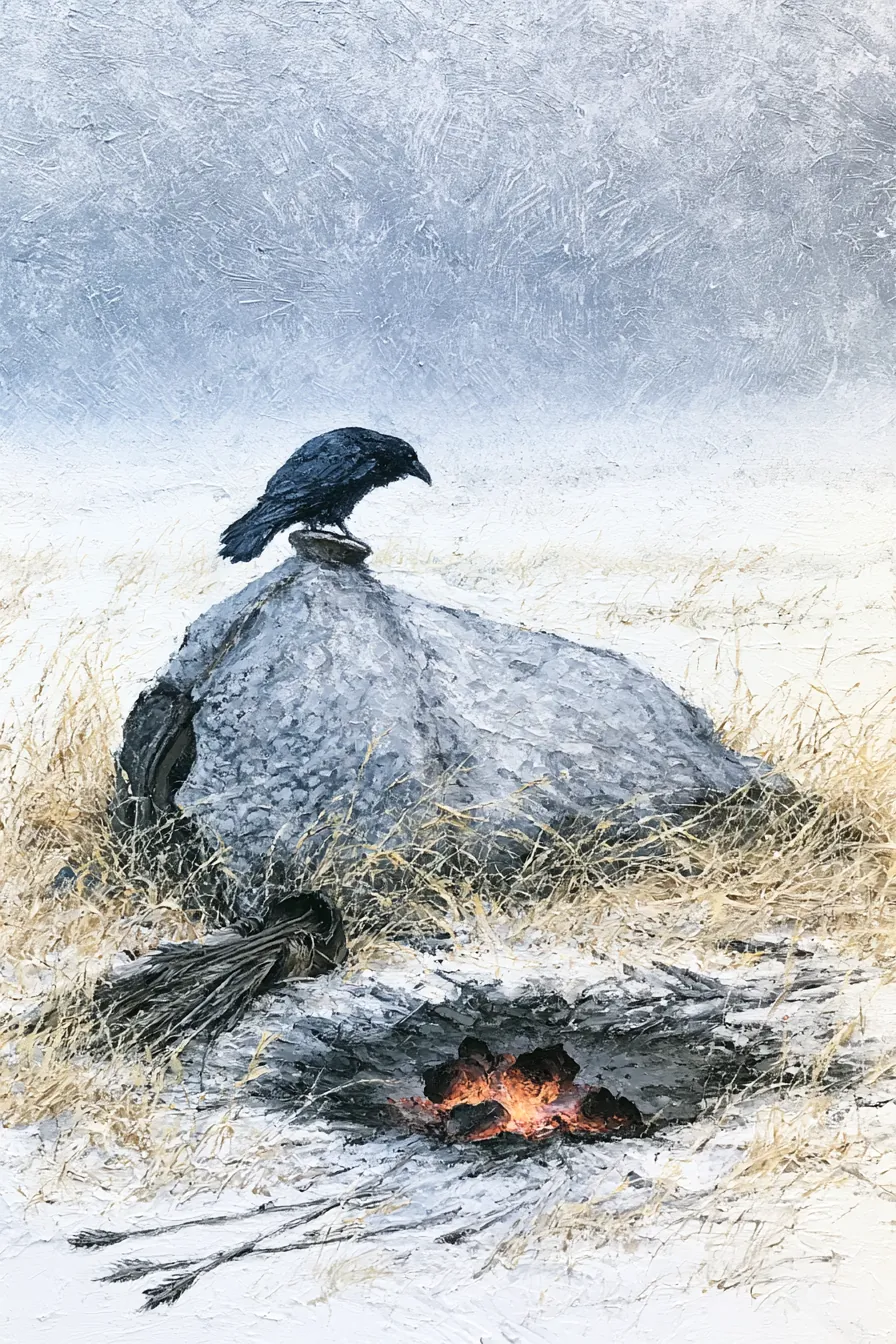
Chapter Twenty
Stomach-Flux, Three Days
Wei came to the cot at the dawn-drum.
He came at the changing of the fifth watch on the morning of the fifteenth day with the brown-paper square folded in the inside of his cuff and the tin of millet-water at his right hand and the small soft hush of his boots on the trampled snow at the lee of the lambing-felt, and he set the tin down at the corner of the cot, and he sat back on his heels at three paces — three paces, not four, because the lambing-felt was at the edge of the squad-line and the wind broke at the corner of the felt and a man at three paces would not be at the wind-line of an orderly walking past — and he looked at me.
I sat up.
I sat up in the lamellar I had laced back on at the cot, with the binding-cloth wound at the soldier's knot my mother had taught me at the spring sowing of the tenth year, and the wool-felt deel folded at the foot of the cot under the wool blanket the squad had spared me, and Belegt-Khan at three paces outside the felt — outside in the way the wolf at the south line of the smith's wagon had been outside, on his belly, with his head between his paws, with his eyes on the door.
Wei looked at the wolf a long moment, and then at me.
He said, very quietly, "He is yours."
I said, "Yes, sir."
He said, "Daughter."
I said, "Sergeant."
He said, "There are two of you in the bowl of you, this morning."
I said, "Yes, sir."
He waited.
He said, "I have not, in my service of the Tenth Legion, been a sergeant of a soldier who carried a second bowl of him at the inside of his own rib-cage. I have read of such soldiers in the chronicles. I have not been one of theirs. The chronicles say a sergeant who has been one of theirs is, in the count of the days that follow the soldier's coming to the bowl, a man who has been given a thing the chronicles will not, in any line, name."
He drank from the tin.
He said, "I am, this morning, a man who has been given a thing the chronicles will not name."
I let the cold sit between us a moment.
I said, "Sergeant."
He said, "Daughter. I am not asking for the name."
I said, "Sergeant."
He said, "I am telling you a thing."
He set the tin down at his right hand.
He took the brown-paper square out of the inside of his cuff.
He set it, face-down, on the corner of the cot at my left knee.
He said, "The slip is stomach-flux. Three days. Lambing-felt at the eastern edge. I have signed it. The orderly has counter-signed it. The orderly does not know the second name in the slip — he thinks the second name is mine — and I have not, this morning, corrected him. The slip is in the ledger at the morning watch. The ledger is at the wagon-master's wagon at the picket. The secretary, when he reads the ledger at second watch tonight, will read stomach-flux. Three days. He will not, at second watch tonight, ask. He will ask at the dawn-drum of the eighteenth, when the lambing-felt is empty. Do you hear me, daughter."
I said, "I hear."
He said, "When he asks, I will give him the sergeant's answer. The sergeant's answer is the answer the chronicles allow a sergeant to give a Bureau secretary when the sergeant's soldier has not come back to the lambing-felt at the dawn-drum of a stomach-flux slip. The sergeant says, I do not, sir, know. The sergeant does not lie. The sergeant has not, on any morning of the rotation, asked. I will give him the sergeant's answer."
He drank.
He said, "He will, on the second giving, ask why I did not, on any morning of the fifteen, ask. I will say I did not ask because a sergeant of the Tenth Legion is not, by writ of his command, required to know the name of the woman who walks in the boots of his squad-archer. I will say it twice. I will say it a third time when he comes back with the Marshal. The Marshal will, on the third saying, send me to the flogging post. The flogging post at the salt-pan air at the foot of the Iron Gates pass in the eleventh month is, daughter, the place a sergeant of the Tenth Legion does not, at twenty-eight strokes, come down from."
He waited.
He said, "I am telling you the count of strokes because the count is, in the chronicles, the count at which a man who has been given a thing the chronicles will not name has chosen to leave. The count is the leaving. I am, this morning, the man who has chosen the count."
I waited.
I said, "Sergeant."
He said, "Daughter."
I said, "I will not — at any hour after the dawn-drum of the eighteenth — ride out of any village south of the Yellow River without writing my mother a letter that says the second name in the slip was a sergeant of the Tenth Legion who chose the count."
He breathed out.
He said, "Good."
He set his palm flat on the cot at the small square of brown paper.
He said, "Take the slip. Put it at the bamboo tube under the binding-cloth. Carry it. When you ride out of the picket on the seventeenth night, the slip will be in your pocket. When you cross the white grass with the wolf at your stirrup and the prince at your right shoulder, the slip will be in your pocket. When you come back, daughter — and you will come back — you will come back to the village south of the Yellow River with the slip in your pocket, and you will set it at the threshold-stone of the kitchen door at Qiaojia, and you will tell your mother, This is the slip the sergeant signed. Do you hear me."
I said, in the smallest voice, "I hear."
He said, "Good."
He drank.
He said, "There is one more thing. Wang Erlang has asked, this morning, for permission to be at the south picket at the second watch of the seventeenth night. I have not granted permission. I have not denied permission. I have set the morning's picket rotation at the orderly's wagon without Wang Erlang's name on it. Wang Erlang, when he sees the rotation at the second hour, will see that the slot at the second watch of the seventeenth night is the orderly's, and the orderly has the dysentery, and the dysentery means the slot is not filled. He will fill the slot. He will fill it because he has decided, in the bowl of his own chest, to fill it. Do you hear me."
I said, "I hear."
He said, "Wang Erlang is the man at the south picket at the second watch of the seventeenth night. He will, when the wagon-master walks to the latrine for the length of half a watch, be at the wagon-master's wagon. He will not, on any breath of the wagon-master's walking, see the small black horse-string at the lee of the smith's wagon. He will see, instead, the lambing-felt at the eastern end of the squad-line. He will see it the way a man on a picket-line sees a thing that is not his to see. He will not, on the eighteenth dawn-drum, remember what he saw."
He paused.
He said, "He is also the man who will, on the seventeenth night when the Bureau outriders come to fetch the prince at the second watch, be at the south picket. The outriders will not — at the lee of the smith's wagon — see the bay mare. The outriders will see the wagon-master's mare. The wagon-master will, at the line of the latrine, be drunk."
He took back the brown-paper square. He folded it. He held it at the line of the slit at the cuff of the inside.
He said, "I will give you the slip at the cot at the second watch of the seventeenth night. The slip will, by the rules of the chronicles, not be in your pocket before the lying. The lying must, by the rules of the chronicles, hold at the wagon-master's morning ledger. The slip will be in your pocket at the moment you ride out of the picket. Do you understand."
I said, "I understand."
He said, "Good."
He stood.
He said, "Eat the millet. The orderly will bring the noon bowl at the third hour. You will be at the lambing-felt for the watch. Liu will, at the changing of the noon, come to sit at the cot. Liu, when he comes, will tell you a thing he has been holding for two days. Hear him, daughter. He has been holding the thing well."
He went.
He went without looking back, in the small soft hush of his boots, and Belegt-Khan at three paces lifted his head and laid it back down on his paws and watched him go.
I held the millet at my knee.
I drank.
Liu came at the changing of the noon.
He came with a small carving in his right palm and a piece of squad-bread in his left and a smear of soot at the back of his thumb from the squad-fire, and he sat on his heels at four paces beside the cot with his right shoulder turned at the wind-line that had been Wei's, and he set the carving on the corner of the cot at the place where Wei's slip had been.
The carving was a duck.
It was not the duck-that-was-a-horse-that-was-a-duck.
It was a small wooden duck the size of his thumb, with the head turned over the right shoulder and the wings folded at the back and the beak open in the small clean angle of a duck calling at the end of a furrow, and the wood was the soft pine of the squad-fire's spare kindling, and the beak had been cut at the last stroke with the small careful knife Liu kept at his right boot.
He said, "Yansheng."
I said, "Liu."
He said, "It is for the road."
I said, "I cannot pay for it."
He said, "It is not for paying. It is for the road."
He breathed out.
He said, "I do not know what road. I do not need to. There is a road. The road is the road a duck goes on at the end of a furrow when the cold has come down off the higher plateau and the rice has been taken in and the threshing-floor is empty. The road is the road my mother taught me as a child, watching the ducks at the rice-pond go in the small careful line of one duck behind the other. The duck at the end of the line carries the small clean angle of the beak. The duck at the head of the line carries the count of the wind. The ducks between carry — Yansheng — the ducks between carry the body of the duck at the head of the line through the wind to the next pond."
He looked at me.
He said, "I am the duck at the end of the line, Yansheng. I am the duck with the beak. You are the duck at the head of the line. You are the duck with the count of the wind. The wolf at three paces outside the lambing-felt is the body the ducks between are carrying. Do you hear me."
I did not answer at once.
I said, "Liu."
He said, "I have known since the bath at Yulin in the third week."
I did not move.
I said, "Liu."
He said, "I have not told. I have not told because the not-telling is the small clean angle of the beak. The squad has not told. The squad has not told because the squad does not, in the bowl of any of the seven of us, hold a name we have not been asked to hold. The squad has held the name for six months. The squad is, this noon, still holding it."
I breathed out.
I said, in the smallest voice, "Liu."
He said, "Yansheng."
I said, "I cannot — at any hour — pay for the holding."
He said, "It is not for paying. It is for the road."
He set the bread at the cot beside the duck.
He said, "Eat the bread. The bread is from the squad-fire of this morning. Mountain baked it. Mountain put a small careful spoon of the salt-pan honey on the inside of the crust, because the honey will hold the bread for two days in the cold, and the road is two days at the least to the ridge."
He did not speak.
He said, "The squad will not, on the eighteenth dawn-drum, be on any line of march that has been told the names. The squad will be at the squad-fire. The squad will eat the bread Mountain has baked at the morning watch. The squad will, in the bowl of the seven of us, hold the small clean angle of the beak. Do you hear me, Yansheng."
I said, "I hear, Liu."
He stood.
He went.
He went with the small soft hush of his boots in the trampled snow, with the right shoulder turned at the wind-line, with the carving-knife at his right boot, with the squad-bread no longer in his left hand and his right thumb wet at the corner of his mouth.
He did not look back.
I held the duck in my right palm.
The wood was warm.
It was warm because Liu had carved it at his belt under the lamellar at the squad-fire on the morning Wei had told him to come at the changing of the noon, and the small soft pine had held the warmth of his belly under the lamellar all morning, and the warmth was the warmth a duck at the end of a line of ducks carries through the wind at the close of a furrow.
I held it.
I held it for a long count.
I set it on the corner of the cot beside the bread.
I went, at the third hour, to the eastern edge.
I went without the bow and without the bamboo tube and without the lamellar — in the under-shirt and the trousers and the boots and the wool-felt deel I had taken back out of the foot of the cot — and Belegt-Khan walked beside me at three paces outside my right shoulder, at the height of my knee, with his shoulder at my hip and his head at the back of my right wrist.
The yurt was at the lee of the supply-wagon.
The door-flap was down.
I stood at the door-flap.
I said, in the steppe-tongue, in the small low voice, "Mother."
She said, from inside, "Come in, daughter."
I went under the flap.
She was at her place with the drum at her left knee.
The bear was at the side of the yurt with his eyes closed and the malgai across his shoulder and his muzzle the colour of the cradle-blanket and his breath at the slow even count of an animal at the start of his last watch.
Möngke-Dam looked up.
She said, in steppe-tongue, "Daughter. You are not, this hour, an anda of nineteen years. You are an anda of fifteen weeks. The fifteen weeks count from the morning of the kitchen-floor and the shears. The four months and eleven days you owe Belegt-Khan are the count of the bond. The nineteen years and four months and eleven days are at the larger count. The fifteen weeks are at the count of the soldier you have been."
She looked at me with her river-mud eyes.
She said, in steppe-tongue, "You have been a soldier for fifteen weeks. You will be an anda for the rest. The soldier in the bowl of you, at the eighteenth dawn-drum, will be the anda's second tool. The anda's first tool will be the wolf. The anda's third tool will be the man at the centre-pole."
She waited.
She said, in the steppe-tongue, in a voice I had not, in any breath of the watch at the folding-stool, heard her use — a voice with a small dry laugh at the bottom of the throat —
"Daughter. I have a thing to tell you about the boots."
I breathed.
I said, "The boots."
She said, "The boots of the southern empire are the worst boots I have, in sixty-two years, seen at the foot of an anda. They are stiff at the heel where the heel of a steppe-boot is soft, and they are soft at the toe where the toe of a steppe-boot is stiff, and the leather is cut at the line of the ankle in the way a southern cobbler cuts a leather he has not been taught by his grandmother to cut. The southern cobblers were never, in any of the dynasties, taught by their grandmothers. The grandmothers of the southern cobblers were married off at the age of twelve to the second sons of farmers and were not, by any rule of the trade, permitted to teach the cutting of leather."
She laughed.
She laughed at the small dry note at the bottom of the throat, in the long careful laugh of an old woman who had been waiting nineteen years to laugh at the boots of an anda at the eastern edge of a hostage-camp at the foot of the Iron Gates pass.
She said, "At the ger at the foot of the Iron Gates, daughter, you will burn the boots. You will burn them at the door-stone in the small ritual of an anda who has come into her own ger. Belegt-Khan will, on the burning, sit at the lee side of the smoke. The bear, if the bear is still in any side of the bowl by the burning, will be at the windward. The boots will not, on the burning, smell of leather. They will smell of the small bad smell of the southern cobbler's tannery, and Belegt-Khan, on the smell, will sneeze."
I laughed.
I laughed — a clean note in the back of my throat that had made no noise of that kind in any breath of the fifteen weeks — and she laughed with me, her dry note under mine.
The bear at the side of the yurt opened one eye.
He looked at us. He did not move.
He closed the eye.
Möngke-Dam said, in the steppe-tongue, "Good. The laugh is a tool also. The anda's fourth tool. You have, daughter, four. Now. Listen."
She told me the plan.
She told me at the slow careful pace of an old woman who had pitched forty yurts in forty hostings and who would, on the morning of the eighteenth dawn-drum, not pitch another, and the telling held the watch from the third hour to the changing of the fourth, and Belegt-Khan at the door of the yurt lay flat with his head between his paws and his ear flat to the felt, and the bear breathed at the slow even count, and the snow that was not yet snow ticked at the small dry tick of the salt-pan air at the foot of the Iron Gates pass.
At the changing of the fourth she stopped.
She said, in the steppe-tongue, "Go back to the cot. Sleep. The seventeenth night will be a long night. Do not eat at the squad-fire tonight. The wagon-master has been told."
I rose.
I bowed at the anda's bow.
I went to the flap.
I stopped at the flap.
I said, in the steppe-tongue, in the small low voice, "Mother."
She said, "Daughter."
I said, "The bear."
She said, "Daughter."
I said, "I will not forget."
She said, in the small voice with the dry laugh at the bottom, "He knows. Go."
I went under the flap.
The bear opened one eye.
He looked at me a long moment.
He closed the eye.
I crossed the trampled snow back to the lambing-felt at the eastern end of the squad-line in the wool-felt deel under nothing, with Belegt-Khan at three paces outside my right shoulder, and the wind at the lee of the lambing-felt at the dawn-drum of the sixteenth morning had a small new edge in it that had not been in the wind at the dawn-drum of the fifteenth.
I lay down on the cot.
I held the small wooden duck in my right hand.
I held the brown-paper square — folded once at the centre, signed at the bottom in Wei's small clipped hand — at my left palm.
I slept.
I dreamed of an apple-tree south of the Yellow River.
I did not, on any breath of the dream, see the small soft piece at the platter.
I had eaten it.
I had eaten it at the prisoner-tent over the fourth cup of millet at four paces, and the small soft piece, in the dream, was no longer at the platter and no longer in my hand but at the back of the teeth of the man at the centre-pole, where I had set it — in the dream, and in the bowl of his chest in the open air.
I did not speak.
I slept.
I did not, on the seventeenth dawn-drum, swallow.