Chapter Twenty-Six
The Crossing at the Long Wall
The Long Wall came up in the grey light of the dawn-drum on the morning of the twenty-first day.
It lay along the angle of the south-east, beyond a low ridge that ran south and west on an old caravan-track — three centuries of tea-brick and salt and conscripts and Bureau outriders had crossed the Wall on that track. We had ridden two days and a half-watch south of the ger in the lee of the long grey ridge, and slept neither night under a roof: in the lee of the horses, Berke at the windward, Toghrul at the lee, Belegt at my ankles, the gyrfalcon working the air to the north-east. We had eaten Berke's dry aaruul and drunk a little mare's-milk and held our line and not broken it.
The aaruul was the steppe in a single hard knot of curd — sour and salt and faintly sweet at the back, dried on a ger-roof through a summer I had not lived, by hands I would never meet, and it sat in the belly for a half-day and did not ask to be thought about again. Berke parcelled it out at each halt in pieces the size of a thumbnail, three to a rider, with the unhurried economy of a man who had crossed the white grass on less for longer. We rode through two short days and two long cold nights, and I learned the rhythm of a steppe-march the way I had once learned the rhythm of a column — not the empire's grinding twelve li a day in a dust of three thousand feet, but the steppe's long lope and longer rest, the horses spelled on the string so none was ridden into the ground, the bird sent ahead and called back, the wolf ranging wide and folding in. It was the oldest way of crossing distance that human beings had ever found, and my body, which had been a southern orchard-keeper's daughter and then a southern conscript, took to it as if it had only been waiting to be asked. I was tired in a clean way I had not been tired in seventeen weeks. The empire tires a soldier by wearing at the edges of her. The steppe tired me from the centre out, the honest tiredness of a body doing the work the body was shaped for, and I slept the two cold nights in the lee of the horses with my face uncovered and woke each dawn steadier than I had lain down.
The Wall itself was a low brown rib, two of Toghrul high on the chestnut, rammed earth gone heavy with three centuries, brick parapet at the cap, a watchtower every three li — half of them empty, the other half held thin by the conscript-rotation of the Yan-Hua directorate. We had come up at the third tower west of the second county, the one the wagon-master at the Iron Gates had told Berke was held at half-strength since the new year, on account of a lung-fever the directorate was nursing among fifteen conscripts down at the third creek.
Half-strength was three men. This dawn it was two — the third was at the latrine on the south side.
I had crossed this Wall once before, northbound, in the spring, packed in a column of three thousand conscripts driven through the great gate at the second county under the cinnabar standard, and I had looked up at the brown rib of it from inside the dust and thought it the edge of the world — the line past which the empire ended and the thing the empire feared began. I had not known then which side of that line I belonged to. I had thought I was being driven out of my country into the steppe's teeth. I knew now that I had been a steppe daughter all along, driven the wrong way across her own border by a country that had borrowed her under a dead man's name. The Wall had not changed. It was the same brown rib, the same conscripts shivering at the same thin towers. What had changed was the daughter looking at it — who crossed it this dawn not through the gate in a column's dust but at a thin tower west of the county, on a stolen mare, between the second pour of two men's salt-tea, going home the way her mother had been carried away from home thirty-one years before.
Berke set the spare string in the lee of the ridge and read it off the bird. "My prince. Two at the cap, drinking salt-tea at the lee of the parapet. The third's at the south latrine, gone the length of a half-watch. The tea's at the second pour. We have until the third."
"How long is that," Toghrul said.
"Long enough," said Berke, and laid the back of his hand over his heart.
Khaghan-bürkii lifted off the saddle and went south, two li, over the cap of the tower and on past it half a li, then turned and came back across — the slow clean pass of a bird that had been telling its master what the Wall's towers held since the Tianxuan reign began. The two men at the cap did not raise their heads. The third did not come out of the latrine.
"Now," Berke said.
We rode. Three horses and a wolf and the spare string, down the lee of the ridge into the south-east, into the dry salt-tick of the dawn air; Belegt loped at my boot, and the bay mare lifted her head and let go a long-held breath and broke into a slow lope, and the chestnut and the grey jenny and the string came after, Berke at the windward. We crossed the line of the Wall — the way steppe horses and empire horses cross it, when the conscript-rotation is at its second pour and looking into its cups — and made no sound, and came up on the south side.
We did not look back. The white grass of the steppe was behind us. The black sand of the empire was under our hooves, and the black sand, which had not held snow all the eleventh month, began to hold it now, thickening to the size of a thumb-joint. I felt the crossing in the mare's stride before I felt it anywhere else — the give of the ground changing, the white grass's frozen turf going to the loose dark grit of the empire's salt-flats, the mare's hooves finding less to push against and her gait shortening for it. The steppe wind dropped. A different wind came up off the empire side — off the salt-fork, off the third county — and I knew it, though I had not stood in it for seventeen weeks, not since the morning of the kitchen-floor and the shears. It was the wind of the empire, of the country south of the Yellow River: it had crossed eleven hundred li of black sand and rammed earth, and it carried the soft tannin of southern cobblers, the cinnabar of lacquered wagon-tongues, the iron of the salt-foundry, the dust of the rice-paddies at the third creek.
It smelled of home.
I had not let myself want home in seventeen weeks. Wanting is a weight a soldier cannot carry on a march, and I had set it down at the orchard gate the morning of the shears and not picked it up since — not at the muster bath where Liu first knew me, not at the prisoner-tent at four paces, not on the blue snow at the bonding. I had carried instead the thing a soldier carries in place of wanting, which is the next task and the next and the next. And now the wind off the empire came up over the Wall smelling of cobbler's tannin and rice-dust and the iron of the foundry that had killed my father slowly across fifteen years, and the want came back into me all at once with the smell, and it was not a sweet thing. It was the want of a daughter riding toward a mother she had not seen in seventeen weeks, across a country that had already taken the father and was reaching for the rest. I let the wind carry it. I did not set it down again. I had learned, somewhere north of the Wall, that there are weights you carry better than you put down.
I did not look back. I rode south.
We came up on the salt-fork at the second hour past noon, in the lee of a low rise of black sand, the snow at the finger-joint and the steppe wind behind us.
The salt-fork was a road — the imperial salt-road, brick at the middle, dirt and drainage at the sides, running a hundred and forty li from the South Fork to the third county. A hundred and twelve li south of the bridge, the Bureau wagon stood at the second outpost: a small brick building behind a low wall, a four-horse stable, a guardroom, an upstairs room for the senior outrider and a four-cot below for the others. The wagon stood at the lee of the stable. The wagon-master sat in the courtyard with his brush and his ledger. And inside the wagon, against the windward wheel-well, were the two captives — the mother and the boy.
And at the windward of the wheel-well, a wolf.
Berke set the string in the lee of the rise, the three horses a li off the outpost, and read it off. "My prince. Senior outrider upstairs. Four below at the cot. Wagon-master in the courtyard, no fighter. Four horses in the stable. The mother and the boy in the wagon. And a wolf at the wheel-well." He let that last sit. "Six fighters, when they gather. The wagon-master sets his brush down at the second pour; the senior comes down at the third; the four come to tea at the third. The bird-eye, my prince."
Khaghan-bürkii lifted off the chestnut and made his pass — south and back, over the courtyard, and not one head lifted to him: not the wagon-master, not the senior, not the four below, not the mother and boy in the wagon.
The wolf at the wheel-well lifted its head.
It set its nose into the wind off our ridge, and held there a moment, and set the nose down, and turned, and came — at a low quiet pace, a li up the lee of the ridge to where I sat the bay mare with the chestnut at my left and Belegt three paces off my right boot. It came up over the better part of a half-watch, and sat at three paces off the bay mare's right shoulder, and looked at me.
I looked at it. "Brother," I said, on the bond.
Sister, it said, into mine.
"You have been at the wheel-well."
Daughter. Since the second day of the wagon. Three days at the line of the salt-fork. I have been holding it.
"Brother. The mother."
The mother is in the wagon, and the boy at her right wrist, and the brown-paper square at the lacquered tube on the thong, and the kitchen-tongue of Qiaojia behind her teeth. And every third watch of every night since the second night past the eighteenth, daughter, your mother has been saying into the wood of the wagon-wall: Arsulan. Come. Come to the bridge.
I said nothing for a moment. Then, in the smallest voice on the bond: "Brother. Why are you here? I have a wolf already."
Daughter. I am the second wolf. The first is three paces off your right boot, with his ears flat and his eye on that wheel-well.
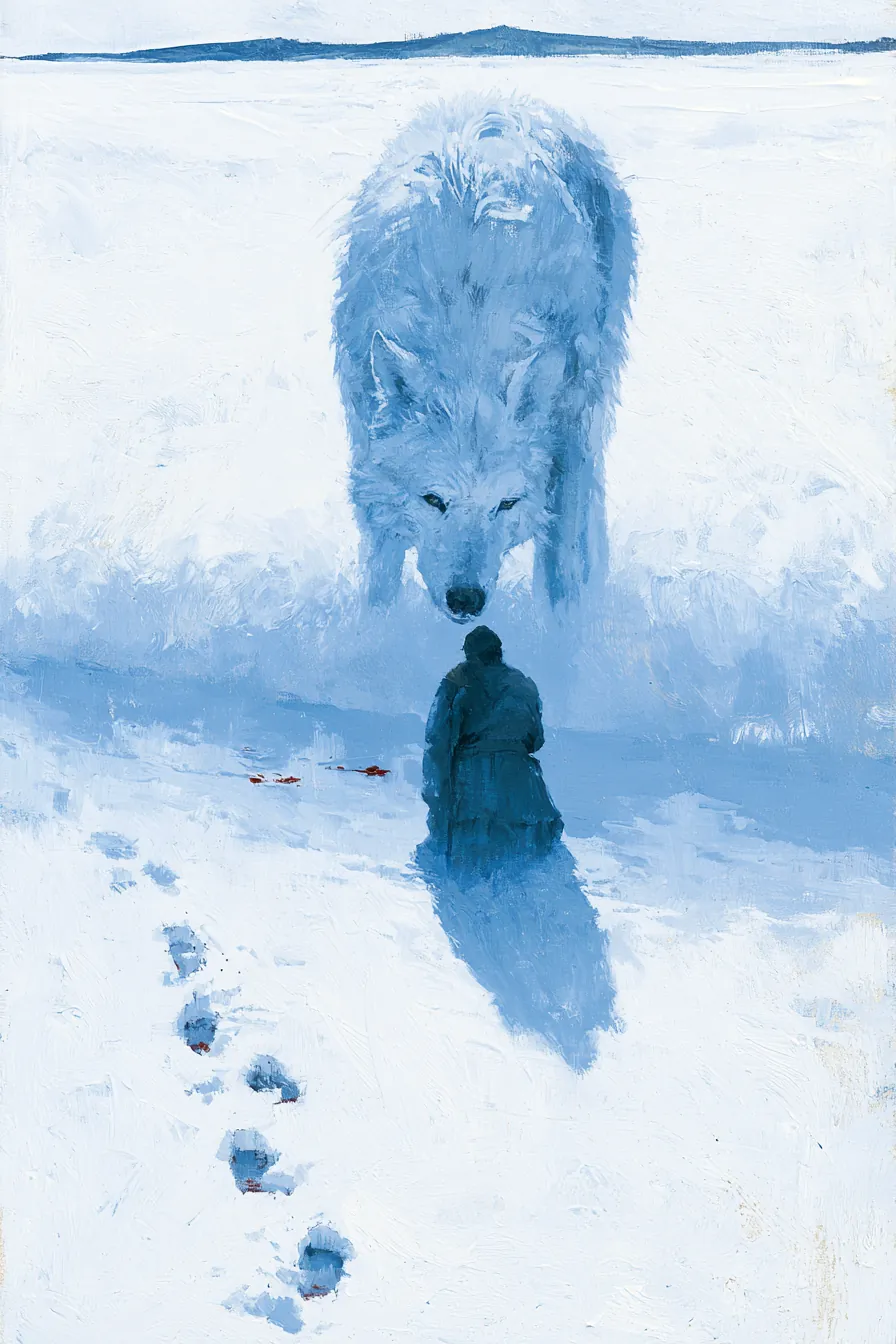
I looked. Belegt had not moved — three paces off, knee-high, ears flat to his skull, his eye on the wagon at the lee of the stable. And I looked at the second wolf, three paces off the bay mare. It was the size of a yearling deer, the colour of a winter sky, and it put no breath on the cold air. Its eyes were yellow at the rim and dark at the centre, the way an old coin is gold at the edge and worn bronze in the middle.
I made myself look, and the looking was the hardest thing I had done since the kitchen-floor. I had not looked at this wolf in nineteen years. I had felt it — at the edge of the orchard, at the boundary stone, at the dark beyond the lamp-light, a presence I had trained my eyes to slide off the way you train your eyes off a thing you have decided does not exist because existing would cost too much. The morning the peddler took my hand in our yard and went white at the lips and would not say what he had seen, I had decided. I had been a child of six, and I had looked at the wolf-shadow once, full, and seen it look back, and seen the peddler's face, and understood in the wordless way a marked child understands such things that to go on looking was to become the thing the peddler had gone white at. So I had stopped. For thirteen years I had kept a wolf at the edge of my own sight by main will, the way you keep a sleeping limb from your weight. And now it sat at three paces off the bay mare in the empire's snow with the salt of the salt-fork on the wind, and I looked at it, and it did not blow away or sink into the dark or turn out to be a trick of the orchard dusk. It was solid. It had a body. It had taken a body the day my daughter-self had finally said, on the blue snow, I will not hide what I am — and somewhere in the bowl of my mother's chest the same words must have been said, long ago, at the bend of the Onon, to give this one its first body. It was the wolf at the orchard, made flesh by the same refusal that had made mine.
It was the wolf-shadow that had paced me at the boundary stone of Qiaojia the morning of the shears. The wolf I had never once let myself look at in nineteen years, since the peddler took my hand in our yard and went white at the lips.
It was looking at me now. And I did not look away. That was the whole of it, and it was everything: a marked child of six had looked away to live, and a nineteen-year-old anda on a stolen bay mare at the edge of her own war did not.
I made myself breathe slow. "Brother. You have been at the wheel-well of my mother's wagon since the second day."
I have.
"You are the wolf-shadow of the orchard at Qiaojia."
I am.
"Belegt-Khan is my wolf — three paces off my boot."
He is.
"Then are you the same wolf?"
The second wolf let the question hang, and answered it carefully.
Daughter. We are the same wolf in the bond at your breastbone. We are not the same wolf in the body. The wolf at your boot came to you on the blue snow at the bottom of the sloped white plain, at the third syllable of I will not hide what I am from you. The wolf at the bay mare's shoulder has lain at the wheel-well of every wagon on every road these three days, while the woman inside it says Arsulan, come to the bridge into the wood. We are one wolf in the bond and two wolves in the flesh — the bonded animals of two anda who are mother and daughter. Do you hear me, daughter.
The cold went all the way through me and I let it.
It rearranged nineteen years as it went. Every silence of my childhood turned over and showed its other face: my mother's quiet hands, that I had read as a southern wife's submission, were a steppe shaman's stillness; the strip of mutton-fat at the doorstone, that I had thought a peasant's small superstition, was a woman feeding her own bonded wolf across thirty-one years of exile; the way she had never once flinched at the wolf-shadow in the orchard, never once told me to fear it, was not a mother's calm but an anda's recognition. She had known what I was from the hour of my birth — known it because she was the same — and she had built nineteen years of silence over both of us not out of a peasant's ignorance but out of a shaman's exact knowledge of what the empire did to the bonded. I had spent those years thinking I was the strange one, the marked one, the daughter with a wolf in her chest that her ordinary southern mother could not understand. And the whole time my ordinary southern mother had had a wolf at the orchard wall, fed at the doorstone, waiting. I had not been the strange one in that house. I had been the second one.
"Brother. My mother is bonded."
Your mother was bonded at the spring sowing of her fifteenth year, three thousand li north at the bend of the Onon, at the kurultai of the Black Banner. And in the thirty-one years since the southern traders took her at fifteen, she never once set me at the wheel-well of any wagon on any road in the empire. She set me at the windward of the orchard at Qiaojia — for the nineteen years and four months and eleven days you owed me on the blue snow — and on the morning of the kitchen-floor and the shears she let me out from under the stone, and she set the shears to the back of your braid, and the braid came off, and I went to the boundary stone to wait for you to come up the road. Do you hear me, daughter.
"Brother. The shears," I said.
Daughter. The shears.
"My mother is in that wagon."
Daughter. Your mother.
I held the quiet a long moment. And then I said the thing I had said to no one, in no tongue, in all seventeen weeks — and I said it in the kitchen-tongue of Qiaojia. "Brother. Take me to her."
Daughter. Come.
I looked at Toghrul. He had been watching me the whole of the bond, and he had heard the saying ride across it.
"Arsulan," he said.
"Toghrul."
"The mother."
"My mother is bonded."
He did not move. "I know."
"How?"
"The bird-eye does not lie about an anda's mother at the wheel-well of a Bureau wagon with a wolf at the same bond as her daughter's. I have known since the smoke-hole of the ger carried Arsulan, come out of an anda of forty-six years into the wood of a wagon-wall, the second night past the eighteenth. I have known two days. I did not say. The saying was yours, daughter — yours and the kitchen-tongue of Qiaojia."
I let the quiet carry me. "Toghrul."
"Arsulan."
"South."
"South."
We went.