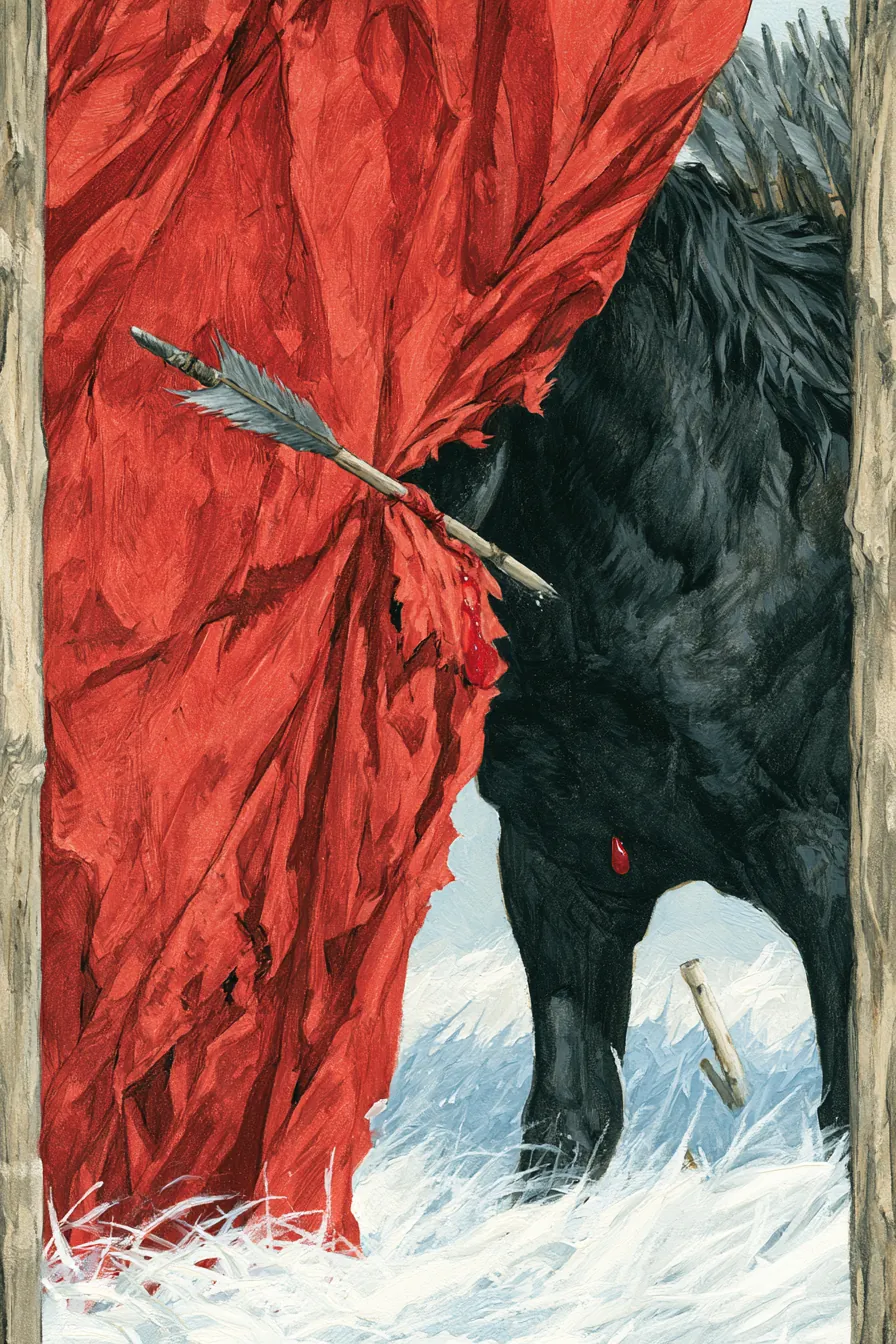
Chapter Thirty-One
The Orange-Peel Man
The Cinnabar Bureau wagon came up at the second hour past noon on the twenty-fourth day.
It came along the south of the white grass under the lee of the higher plateau — black canvas at the cap, cinnabar curtains drawn at the sides, eight horses on the wagon-string moving at the unhurried pace of a wagon-master who had rolled south behind his master at the dawn-drum of the nineteenth and meant to arrive unwearied. The wagon-master himself rode the third horse of the string.
The orange-peel man rode the front horse.
He sat a black gelding of the Vermillion Guard the way a man sits a thing he has sat for eighteen years — three hundred and four wagon-strings, by the Bureau's own ledger, between the imperial capital and the Long Wall. He was a small neat man, narrow at the shoulder, with a face the colour and the texture of a winter orange-peel left to dry on a sill, which was the thing the squad had named him for at the muster long before any of us had heard him speak: not the cruelty in him, which we did not yet know, but the pitted dryness of the face, the look of a fruit that had given up all its water and kept only the rind. Behind him rode thirty-two of the Vermillion Guard, two abreast, sabers cased, the salt-iron quarrels standing up out of the saddle-bow quivers in their dull grey rows. Behind them, nine Bureau outriders of the Yan-Hua directorate, in the lacquered scale of the directorate, riding loose. Behind those, the seven of his own Lihuo — the cinnabar-and-black detachment that carried the lacquered box of teeth and had ridden at the rim of his tent for the whole eighteen years, and at the saddle-bow of each of the seven, folded and pegged, the pale green knotwork of a jade net.
Forty-eight, all told, around the Bureau wagon. They came on at the unhurried walk of men who do not believe they are riding to a fight, and the wagon's eight-horse string set the pace of the whole column, and the cinnabar curtains did not so much as stir, and the only sound that carried the half li to our ridge was the wet creak of forty-eight saddles and the small dry hiss of the runners over the frozen grass.
We were six, in the lee of a small ridge to the north, half a li off their line. The mother and the daughter, the boy and the prince and the old falconer, the two wolves and the bird. Between them the wolves carried five salt-iron quarrels in their bodies. Belegt-Khan stood three paces off my right boot and had not eaten; he had taken a little mare's-milk from Berke's hand in the small hours of the night and nothing since. The second wolf, at my mother's right, had drunk the same and no more.
My mother sat the bay mare with one hand at the back of its neck and the other closed around the small lacquered tube on the thong at her throat. She did not speak. She watched the wagon come. I had learned, in the eleven days since the wagon on the salt-fork, to read the small weather of her too, and what was in her face as the black canvas came up under the higher plateau was not fear and not hatred but a kind of grim recognition — the look of a woman seeing, at last and in the flesh, the shape of the thing that had cost her nineteen years. The orange-peel man on the front horse was the engine of the writ that had taken her son's life in a wagon and her husband's under a brown cloth and would have taken hers at the Changlin fire, and she watched him come on at the unhurried walk of a man who believed himself safe, and her hand tightened once on the lacquered tube at her throat and did not tighten again, and she said nothing, and I understood that she had decided long ago, somewhere on the road south, exactly how much of her face she would let this man have, and the answer was none of it.
Toghrul, on the chestnut at my right, said low, in the steppe-tongue, "Berke. The bird's eye."
Berke answered from the falcon's sight. "My prince. Forty-eight. Thirty-two Guard with salt-iron at the saddle-bow. Nine outriders, sabers at the right hip. Seven Lihuo — long-knives at the hip, and jade nets at the saddle-bow."
"The jade nets," Toghrul said.
"Yes, my prince."
He was quiet a moment, doing the arithmetic men do before they say a hard thing. Then: "Daughter."
"Toghrul."
"Arsulan. The jade nets are the inquisitor's Lihuo tool, woven by the dragon-blood priests. They cut the bond at the breastbone. For as long as the net holds you, the wolf cannot fight, the anda cannot see through the bird, the bird cannot keep the air. The net of a true seventh-year dragon-blood holds three breaths."
"Three breaths," I said. "Then the bond comes back in three."
"In three breaths the inquisitor has the wolves netted, the salt-iron at your throat, and the fire lit. Three breaths is the whole of it, daughter."
I looked at the line of them, and the arithmetic in me ran differently than it did in him. "Toghrul. The dragon-blood has been two centuries diluting. These seven are not seventh-year. Look at their nets — that weave is seventeenth-year work, the thin late craft. What does a seventeenth-year net hold?"
He let out a slow breath. He had hoped I would not get there. "Daughter. A seventeenth-year net holds one breath."
"One breath."
"One breath, daughter. And at one breath you cannot ride, your wolf cannot run, and your mother and your brother and your prince and your falconer cannot, against forty-eight, hold the ground long enough for the bond to come back."
So there it was. I made myself breathe slow and even, and I let the cold settle the thing in me that wanted to argue with it. "Then I don't take the count against all forty-eight. I take it against one."
He went still.
"The inquisitor came to me, Toghrul. He has been counting animals for thirty-three days at the lee of the Iron Gates, and he brought forty-eight men two days north because at forty-eight he is safe and at one he is not. He has a box of one hundred and forty-three teeth and a twelve-year-old's letter folded in the corner of it, and somewhere in his sleeve he has whatever he means to do with my name. He did not come to fight us. He came to be sure of us. That is his weakness. He has made himself a count of forty-eight so that he need never be a count of one." I looked at the front horse. "He is a count of one."
He breathed out again, and this time it had give in it. "Arsulan."
"I will ride alone."
He looked at me a long moment — and then he did the thing only Toghrul did, the steppe-thing, the held thing, where a man takes a refusal and a fear and a love all into the same place behind his ribs and waits there with them until they have stopped fighting each other and come to a single weight he can lift. I watched it cross his face and leave it. And when it had gone he had stopped being the prince who would talk me out of it and become the anda who would hold the line behind me.
"Then hear how it goes," he said. "I hold the bond through the bird's eye. Berke holds it at the spare horses and the second falcon at the willow on the second creek. Your mother holds it through the second wolf at the bay mare's lee. Your brother" — Belegt, three paces off my boot — "holds it at the breastbone, in the kitchen-tongue of Qiaojia. And you, daughter of Möngke-Mara of the Black Banner, ride out alone to half a li off the front horse."
"Yes."
"And the wolf at your boot, with the two quarrels in his shoulder, rides with you. The bond carries him. He keeps the angle on the inquisitor while you ride in."
"Toghrul. The wolf is hurt."
"The wolf rides with you," he said, and there was no moving him. "He would not let you go without him, and you know it."
I knew it. "And the net," I said. "If they net me on the way in—"
"They cannot. The nets are at the saddle-bows of seven men nine paces deep behind him. A net thrown nine paces is no net at one breath. The nets are for the chase, daughter — for the bound anda led to his table after. His first tool is the salt-iron at the saddle-bows of the thirty-two Guard, three paces behind him. The second is the net. Both wait behind the front horse. The front horse is alone in front of his own line." He looked at me. "Three paces of salt-iron behind him, daughter. That is one breath, if it comes to it."
"Then I ride. The wolf rides. The bird holds my eye for one breath. And at one breath, the inquisitor—"
"At one breath, daughter," he said. "At one."
I turned the chestnut and came up alongside the bay mare in the lee of the ridge. I drew my breath even. "Mama," I said, in the kitchen-tongue of Qiaojia.
"Daughter."
"I am going to ride to the orange-peel man."
She let go a breath she had been keeping. "Yulan," she said — and then, "Arsulan. Daughter of Möngke-Mara." As if she needed to say both names of me before she could say the rest.
"Mama."
She looked into the bay mare's mane and not at me. "Daughter. The orange-peel man carries a small lacquered post-tube inside his under-sleeve, over his heart — the memorial he means to send the throne. He has not sent it. It holds, in the corner of the third sheet, your name." She paused. "That post-tube, over his heart, sits exactly where a salt-iron tip broke against the parapet at the South Fork — the place a quarrel breaks clean."
I set my teeth and said nothing.
"When you come up," she said, "he will set his right hand over his heart, the way an inquisitor does who has made that gesture eighteen years. He will lift the post-tube from the sleeve to show it to you. And in the lifting he will open the place over his heart — the very place his own hand has guarded for eighteen years. He will uncover it himself, daughter, to make his small triumph. That is when the place is yours."
She was quiet. Then: "Mama. The bow."
"At your back. Old Crow's steppe-bow, from the willow on the third creek. Half a li is nothing to it."
"The arrow."
"In the quiver. The grey-fletched one Berke set there, sinew off the willow whipped to the string." She turned the lacquered tube once at her throat. "At his gesture, daughter. Not before."
"At his gesture," I said.
"At his gesture."
I rode.
I rode out alone at the slow pace of a thing that means to be seen coming — across the white grass under the higher plateau, half a li of frozen ground between the ridge and the front horse of the wagon-string. Lamellar at my shoulder, under-shirt at my throat, Möngke-Dam's wool deel beneath at my right side; the steppe-bow at my back, the grey-fletched arrow in the quiver, the steppe-boots my own. Belegt loped three paces off my right boot, the two quarrels riding in his shoulder, his breath coming short and careful, and at every fourth stride the bright wire of his shoulder crossed mine and I let it cross and did not slow.
Half a li is a long way to ride at a man you mean to kill, when you have decided he will probably kill you back. I had time, on that frozen ground, to be afraid, and I let myself be afraid, because I had learned at the muster that the fear is not the enemy — the fear is the body counting the cost honestly, and a soldier who cannot hear her body count the cost is a soldier who gets her squad killed. So I rode and I was afraid and under the fear I kept the one thing the fear could not argue with, which was the corner of the third sheet with my mother's name on it, riding south in a dead man's sleeve unless I rode it down first. The white grass went under the chestnut's hooves stiff with rime, breaking with a sound like a slow fire. The Bureau column held its line and watched me come, forty-eight men turning their heads in a long slow ripple, and not one of them moved to meet me, because their master had not told them to, and a column that has spent eighteen years doing only what the orange-peel man tells it does not know how to do the thing he has not told it. That was the count of one I had ridden out to find. Far off to the south-east, two li up, Khaghan-bürkii held the air and gave Toghrul my eye, and through Toghrul, faintly, gave it back to me, so that I rode toward the orange-peel man and at the same time looked down on my own small dark shape crossing the white grass from a great cold height, and the two views did not fight; they steadied each other.
I came up on the front horse and stopped nine paces short of the black gelding.
The orange-peel man did not move. He let the moment hang, the way he must have let a hundred and forty-three of them hang, and he looked at me with the small clean smile of a man who has hunted a thing for thirty-three days and found it walking up to his stirrup of its own accord.
"Wolf-girl," he said, in the carrying voice of the Bureau. And again — "Wolf-girl. Qiao Arsulan, alias Yulan, true-name in the heretic tongue Arsulan. Daughter of Lu of Qiaojia, daughter of Möngke-Mara of the Black Banner clan, granddaughter of Möngke-Dam of the bogdo-shamans at the bend of the Onon-Selga." He had the whole pedigree by heart; he had earned it the way he earned everything, by counting. "Wolf-girl. You have come to me."
I said nothing.
"You have come," he said again, pleased, "and so it ends well, and quickly. Hear me. Over my heart, inside my sleeve, I carry my memorial to the throne. In the corner of the third sheet is your name. When I lift it and set my seal, the memorial passes to my post-rider, and your name rides south. By the third dawn it is at Changlin, and on the third day the herald lights the fire at the execution-ground under Article Nineteen of the Yellow Scrolls." The smile did not change. "You will surrender. Now."
I said nothing. I did not surrender. I sat the chestnut nine paces off with my hands quiet on the rein and the bow at my back and I let him have the silence, because the silence was the last gift his own habit would give me. A man who counts needs the other party to do the next thing in the count — to plead, to bargain, to break — and when I gave him nothing he did the only thing left to a man who has run out of other men to count: he reached for his proof. He reached to show me the thing that proved he had won. That is the disease of a man who has made himself a count of forty-eight so he need never be a count of one; even at the end he cannot simply act. He must be witnessed acting. He must lift the tube and let me see the seal and the corner and my name, must make me watch my own undoing, because the watching is the count and the count is the whole of him.
And he drew his breath even, and he set his right hand to his under-sleeve in the gesture eighteen years had made automatic in him, and he laid the back of that hand over his heart, and he lifted — drew the post-tube out into the cold air and held it up at the small open angle of a man showing a child the thing that will undo it.
He opened the place over his heart himself.
I drew. I drew the bow Old Crow gave me at the willow on the third creek, the way my father had taught my hands in two winters of the orchard at Qiaojia. I loosed.
The grey-fletched arrow took him over the heart — through the lifted post-tube, through the under-sleeve, through the cinnabar silk of the Master of the Cinnabar Bureau, into the place his own raised hand had just uncovered for me.
He did not speak. He did not cry out. He looked at me with the same small clean eye that had looked on a hundred and forty-three bonded subjects at the Changlin fire — the eye of the man who counts — and for the first time in eighteen years it was his own count being read back to him. One hundred and forty-four. Himself, the last of the tally.
His right hand stayed over his heart, where it had always been. He did not move it. He breathed, once, shallow, around the shaft. Then he went off the black gelding into the snow at the edge of the white grass, and he did not get up.
The thirty-two Guard, three paces behind, did not move. The nine outriders at the flank did not move. The seven Lihuo, nine paces back with their useless nets, did not move. Forty-eight men, and not one of them spoke, because their count was lying in the snow and they had no other.
I had ridden out to kill one man and die for it. I want to be honest about the inside of that, the way I will be honest about the morning after at the lee of the snow: I had not expected to be alive at the end of the loose. I had spent the half-li ride making peace with the not-being-alive, the way you make peace with a cold you cannot get warm out of, and now the loose was made and the man was down and I was still on the chestnut with my breath going in and out and forty-eight men in front of me who had every reason and every means to finish the thing the orange-peel man's own hand had only half-finished — and they did not. And I sat in that not-finishing and felt the strangest thing, which was not relief and not triumph but a kind of vertigo, the lurch of a foot that has come down expecting a stair that is not there. I had built my whole ride on the arithmetic of my own death, and the arithmetic had been wrong, and there is no harder thing to stand in than the place past where you thought your life ended. My mother had stood in it for nineteen years. I had it for a single morning on the white grass, and it was almost more than I could carry.
I drew my breath even and held it, and the bird kept my eye, and the bond did not break.