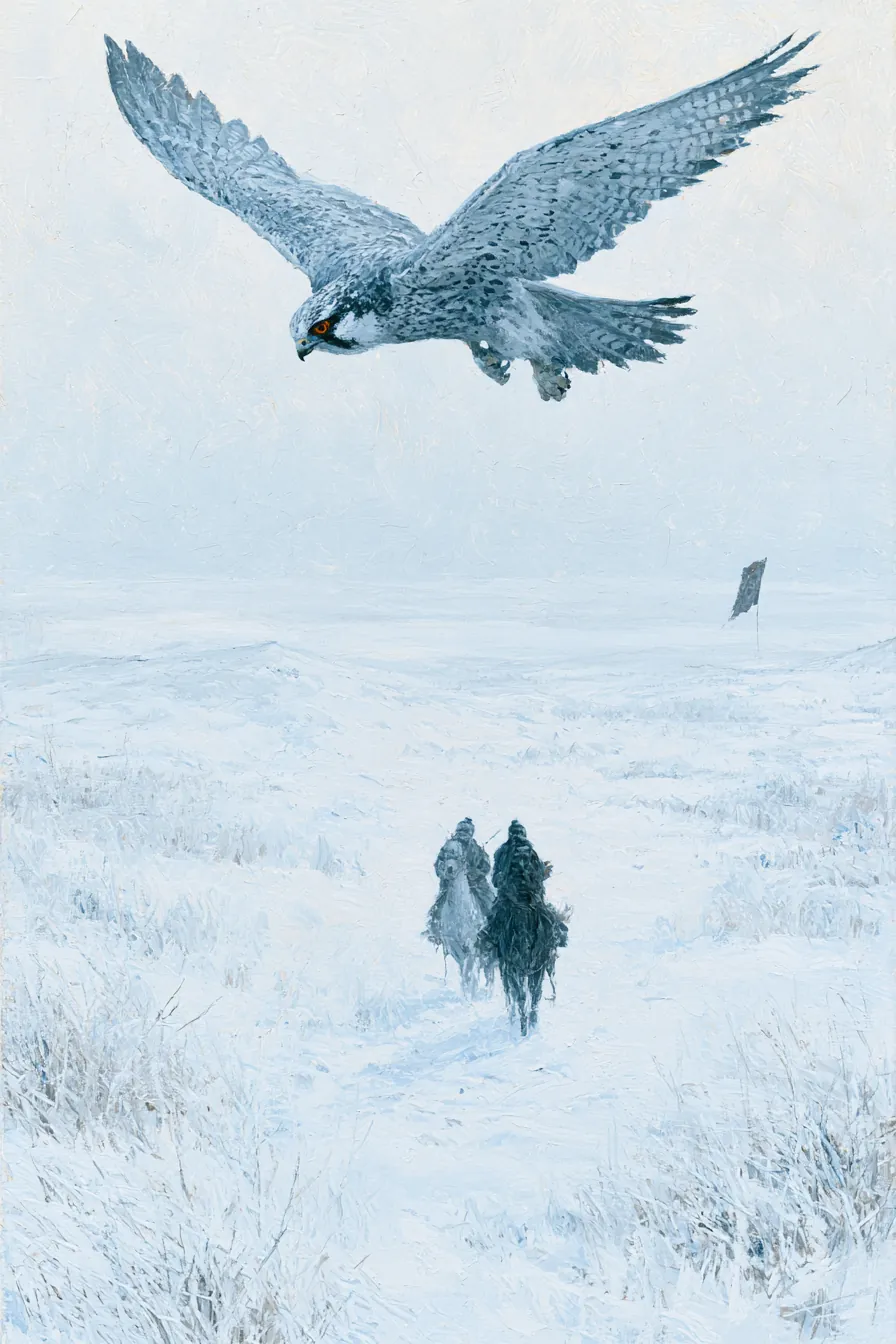
Chapter Thirty-Two
The Snow at the Lee
The orange-peel man lay in the snow at the edge of the white grass and did not move, and the forty-seven men who had ridden north to be sure of me did not speak.
I sat the chestnut nine paces off and waited to die. I want to be honest about that, because the songs the Black Banner would later make of this morning do not say it: I had loosed one arrow at one man, and behind that man stood forty-seven more, and by every reckoning I had carried into the ride, the next thing that happened was that the forty-seven killed me, or netted me, or took me south to the fire. I had ridden out knowing it. I had decided that the inquisitor's death was worth my own, because a man who counts in fours does not stop at one hundred forty-three, and because my mother's name was in his sleeve, and a daughter does not let her mother's name ride south if she can put an arrow through it first. So I sat the chestnut and held the wolf still at my boot and waited for the forty-seven to be forty-seven.
They did not move.
I will tell you what forty-seven men look like when their count has just died in the snow in front of them. They look like a thing that has had its centre taken out. The wagon-string's eight horses shifted and were stilled by a wagon-master who did not know he had reached for the reins. The nine outriders at the flank sat their mounts and looked at one another and away again. The seven Lihuo, nine paces back with the jade nets they had not had a breath's warning to unpeg, held still in the particular stillness of trained men who have just understood that their training was for a different morning than this one. And the snow went on falling in the small dry flakes of the higher plateau, the kind that does not melt where it lands but sits, so that already there was a thin grey skin of it on the dead man's shoulder and across the back of the hand he had laid over his heart, and no one brushed it off.
The thirty-two Vermillion Guard sat their horses three paces behind the black gelding's empty saddle. Their wedge-captain was a man of forty-six in the cinnabar-edged lamellar of a senior Guard — twenty-eight years in the Guard, three of them under the orange-peel man — with the deep weather-scored face of a man who had spent those years in the wind at the edge of other men's fires. He looked at the snow where his master lay. He looked at the broken post-tube glinting at the inside of the dead man's sleeve. He looked at me, nine paces off on the chestnut, the steppe-bow at my back and the wolf at my boot. I watched him look, and I watched the look go through him the long way — past the dead inquisitor, past the broken seal, all the way back through twenty-eight years to whatever it was a senior Guard kept at the bottom of himself under all the writs he had carried — and I held my own breath very still and did not reach for the bow, because I understood, in the watching, that the next thing was not mine to decide. It was his. And he took a long breath and let it go, the way a man does when he is about to step off a road he has walked twenty-eight years.
"Wolf-girl," he said, in the carrying voice of a senior Guard. And again: "Wolf-girl. The inquisitor is down. The post-tube is broken."
I said nothing.
"The memorial to the throne — the one with your name in the corner of the third sheet, the one that was to pass to the post-rider and ride south and put you on the Changlin fire by the third dawn — that memorial is in the snow. Your arrow took the seal with the tube. The seal is broken."
I found, when I went to answer him, that the voice that came up was the flat administrative voice of a soldier of the Tenth Legion — the no-one voice I had built in the dark of a lambing-felt, the voice I had used on a Bureau secretary and at three passing-outs before the Marshal. It came up unbidden, and I let it, because it was the voice this man would hear and trust; a senior wedge-captain of twenty-eight years reads the flat voice the way a wolf reads another wolf's easy gait, and answers it in kind. I had thought, riding north, that I would put that voice down with the lamellar and the binding-cloth and the name Yansheng, that it belonged to the disguise and the disguise was over. I understood, hearing it come up to meet a wedge-captain across nine paces of snow, that it was not the disguise. It was a tool I had forged inside the disguise, and it was mine now, and I would use it again — at a Marshal's cinnabar curtains, the Khan would tell me, in nine days' time.
"Captain," I said.
"Wolf-girl."
"The seal is broken. The name in the corner is no longer at the imperial step."
He was quiet a moment, and steadied himself. "Yes, wolf-girl."
"Pick up the memorial," I said.
He swung down off his horse. The dismounting of an armoured man is a slow and graceless thing, and he did it slowly and gracelessly, the lamellar clashing once at his hip, and he crossed to where the inquisitor lay over the unbroken snow and knelt at one pace, his knee going down into the white with a small crunch, and he was careful — I saw him be careful — not to kneel on the dead man's spread cinnabar robe. He drew the broken post-tube from the dead man's sleeve, working it free past the arrow-shaft with two fingers, not disturbing the hand over the heart. The third sheet was inside it, with a clean hole through the corner where the inquisitor's cinnabar seal had been — half a day old, that seal, and broken now by a willow-sinew arrow off the third creek. He drew the sheet out and stood, the snow falling off his knee, and held it up so I could see it across the nine paces, his arm steady, the wind taking one corner of the sheet and worrying it.
"Wolf-girl. The memorial holds your name, in the corner — where the seal was. The inquisitor set it there himself. It is the name the herald lights the fire on, by his writ." He folded the sheet once, slowly. "I have stood at the lee of one hundred and forty-three of his fires, in three years. The fire is dragon-blood work, the seventh-year craft of the temple priests, and they have been pouring it one hundred and forty-three times across eighteen years. One hundred and forty-three. I have stood at the lee of every one."
He looked at the folded sheet, and then at me.
"My service to the Vermillion Guard is to the Emperor's herald," he said. "This man in the snow is not the Emperor's herald. This memorial is not the Emperor's writ. The inquisitor has written the throne in his own hand, under his own seal, in his own cinnabar wax, for three years of the Tianxuan reign, and called it the imperial step. But the imperial step is at Changlin, three thousand li south." His mouth thinned. "And the Emperor at Changlin has dreamed beneath the Black Dragon for seven years and not once woken. The Court Astrologer attends his dream and writes it down. The Emperor does not hold the writ. The inquisitor held the writ — and the inquisitor is in the snow, and the writ is broken at the seal of his own right hand over his own heart."
He set the third sheet down in the snow at the inquisitor's side. He set the broken post-tube beside it. He laid the back of his hand over his own heart, and bowed from where he stood. I understood, watching him set the sheet down rather than burn it or pocket it or carry it south to a new master, that he was leaving it exactly where the truth of it could be read by anyone who came after — the inquisitor's own seal, the inquisitor's own corner, the inquisitor's own name made into the hundred-and-forty-fourth of his tally — and that the setting-down was itself the verdict. He was not destroying the writ. He was refusing to carry it, and leaving it in the snow to say what it said, which was that one ambitious man had written the throne in his own wax and called it the empire, and that the men of the empire had walked away from it the morning the man was dead.
"Wolf-girl. The Vermillion Guard, this day, on this grass, under the Cinnabar Bureau's broken writ — holds no writ at all."
I did not move.
"The Guard will ride south," he went on. "The nine outriders of the directorate will ride with us. The seven Lihuo, with their late-craft nets that hold a bond one breath and no more, will ride with us. And the wolf-girl, with her bow at her back and her wolf at her boot, will ride north." He raised his eyes to mine. "The wolf-girl will ride free."
He let that stand in the cold a moment. Then, in the smallest voice: "Go."
I held the silence between us — I owed him that much, to weigh what he had given me before I took it — and then I answered. I thought, in the holding, of what it had cost him to say it. Twenty-eight years a man builds himself into a thing, the way a tree builds itself around the stake it was tied to as a sapling, and the Guard had been this man's stake; he had grown around it until the writ and the man were the same wood. And he had just, in front of thirty-one men of his own wedge and nine of the directorate and seven of the dead inquisitor's own Lihuo, named the writ a dead man's vanity and set it in the snow — and there is no way back from a thing said like that in open air. He had stepped off his road as surely as I had stepped off mine when I drew the bow. We were two people standing in the place past where our old lives ended, nine paces apart on the white grass, and I owed it to the both of us not to take what he had given lightly.
"Captain. You have set the writ down in the snow. You have named me."
"Yes, wolf-girl."
"Then I am named. Named in open air, on this grass, by a senior wedge-captain of the Vermillion Guard who has set down the inquisitor's writ — and so I am no longer a wolf-girl of any imperial writ at all." I set my teeth and gave him the rest, because he had earned the whole of it. "Qiao Arsulan. Daughter of Möngke-Mara of the Black Banner clan. Granddaughter of Möngke-Dam of the bogdo-shamans at the bend of the Onon-Selga. Bonded to the white wolf Belegt-Khan, at the third syllable of I will not hide what I am from you, on the blue snow at the bottom of the sloped white plain, at the third watch of the fifteenth night. Anda of Toghrul Bekei of the Black Banner, sworn in open air at the felt of the ger in the lee of the long grey ridge, on the first day past the breakout."
He bowed again from the saddle he had not yet remounted.
"Lady Qiao," he said. And again, lower: "Lady Qiao. The senior wedge-captain bows. May the road carry you north."
"Captain," I said. "May the road carry you south."
He stood, and put his foot to the stirrup, and the mounting was as slow as the dismounting had been, and when he was up he gathered the reins and laid the back of his hand over his heart in the old open gesture — the Emperor's herald to a free woman — and turned the black gelding. The turning of him turned the whole column. The thirty-two Guard came round behind him in their two-abreast file, and the nine outriders fell in, and the seven Lihuo with their useless nets, and the wagon-string's eight horses leaned into the traces and the wagon came about with a long groan of its frozen runners, and he rode south. None of them looked back. The Bureau wagon-master fell in behind, head down, nineteen years on the wagon-string and not one of them his to spend, and the cinnabar curtains of the empty wagon swung once and were still, and the column drew out into a thin dark line on the white grass and dwindled, and the orange-peel man lay where he had fallen with his hand over his heart and the snow coming down on him, and he grew small behind them, and smaller, until the dwindling line and the falling snow had between them taken him out of the morning.
I sat the chestnut and watched forty-seven men ride away from a thing they could have done and chose not to, and I learned, in the watching, the lesson that Bald Wei had been trying to teach me at the squad-fire without ever once saying it plain: that an empire is not held up by its writ. It is held up by the men who agree to carry the writ, and the writ has no power the morning those men decide it is not the Emperor's writ but one ambitious man's, and the ambitious man is dead in the snow with his own hand over his own heart. I thought of Wei at the squad-fire, the tin cup he held through the whole of the herald's standing, the way he had told me a thing by taking the morning air at the fire and saying he was telling me nothing. I had taken him, then, for a careful man minding his own neck. I understood now that he had been showing me the seam in the thing — that every order ran through a man, and every man kept his own count under the order, and that the empire was a great machine of orders that worked only so long as no one looked too hard at the men running through its gears. The orange-peel man had looked at men his whole life and seen only the count. He had never once seen that the count looked back. The orange-peel man had spent eighteen years making himself a count of forty-eight so that he need never be a count of one. He had not understood that the forty-eight were men, and that men keep their own counts, and that a senior wedge-captain of twenty-eight years had been keeping a count of one hundred forty-three fires at the lee of which he had been made to stand, and that a count like that comes due.
What was left in the snow was the broken post-tube, and the third sheet — Qiao Arsulan, alias Yulan, true-name in the heretic tongue Arsulan, in the corner where the seal had been — and the orange-peel man himself, his right hand still laid over his heart in the open gesture, where it had always been and would stay now three days and three nights, until the snow of the second day drifted over his boots and the snow of the third day took his hands and the snow of the fourth closed over him and he was not found.
The post-tube and the sheet would be found, though — by Berke, riding the line at the pace of an old falconer, who would tuck them into the inside of his wineskin against the lacquered tube at my mother's throat, and carry them two days east, and at the willow on the second creek hand the third sheet to the second of the Khan's falcons, who would lift on the wind and carry the name seven li east to the willow on the third creek, where the Khan's own bürkii would take it and carry it on to the ordu at the bend of the Onon-Selga.
The Khan of the Black Banner would receive it at the dawn-drum of the twenty-ninth morning, in the felt at the right side of his pavilion. He would read the third sheet. He would read the name. He would lay his hand over his heart and say, into the felt, "My son. You have come back." And he would not say the wolf-girl's name aloud — he would hold it behind his teeth, in the kitchen-tongue of the ordu, the way a father holds a thing he is not yet allowed to be glad of, and keep it there until the daughter of Möngke-Mara and the son of the Khan rode up to the felt at the centre of his camp with their own mouths to say it. Nine days east of this grass. Nine days from now.
But that was nine days off, and the forty-seven were already three li south, riding slow.
I turned the chestnut and rode back to the lee of the ridge. The white grass came up under the hooves at the slow walk of a horse whose rider has nowhere left to hurry to, and I crossed the half-li the other way, away from the dwindling column, toward the five who had held the ground behind me while I rode out to die and had watched me come back instead. I do not know what my face did on that ride back. I had ridden out with it made into a wall and I had let the wall down somewhere over the orange-peel man's body and I had not gathered it up again, and so I came back to them with my face open, the way you come back from a thing you did not expect to come back from, and I watched their faces watch mine across the closing distance — my mother's first, who had said both my names before she could let me go, and who now sat the bay mare with one hand still at the lacquered tube at her throat and the other pressed flat to her own breastbone where the second wolf's bond ran; and Anshi's beside her, the boy gone still on the grey jenny; and Berke's, the old falconer reading me off the air the way he read everything; and Toghrul's last.
Toghrul, on the third horse, looked at me as I came up. He let the quiet sit, and then he said it, in the steppe-tongue: "Lady Qiao." And again — "Lady Qiao. Daughter of Möngke-Mara. Anda." He said it the way he had held my three sayings, without showing the strain — but I had ridden fifteen weeks at the heel of men learning to read the small weather of their faces, and I read his, and what was in it was a man who had stood at the lee of a ridge and watched his anda ride alone at forty-eight men and had not been able to do one thing about it but hold the bond and breathe, and who was only now, with me a pace off and whole, letting himself feel the full weight of the watching. He had carried his own iron that morning, of a kind no kam draws out.
"Toghrul," I said. "Son of Yesügen. Anda."
He drew his breath even. "East," he said.
"East," I said.