Chapter Thirty-Eight
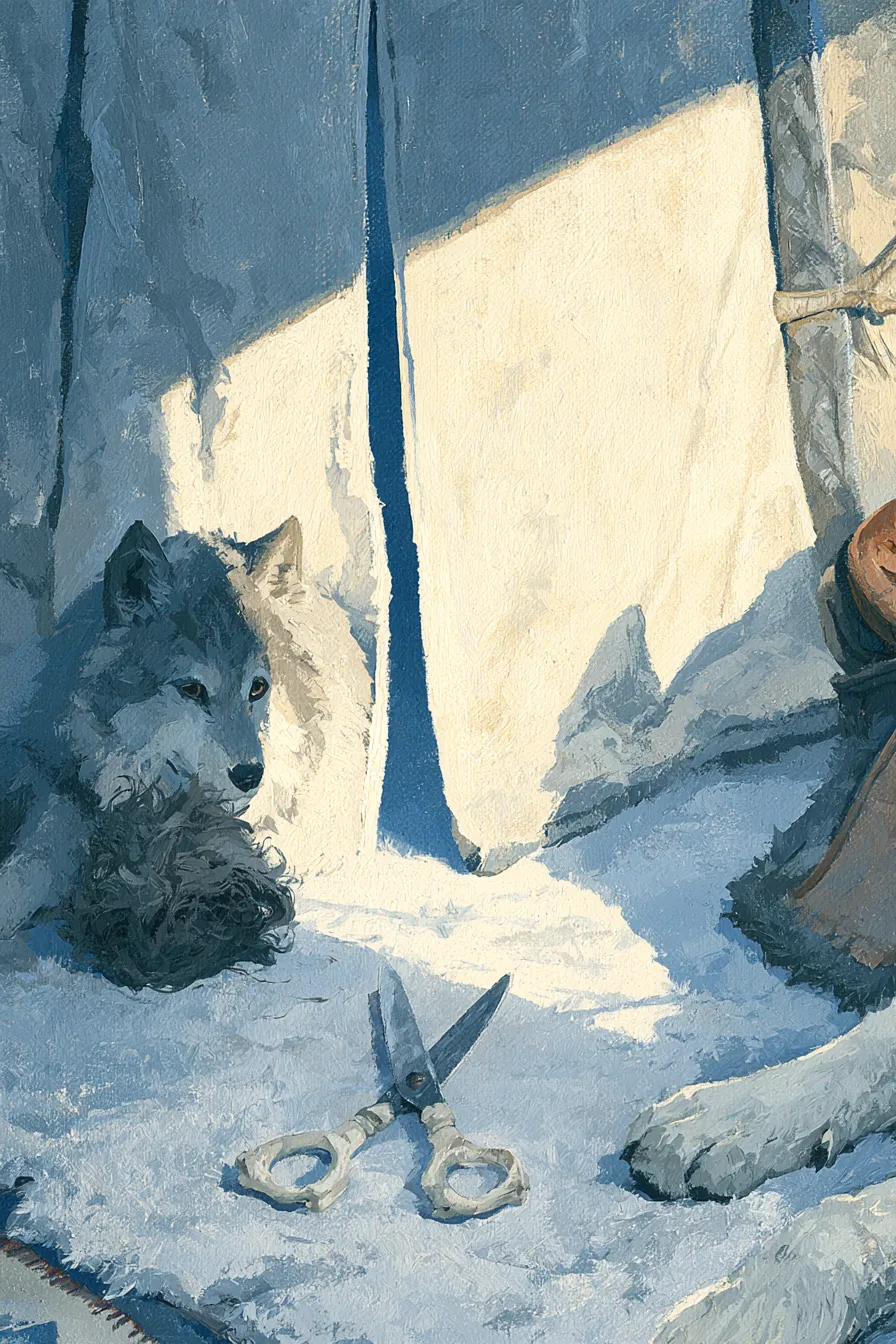
The Shears at the Threshold
The night before I rode out as my mother's daughter, my mother held the shears in two hands and made them close.
She had been a daughter of the Black Banner clan for thirty-one years, and the wife of a salt-foundry-man at the third creek for thirty, and the mother of three: one dead of the lung-fever in a Bureau wagon with the brown cloth at his hand; one asleep at the windward of the fire; and one kneeling now at her right side, a daughter who had ridden three thousand li north from the orchard at Qiaojia to the third ring of the ordu at the bend of the Onon-Selga.
In seven days at the ordu she had been all three of her names. On the twenty-ninth, at the door-flap of the Khan's pavilion, she had been Madam Lu of Qiaojia. On the night of the thirtieth, at the windward of the fire, she had been Möngke-Mara of the Black Banner. On the first morning of the twelfth month, at the drum of her second-sister Möngke-Tara, she had been a daughter of the bogdo-shaman lineage of Möngke-Dam, bonded in the third generation to the second wolf at her side.
She was, this second watch of the seventh night, all three of them — and she had the shears in her two hands.
The shears were the shears. Bone-handled, seven notches cut at the foot of the handle by the kam who had held the drum at the bonding of the Khan Boroldai, one for each naadam of his seventh year — the shears that had been carried south at the taking of my mother at the spring sowing of her fifteenth year, in the third year of the Wuding reign. On the first morning of the twelfth month Möngke-Tara had set them back into my mother's hand, a second-sister returning to a sister the shears of their grandmother's kam.
She had taken them. In seven days at the kurultai she had not used them — had set them to the back of no braid of any anda of any clan.
She held them now, in two hands, kneeling at the felt at the lee of the door-flap. I knelt a pace from her, in the wool-felt deel of Möngke-Dam with the wolf-skin trim at the collar — the deel my grandmother had pressed into my palm at the entry of the throat, the deel of the bear that lay now in the snow at the lee of the second ridge. It was warm. The wolf-skin at the collar was the colour of the inside of a winter sky. I had worn it now eleven days, and it had stopped being a borrowed thing and become a thing of mine, the way the lamellar had become mine across fifteen weeks of the muster, the way a tool becomes the hand's before the hand has noticed. There was a place at the right side of it, low, where Möngke-Dam had worn it thin against the folding-stool across some number of years I would never know, and I had taken to resting my own hand there without meaning to, the way you press a sore tooth with your tongue, and I rested it there now, kneeling at the felt across the shears from my mother, and I thought of the old woman who had laughed at the southern cobbler's boots and said the bear would sneeze at the burning of them, and who had not lived to see the ger at the Iron Gates where the burning was to be. The bear had not lived either. They lay together in the snow at the second ridge, the kam and the animal that had carried in the bowl of her chest a thing larger than a prince's, and the deel she had given me was the warmest thing in the yurt, and I wore it, and that was the only kind of keeping I had to give her.
Belegt was at my ankles. The bird was at the rafter. The fire burned at the centre. At the windward, Anshi slept — the boy who had said to Berke at the noon-bell, in the kitchen-tongue, Old falconer, I'll hold the lee with the spare horses at the dawn-drum, and bowed, and been answered, Boy. The lee. He had taken to Berke the way a boy who has lost a father takes to an old man who lets him be useful, and Berke had taken to him the way an old falconer with no son takes to a boy who will hold a lee without being asked twice, and somewhere in the seven days at the ordu the two of them had made a small wordless country of their own out of spare horses and the windbreak watch, and I was glad of it; a boy needs a thing to hold, and Anshi had spent three thousand li with nothing to hold but our mother's hand and his own dread, and now he had the lee and the spare string, and he slept the sleep of a boy who has been given work he can do. And at the centre, on the chestnut-leather saddle at his head, Toghrul slept — the elder son of the Khan, the war-arrow at the third notch, riding for the Iron Gates at dawn. He had set his head down and not woken, his hand fallen open on the felt, the war-braid loose at the back of his head where no barber's shears would ever come again, and I looked at him a while across the fire and thought that I had bonded my life, on the blue snow, to a man I had only ever seen in chains, and that tomorrow I would ride beside the free version of him into a war, and that this was the strangest and best fortune I had been given: to have chosen a man at his lowest and get to keep him at the height of himself.
My mother held the shears, and looked at the backs of her own hands, and held them up at a pace between us, and she did not shake, and she did not say Are you certain, and she did not say my name. Not Yulan. Not Arsulan.
"Daughter," she said, in the steppe-tongue.
"Mother."
"The shears."
"Mother. The shears."
She breathed out. "Daughter. At the kitchen-floor, at the third saying of Are you certain, these shears could not close. Tonight, at the ordu, at the kurultai of the elder son's anda—" She stopped. "Daughter. Are you certain."
I said, in the smallest voice, "Mother."
"Daughter."
"The braid."
"Daughter. The braid is three thumbs' breadth grown out from the kitchen-floor, through seven months of the muster — grown to the anda-length, above the collar of the deel of Möngke-Dam. It is the braid of an anda of the Black Banner clan." She looked at me. "And so these shears, tonight, are not the shears for the cutting of the braid."
I breathed out. "Then what are they for, Mother?"
She was quiet a moment, and the fire breathed at the centre, and the wolf shifted at my ankles, and somewhere out at the windbreak Berke coughed his dry old man's cough and was still. She turned the bone-handle once in her two hands, and I watched her find the words, and I understood that she had been finding them for nineteen years, against a night she had not been sure would come.
She steadied. "They are the shears of an anda's mother to an anda, on the eve of the dawn-drum that takes her."
She set the shears at her right hand, and turned the bone-handle, and brought them up to her own iron-coloured hair — the hair of Madam Lu of Qiaojia, which was now the hair of Möngke-Mara of the Black Banner, the daughter of Möngke-Dam. The hair of an anda.
She held the shears at the angle, in two hands. She did not shake. She made them close.
The first cut was iron on iron, hair parting strand by strand like cordage. I had heard that sound once before in my life, on the kitchen-floor at Qiaojia the morning she had cut mine, and I had been on the other end of it then, the one being made into something, and I had not understood — kneeling with my own braid coming away into my own lap — that the woman behind the shears was cutting against the whole grain of herself to do it. I understood now, watching her turn the blades on her own head. The second cut was the same, and the third, and the fourth — and then the iron-coloured hair of Madam Lu lay across her own thighs on the wool deel of Möngke-Mara, like a sleeping snake the colour of iron, the hair of a woman who had worn it long and bound and southern for thirty years in a country that read a steppe-woman's cropped head as a confession. She combed the cropped ends out with her fingers, the gesture of a steady-handed woman of forty-six who had set a child's dislocated finger straight and bound a husband's broken ribs and laid out that same husband's body, in the end, for an empire that did not know it had killed one of its own. Her hand did not shake. I watched her hand and it did not shake, and I understood that this was the cut her hands had been able to make all along — not her daughter's, never her daughter's, but her own; that the morning at the kitchen-floor her hands had refused the braid of a daughter going out as a son, and tonight at the ordu they took, without a tremor, the hair of a mother who had finally come home enough to put down the disguise of the long southern braid.
She set the shears down on the felt at the lee of the door-flap, the bone-handle to her right, the blade to her left.
"Daughter," she said.
"Mother."
"The shears are at the ordu now. By the seventh notch of the bone-handle, by the kam who held the drum at Boroldai's bonding, they are the shears of a daughter of the Black Banner clan, on the eve of the eighth day." She kept the silence a moment. "Daughter. The shears." And she lifted them in two hands and gave them to me.
I took them in one hand, by the bone-handle, and held them — and I did not close them.
I steadied. "Mother."
"Daughter."
"The shears."
"Daughter."
I set them down on the felt at a pace from her, at the lee of the door-flap, and I did not close them.
"Mother," I said. "These shears, at the ordu, on the eve of the eighth day — the war-arrow at the third notch, the anda of the elder son — are the shears of the kam who held the drum at Boroldai's bonding. They are the shears of an anda's mother to an anda." I drew the breath even. "And I will not close them. At the ordu I have the anda-braid. At the dawn-drum I ride to the Iron Gates with it, and at the cinnabar curtains I will lay my hand over my heart in the gesture of a squad-archer of Squad Five at the third quarter of the lamp, and I will say, in the flat administrative voice, Marshal. The pass." I set my teeth. "The shears of an anda's mother to an anda, here at the lee of the door-flap — they are not at any closing."
She set her hand over her own heart, and bowed.
"Daughter. Good," she said. And then, in the kitchen-tongue of Qiaojia, in the smallest voice: "Yulan. Arsulan. Daughter. Good." She was quiet. "Daughter. Sleep."
"Mother."
"Daughter."
"Sleep with me."
She steadied, and said, in the smallest voice, "Yes."
She lay down on the felt at the lee of the door-flap. I lay down a pace from her, and the shears lay between us in the small space at the lee of the door-flap.
The shears held. They did not close. They did not open. The bone-handled shears of the kam who had held the drum at Boroldai's bonding held the space between an anda of nineteen years and four months and seventeen days and her mother of forty-six — and the seven days of the ordu.
I closed my eyes. I held Arsulan at the back of my throat, and Toghrul at the back of his, and Mama at the back of mine — and the shears at the lee of the door-flap, and the dawn-drum of the eighth day, and the Iron Gates pass, and the second-ever Marshal at the cinnabar curtains — and I held them all the length of the night, and I slept.
I dreamed of an orchard south of the Yellow River.
In the dream the wolf-shadow stood at the windward of the threshold-stone of the kitchen door at Qiaojia, where the wife of Old Yang had set a strip of mutton-fat every dawn-drum since the twenty-third day. In the dream the wolf-shadow was Belegt, and the wolf-shadow was the second wolf, and they were the same wolf. In the dream my mother stood at the threshold-stone with a soft piece of apple in her palm, and set it down at the doorstone in the old ritual of a mother who has been told her daughter is riding north, and did not look up, because she knew.
In the dream the kitchen door opened, and the wife of Old Yang stood at the threshold, and she said, in the kitchen-tongue, in the smallest voice: "Daughter. The wolf at the windward is the wolf at the windward. The strip at the doorstone is the strip at the doorstone. The shears at the kitchen are at the kitchen." And then: "The road home is the road home."
I held the dream a long while, and then I woke at the dawn-drum of the eighth day, with the shears on the felt a pace from me at the lee of the door-flap.
The shears held. They did not close. They did not open. They held.
I rose. I dressed in the wool deel of Möngke-Dam with the wolf-skin at the collar, and laced the lamellar at my shoulder, and set the steppe-bow at my back and the quiver of grey-fletched arrows at my side and the bamboo tube against my chest — the bear-tooth in it, and the folded piece of orchard-apple, and the brown-paper square Wei had signed at the dawn-drum of the fifteenth day — and pulled on the steppe-boots.
The bamboo tube had ridden against my chest for fifteen weeks of the muster and now eleven days past it, and it had begun, somewhere on the road north, to be less a thing I carried and more a part of the carrying itself — a small wooden reliquary of everyone who had put a thing in it for me to keep. The bear-tooth was Möngke-Dam, who had laughed at the boots and named me and stayed in the snow. The folded piece of orchard-apple was my father, who had set it on the platter the morning of the kitchen-floor and taught my hands the draw across two winters and gone grey under a brown cloth in a wagon and never once, in nineteen years, said the thing he must have known. The brown-paper square was Wei, who had signed stomach-flux, three days and walked toward twenty-eight strokes with his eyes open and called me daughter at the flap of his own tent at the third watch. Three of the dead in a tube the length of my hand, against my breastbone, over the wolf — and I set the tube against my chest the way you set a thing down that you have decided to carry the rest of your life, and I laced the lamellar over it, and I was dressed for the eighth day.
I did not take the shears. I left them on the felt at the lee of the door-flap, a pace from where my mother lay, by the bone-handle.
I went under the flap.
The dawn-drum of the eighth day broke grey at the lee of the bend of the Onon-Selga. The seven minghans were drawn up at the lee of the third ring. The bay mare stood at the door-flap. Belegt was three paces off my boot. Toghrul sat the chestnut at the mare's right. The bird worked the south-east.
My mother came out under the flap — in the deel of an anda's mother of the Black Banner, her cropped iron hair at the anda-length above the collar, the second wolf three paces off her side. Anshi was on the grey jenny at the mare's lee, Berke on the third horse beyond him.
"Daughter," she said, in the kitchen-tongue.
"Mama."
"The shears."
"Mother. The shears are on the felt at the lee of the door-flap, a pace from where you lay."
"Good," she said. And then: "Daughter. The shears at the lee of the door-flap, at the dawn-drum of the eighth day — they hold."
I drew the breath even. "They hold."
"They will hold," she said, "the eighth day, and every day after, and every year after that."
I set my teeth. "Yes."
"Daughter. The road."
"Mama."
"The road home is the road home."
I answered her in the steppe-tongue, in the smallest voice: "Mother. The road north is the road home."
She let the silence carry. She set her hand over her heart, and bowed. "Daughter. The road north."
I bowed. "Mother. The road north."
I mounted the bay mare. Toghrul, on the chestnut at my right, laid his hand over his heart.
"Arsulan," he said.
"Toghrul."
"The Iron Gates."
"The Iron Gates."
We rode — the bay mare and the chestnut and the grey jenny and the third horse and the seven minghans of the seven clans, the war-arrow at the third notch, Belegt three paces off my boot and the second wolf off my mother's side, Anshi at the lee, Berke beyond him, the bird three li up in the south-east, in the grey light of the dawn-drum at the bend of the Onon-Selga.
I did not look back.
If I had looked back, I would have seen the shears on the felt at the lee of the door-flap, where my mother had set them down.
The shears held. They did not close. They did not open. They held — in two hands that were no longer holding them — the whole weight of an anda of the Black Banner clan, and a squad-archer of Squad Five, and a mother south of the Yellow River, and the kam who held the drum at the bonding of the Khan Boroldai.
I rode north. I rode with both hands on the reins. I rode at the pace of an anda of nineteen years and four months and seventeen days — white-wolf-bonded, anda of the elder son of the Khan, daughter of Möngke-Mara and of Qiao Yansheng of Qiaojia.
I rode north with both hands on the reins.
I rode north with both hands open.