Chapter Thirty-Seven
The Kurultai of the Seventh Day
The kurultai gathered at the third hour of the afternoon of the seventh day of the twelfth month.
Seven thousand of the minghans of the Black Banner stood at the lee of the central pavilion at the ordu at the bend of the Onon-Selga — the minghaghans at the inner ring, the jaghutus at the second, the arbatus at the third, and the seven thousand beyond in a long arc that ran from the third bend of the river to the lip of the white grass at the third ridge east. I had stood in formations my whole short soldier's life — the squad of seven at the fire, the company at the morning drill, the three thousand of the Tenth at the Yulin muster — and I had thought I knew what it was to be a small thing inside a large arrangement of bodies. I had not. Seven thousand of the Black Banner standing silent on the frozen grass is not a formation. It is a weather. The breath of them went up off the arc in a low haze that hung over the rings like the mist over the river, and the cold held it there, and the only sound in the whole of it was the wind taking the nine tails of the standard out straight and the small constant shift and stamp of seven thousand pairs of boots on ground too cold to stand still on, a sound like a far sea, and under it nothing — no voice, no bell, the smiths' fires banked, the colts taken off to the far lines so they would not call into the silence. They had come to hear a war-arrow named. They held the silence the way you hold a full vessel you do not want to spill, and I stood at the inner ring a pace from the elder son of the Khan and felt the weather of them on the back of my neck and made myself breathe slow and even and not be afraid of seven thousand people who had decided, this afternoon, to be mine.
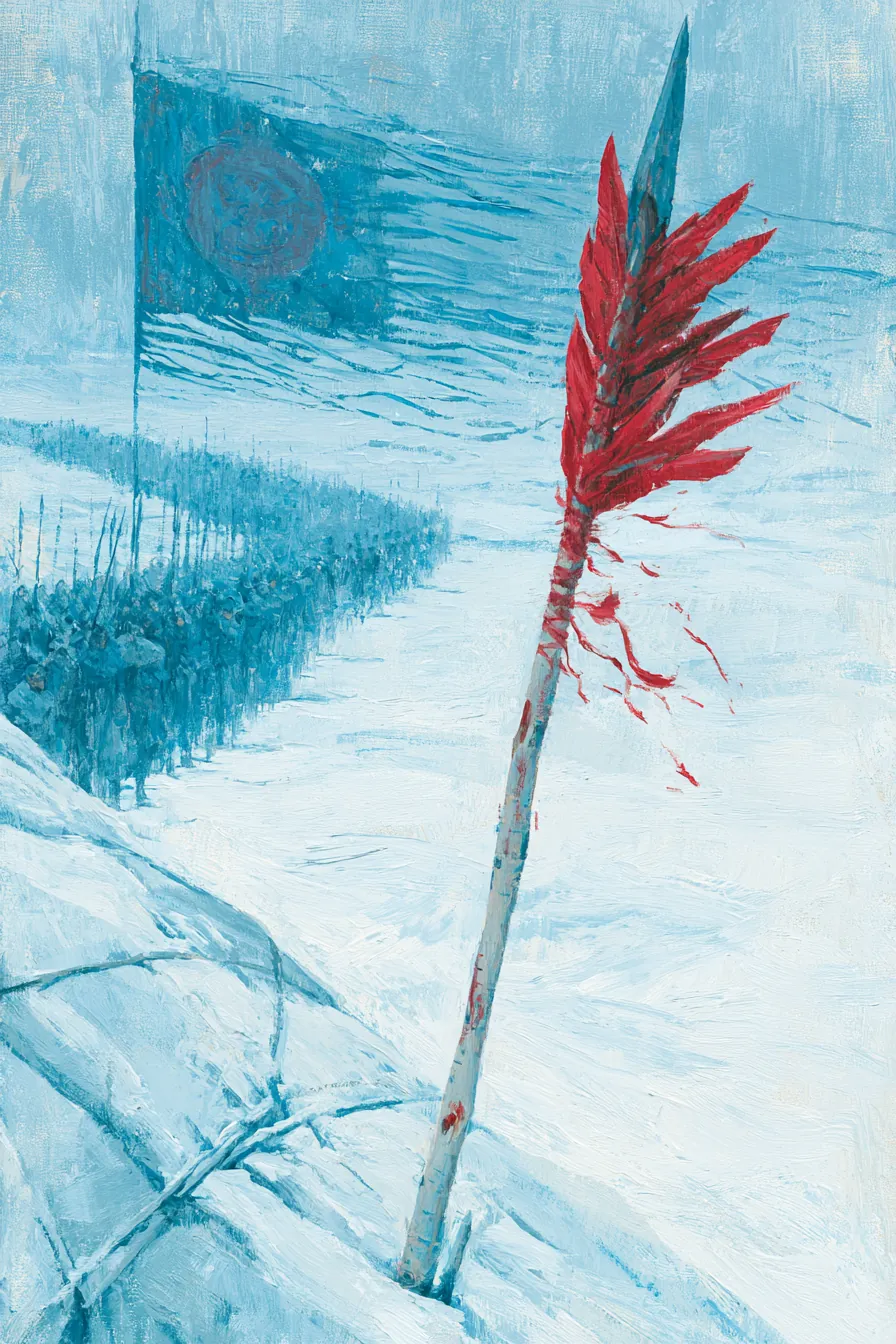
The Khan stood at the door-flap of the central pavilion — wool deel with sable trim, wolf-skin malgai, saber at the hip, the eagle-feather rank of nine bogdo-tails at his crown, the eagle Boroldai hooded at his right shoulder. The war-arrow was at his right hand: a birch shaft fletched with the seven red feathers of the seven clans, three notches cut at the nock, the third notch lacquered red.
He let the seven thousand settle, and then he spoke, in the carrying voice of the Khan of the Black Banner:
"Black Banner. The Iron Gates. The war-arrow."
The seven thousand did not move.
"Black Banner. The Iron Gates. The war-arrow," he said again. And a third time: "Black Banner. The third notch."
He set the war-arrow at the post of the central pavilion, at the third notch, and it held there, and the seven thousand were silent.
"Black Banner," he said. "By the third sheet of the inquisitor's broken seal, read at my hand at the dawn-drum of the twenty-ninth, the empire of the Vermillion south of the Yellow River has set its writ on a daughter of the Black Banner — at the Iron Gates." He let it land. "The Black Banner does not give a daughter to the fire at Changlin." He breathed out. "Black Banner. The war-arrow."
The seven thousand raised the long greeting of the ordu to the war-arrow at the third notch, and it carried across the rings and hung in the cold.
"My son," the Khan said, and looked at Toghrul.
Toghrul, a pace from the door-flap, laid his hand over his heart and bowed. "My father."
"My son. The war-arrow."
"My father."
"For seven years of the kurultai I have set the war-arrow at this post at the second notch, at the lee of the Iron Gates — the notch of a Khan's long patience. At the third notch, on the seventh day, for a daughter of the Black Banner and a son of the Khan, the war-arrow is no longer at the second notch." He steadied. "My son. The war-arrow."
"My father."
"The war-arrow is at my right hand, and the war-arrow at my hand is the writ of the Khan of the Black Banner. And the writ at my hand," he said, lower, "is at the count of the lung-fever of this third year — and the lung-fever, my son, at the kurultai of the seventh day, is at the count of seven."
Toghrul breathed out. "My father."
"My son. This war-arrow, at the third notch, is the war-arrow of a father who has set it there in open air for his elder son." He kept the silence a moment, then took the arrow from the post — and I watched him do it, and I watched what it cost him. He was a man of sixty-three in his seventh year of lung-fever, and the reaching up to the post and the drawing-down of the shaft was the work of an old man's arm, slow, and his hand closed around the birch and held it a moment longer than the giving needed, the way a man holds a thing he is about to set down forever, and then he lifted it and held it out across the pace between them. The seven red feathers of the seven clans stood off the nock and the wind worked them. "Take it. The war-arrow of my right hand passes to the right hand of my son." And in the saying I heard the whole of what was under it: not only go take the pass, but I will not hold the banner again; the lung-fever has the count; the next war the Black Banner rides, it rides behind you — a father handing his son the thing that meant he was no longer the man who held it, in front of seven thousand who could read the handing the way I had learned to read everything now, and who held their silence and let the old Khan give his war away.
Toghrul let the moment hold — and then he stepped forward and took the war-arrow and held it in his right hand, and set his teeth, and turned to the seven thousand:
"Black Banner. The Iron Gates. The war-arrow," he said. And again: "Black Banner. The Iron Gates. The third notch." And a third time: "Black Banner. The war-arrow."
He set the war-arrow back at the post, at the third notch, and looked at his father, and bowed with his hand over his heart. "My father. The war-arrow, the Iron Gates, the kurultai of the seventh day — the elder son of the Khan takes the war-arrow." He drew a breath. "My father. The elder son takes the war-arrow with his anda at his right hand."
He turned, and laid the back of his hand over my own heart, and steadied himself, and spoke to the seven thousand:
"Black Banner. The anda of the elder son of the Khan, at the war-arrow of the third notch, on the seventh day—"
He paused — and I knew, in the pause, what was coming, because I had given him a thing at the felt of the ger the morning of the broken blizzard and told him I would not have it back until a debt was paid. I had said I love you three times into the small space between our mouths, and he had said he would hold the saying-back until my mother was free, and he had held it across the bridge and the watchtower and the inquisitor and the long ride east — held it the way he held everything, without showing the strain of the holding. I had watched him hold it. I had watched him hold it on the white grass with the orange-peel man's column three li south, and at the willow with the iron coming out of the wolves, and at his brother's door-flap with the saber-or-embrace balanced on its edge, and at the door of his father's pavilion; he had carried my three sayings the whole way north and never once set them down where it would have cost me anything to have them set down, and that — I understood now, with the weather of seven thousand on my neck — was the saying-back, had been the saying-back the whole time, the holding itself. A man tells you he loves you by what he is willing to carry of yours without dropping it. He was about to say it the other way too, the spoken way. He was about to set it down here, in front of seven thousand of his clan, at the war-arrow, where a thing set down cannot be taken back up — and there is no braver place to set such a thing down than that, because a thing said at a war-arrow before the whole clan is a thing you have made it impossible to unsay.
The next of it was the saying I had owed him: the saying I have heard.
He had heard.
"Black Banner," he said, "the anda of the elder son of the Khan, at the war-arrow of the third notch, on the seventh day, is Qiao Arsulan — daughter of Möngke-Mara of the Black Banner clan, granddaughter of Möngke-Dam of the bogdo-shamans at the bend of the Onon-Selga, great-granddaughter of the kam who held the drum at the bonding of the Khan Boroldai in the seventh year of his name; bonded to the white wolf Belegt-Khan at the third syllable of I will not hide what I am from you, on the blue snow at the bottom of the sloped white plain, at the third watch of the fifteenth night of the eleventh month; and anda of Toghrul Bekei of the Black Banner, sworn in open air at the felt of the ger in the lee of the long grey ridge, on the first day past the breakout." He let it stand. "Black Banner. The anda."
The seven thousand were still — and then they raised the long greeting, and it carried, and it held.
The Khan set the back of his right hand at his son's right shoulder, and his left at the left, and let the silence carry. "My son. The Iron Gates."
"My father. The Iron Gates."
"You ride at the dawn-drum of the eighth day, with the seven minghans of the Black Banner, under the third notch of the war-arrow."
"My father. Seven minghans."
"The Iron Gates pass is the line where the empire set its writ on a daughter of the Black Banner. By the writ of the kurultai, it is the line where the Black Banner sets its banner. The pass has been at the empire's hand eight hundred years, through eight risings of the bogdo-tail. At the dawn-drum of the eighth day it comes to the Black Banner." He steadied. "Take it."
Toghrul was quiet. "My father. To take the pass is to take it and hold it against the imperial Marshal of the Tenth Legion at the cinnabar curtains."
"My son."
"My father. The Marshal."
"The Marshal at the lee of the Iron Gates," the Khan said, "is the second woman ever to hold a Marshal's tassel. She sits the pass with three thousand of the Tenth Legion, two hundred of the Vermillion Guard, nine Bureau outriders of the directorate — and no inquisitor of the Cinnabar Bureau, not since the second hour past noon on the twenty-fourth day."
I knew her. The Khan said the second-ever Marshal and I saw her: the cinnabar-and-gold standard, the herald's stave going down the line at the third hour of the fourteenth morning, the slow careful pace of a woman who had earned a tassel no woman before her but one had earned and meant every man under her to remember it. I had stood at attention before her at three passing-outs, a squad-archer of Squad Five with my face made into a wall and the bamboo tube at my chest under the binding-cloth, and she had walked the line and looked at me and seen a soldier and not a wolf-girl, because that was what I had given her to see, and she had taken what I gave her the way a good officer does. She had not been cruel. She had signed the order that put Toghrul under the black canvas and given the Tenth Legion's squads back their rotation, and she had done it in the flat administrative voice of a woman doing the empire's work, and the empire's work had nearly burned me at Changlin — and she had also, I understood now, been the only woman in the whole of the Tenth Legion's command who had ever, by being a woman who held what no woman was meant to hold, told me without a word that the wall I was making of my face had a door in it somewhere. The Khan was telling me to go ride to her and name myself. I felt the ground tilt under that. Of every face south of the Wall, hers was the one I had spent seven months learning to keep my secret from, and now I was to lay my hand over my heart at her cinnabar curtains and give her the secret entire, in the very voice I had used to hide it.
Toghrul breathed out. "My father. The Marshal."
"My son. That Marshal will give the pass."
"My father — how?"
"By the broken seal," the Khan said. "The daughter of Möngke-Mara, anda of my son, will ride at the dawn-drum at the head of the seven minghans to the cinnabar curtains of the command-pavilion. And at the Marshal's tent she will lay her hand over her heart in the open gesture of an anda — and she will say to the second-ever Marshal, in the flat administrative voice of a squad-archer of Squad Five of the Third Company of the Tenth Legion at the third quarter of the lamp of a seventeenth night:
"Marshal. The Iron Gates pass, by the broken seal of the inquisitor's writ against the wolf-girl, is the pass of the Black Banner. Marshal. Will you give the pass."
The Khan did not move. "And the second-ever Marshal," he said, low, "hearing the flat administrative voice of a squad-archer who served seven months under her own command, will give it." He let the silence carry. "And the daughter will lay her hand at the Marshal's right shoulder in the open gesture of an anda to a Marshal who has given the pass." He drew his breath even. "My son — the taking of the Iron Gates is the taking of the second-ever Marshal to the side of the anda and the elder son of the Khan. At the dawn-drum of the eighth day, the pass is the Black Banner's."
Toghrul was quiet. "My father. The dawn-drum of the eighth day."
"The dawn-drum of the eighth day."
He let go, and stepped back a pace, and looked at me. "Daughter," he said.
I waited a beat. "Father of my anda."
"At the dawn-drum of the eighth day, daughter — ride."
"Father of my anda. The daughter will ride."
He breathed out. "And at the cinnabar curtains, in the flat administrative voice of a squad-archer of Squad Five, the daughter will name herself."
"Father of my anda."
"The Marshal has known that squad-archer seven months — every drill, every passing-out, every dawn-drum of the muster. She will see her in the flat voice." He paused. "Daughter. The naming is the naming."
I felt the whole arc of it close as I said it — every name I had been handed and every name I had been denied, gathered at last into one mouth in open air at a war-arrow. The grandmother's whisper over the cradle that had put Arsulan under a stone for nineteen years. Möngke-Dam at the supply-wagon saying it back to me, the first person in my life to say it to my face. The inquisitor saying it as a death-warrant on the white grass. The wedge-captain saying it as a freedom in the snow. The Khan saying it as a homecoming at his door. I had been every one of those names and refused none of them, and now I would say the whole tally myself, in the smallest voice, at the loudest place a person can stand.
I said, in the smallest voice, "Father of my anda. The daughter will name herself. Squad-archer of Squad Five. Bonded of Belegt-Khan. Anda of the elder son of the Khan of the Black Banner. Daughter of Möngke-Mara of the Black Banner clan." I steadied. "And the daughter will name herself Arsulan."
He steadied too, and set his hand over his heart, and bowed. "Good."
And to the seven thousand: "Black Banner. The Iron Gates. The dawn-drum of the eighth day."
The seven thousand raised the long greeting a last time, and it carried from the third bend of the river to the lip of the white grass at the third ridge east — the greeting of the Black Banner to the war-arrow at the third notch, to the elder son and his anda, to the dawn-drum and the pass — and it held.
I stood at the inner ring with the war-arrow at the post at the third notch and the elder son of the Khan a pace from me and his hand still warm where it had lain over my heart, and I let the long greeting wash up over me off the seven thousand, and I thought about how far the flat administrative voice of a squad-archer of Squad Five had carried. I had built that voice in the dark of a lambing-felt to keep myself alive in an army that would have burned me. I had used it to lie to a Bureau secretary and to stand at attention before a Marshal and to keep a squad of seven men from having to choose between their archer and their oath. And now a Khan of the Black Banner had named it the weapon that would take the Iron Gates — not the war-arrow, not the seven minghans, but the flat voice of a girl who had learned to disappear inside an empire, turned at last on the empire itself. There is a justice in a thing like that I do not have the words for. The empire had taught me to be no one so that I might survive it. It had not understood that a person who has learned to be no one has also learned exactly where the seams of someone are, and can find the woman inside the Marshal, and say to her, in the no-one voice, the one true thing that will move her.
I closed my eyes. I held Arsulan at the back of my throat, and Toghrul at the back of his, and Mama at the back of mine — and the dawn-drum of the eighth day, and the Iron Gates pass, and the second-ever Marshal at the cinnabar curtains — and I held them all through the long greeting of the kurultai of the seventh day.
The count held.