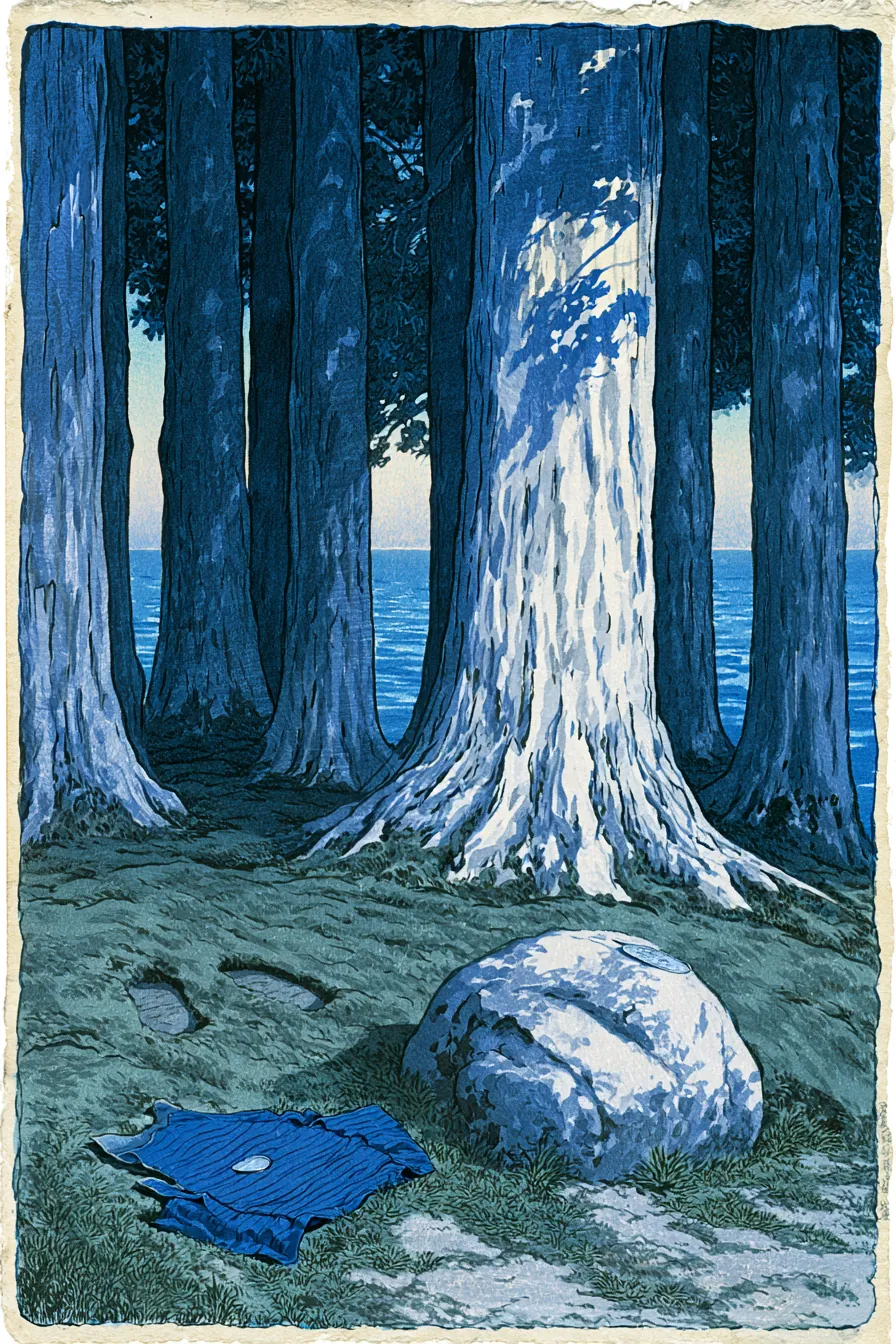
Chapter 19 — The Form
He did not, for one breath, speak.
Neither did I.
I had timed the kneeling so that, by four-twelve, the muscles at the back of my legs would not be in any small private discomfort. I had been kneeling for thirty-two minutes. The moss held its damp under me, even and cool. The cedar at the inside of my right knee had — across the patient circling of seven trees — agreed with the knee on the matter of the moss. The body was not, at four-twelve, going to be the thing that interrupted.
He was in the dark grey kimono of the older sleeves. It was the same kimono of Wednesday at the inari plate and Friday at the upper shrine, except that it had — through twelve hours of walking on the western road, through some span of rain near Bizen I read at the lower hem in a faint salt line, through the body inside the kimono going since four in the morning on the long route — passed, in some private interior of the cloth, the point at which a kimono was the kimono one wore and become a kimono that was wearing the man.
His right hand, at his side, was empty.
He had not, since Saturday at three in the morning at the inner stone of his line's grove, had the silver coin.
The empty right hand was the unhanded hand.
I did not let my eyes rest on the unhanded hand for more than one count of the body's first relaxation at the throat after the kneeling.
I looked, instead, at his face.
His face was the face of a kitsune of his rank who had walked twelve hours along a road that was not on any map the city had filed since 1893, and who had — by some interior of the kimono I had just read — come at the form. He had been preparing the form for twelve hours by the slow ordering of his own breath. He had been preparing it for some longer count than that — the seventy-two hours since I had not been at the counter at midnight, the eight months since Aunt had spoken to him on the second of November 2024, the sixty-one years since he had carried the coin without unhanding it.
He had been preparing the form for sixty-one years.
He saw, by some small reading of his own at four-twelve and a half, that I had been kneeling on the moss for thirty-two minutes and that — by my hands at the moss, by the apron at the indigo of two ties, by the seventh fudasetsu in the pocket, by the silver coin in the inner pouch, by the page from the noren folded in the apron string — I had also, in my own way at my own pace across a single sleepless night in a cottage, come at the form.
He went, by the second count of the body, more still.
He said, in a voice the cedars at the upper edge of the grove did not, in the bamboo behind him, take:
Aoba-san.
Kuzunoha-san.
You are not, by any reading of Pip's I had access to in Bizen —
I am here.
Yes.
By my own choice.
Yes.
Aoba-san.
Yes.
I cannot, at four-thirteen on Sunday afternoon at the inner grove of seven cedars at the back of the property of the appointed senior of your line, ask you not to be here.
No.
I will not, by any clan custom I am under, ask you that.
No.
I will, however, in the small private courtesy of a thing I have not, in two centuries, been in the position to do —
Kuzunoha-san.
Yes.
Do not.
He did not finish.
He did the thing he had done on Wednesday at the inari plate and on Friday at the upper shrine, which was to be — for half a second — young. The being-young, on this afternoon, lasted longer than a half-second. It lasted, against the second hand at the back of my own pulse, three. The three seconds was the longest count he had, in fifteen days of my acquaintance with him, been in the small register of the imo who was not, in his own discipline, imo.
He closed the three seconds.
He bowed.
It was not the bow of a man at an inari plate or the bow of a man at the second step of an upper shrine. It was the bow of a kitsune of his rank at the upper edge of the inner grove of the appointed senior of the line of his — by his line's old grammar — peer.
The bow was the bow of a peer.
Nothing in any volume of Sumire's diary had prepared me for him to make the bow of a peer in the inner grove of Ono no Mariko on a Sunday afternoon in July at four-thirteen.
He had decided, by the silver coin on the inner stone on Saturday at three in the morning at his own grove, that the line had been finished by the unhanding. He had decided that the carrying of the coin had been finished by him on his stone. He had decided that the daughter of the line who carried the coin from his stone to her own apron pocket was, by the line's old grammar, the peer of the kitsune who had finished the carrying.
He had decided, by the bow, that I was — at four-thirteen — kin.
I had not — at any hour of the night in the cottage with the four objects on the table — expected him to decide that.
I had been ready. I had been ready for the form. I had been ready for the price.
I had not been ready for the bow.
I bowed my head.
I held the head down for the count of a slow seven.
He had — I noticed at the count of four — bowed his head also and held it.
We held the bow for the count.
At seven we raised our heads.
I rose.
I rose with the slow proper folding-out of an old witch who had been kneeling for thirty-two minutes. The body did not, this afternoon, allow itself to falter. Since five-twenty in the morning it had agreed with me on the matter of the day.
He did not, by any small kindness of his clan's old custom, offer the hand of a kitsune of his rank to a woman of my line rising from the moss. He did not, by any small kindness of his clan's old custom, not offer it. He stood at the upper edge of the grove. He waited. He had read, by some small reading of his own at four-fifteen, that the rising was a thing I was doing — a daughter of the line at her own form — alone.
I came, very slowly, to the upper edge of the grove.
I stopped at three paces from him.
I did not close the three paces.
He did not close them either.
Aoba-san.
Yes.
Will you, by the form, address Ono-sensei.
Yes.
With me.
With you.
The form, he said, carries —
Two prices.
Yes.
And the witch chooses, I said, which price she gives.
He did not, for a moment, answer.
He looked at my apron. The silver coin had been, at three-twenty in the morning, on a square of muslin on the table of the cottage. Since five-twenty it had been back in the inner apron pocket. By my closed hand at five-twenty it had been received. He read the apron pocket and the silver coin and the seventh fudasetsu and the folded page in the apron string. He read them in order, from the inside of the apron to the outside.
He read them three times.
He bowed his head, the smallest bow.
You have, he said, read the form by the long reading.
I have read Saitō-sensei in volume nineteen. I have read the yamabuki on the previous page of volume seven. I have read the cedars at the third bend in 2002. I have read the cadence of my great-aunt at sixty-three. I have read, alone, at five-twenty.
He closed his eyes for one count.
Aoba-san.
Yes.
The reading is —
The correct reading.
Yes.
Then we will speak in concert.
We will speak in concert.
He bowed.
I bowed.
I turned, with him at my right shoulder at the two paces of two creatures of two lines walking into the inner grove of the appointed senior, and we walked together to the flat stone at the centre of the seven cedars.
We came to the stone at four-eighteen.
We knelt at it — not on it — together.
We did not, on the moss at the flat stone, address it. The form was not an address to a stone.
I lifted my eyes to the lower edge of the inner grove, where the bamboo had been, in the three minutes since he had come through, very still.
The bamboo parted, by no hand, three.
Mariko walked through.
She was in the indigo so dark it passed to the colour of the inside of an inkstone. She had the basket of the knife and the cotton cloth folded at her hip. She had — at the right hand — a small clay teapot. The teapot showed, from the long use of the senior witch of the Inland Sea route at her own porch, the cracks of three pottings repaired in an old gold lacquer the line had taught her in 1971.
She came to the upper edge of the bee-balm hedge at the lower lip of the grove.
She stopped.
She bowed at the angle of the appointed senior of the line approaching the form of the daughter of the line in concert with the kitsune of the line her own friend had — in 1979 on a porch on this island — spoken the name of.
She held the bow at the count of the line's long grammar.
She straightened.
She came, by the small slow walking of an old witch of her own grove on the moss of her own years, into the inner grove.
She came to the flat stone.
She knelt at the stone.
She set the teapot, very gently, on the stone — the only object the form permitted to be set on the stone.
She did not, on the stone, pour.
She did not, by any rule of the form, speak first.
She waited.
He looked at me.
I looked at him.
We did not, for the count of three slow breaths, look at her.
The three breaths were, by the line's long arithmetic, the three breaths of the agreement to speak the form.
At the end of the third breath I closed my hand on the silver coin in the inner apron pocket.
He, at his side, opened his right hand. He held nothing in it. The opening was — in the long grammar of the unhanded hand — the gesture of the hand that has accepted that the carrying is the witch's.
I took the silver coin out of the apron pocket.
I held it in my open palm.
I set it, very slowly, on the flat stone beside the teapot.
The coin, on the stone, was the colour of an old hand mirror in a 1971 lower right corner of an otherwise clean reflection.
The stone, at the coin, went — by some long arithmetic of the Yodo and the inner grove and the bare moss at the centre of the seven cedars — warm.
He bowed his head.
I bowed mine.
We spoke.
We spoke together, in the form of the address, in the cadence of the second-degree-larger hand my brush had given me at eight this morning. The form was eleven words. It had not, in any volume I had read, been written down. By the line's long custom it had only ever been spoken — only taught — passed from a head of the line to a senior of the line in a teaching that did not, by the line's grammar, allow the form to be a written thing.
I did not, in the cottage at four-thirty in the morning, know the form.
I had not, in any reading I had, known the form.
I spoke the form anyway.
I spoke it because the seventh fudasetsu in the apron pocket — Pip sitting on it with its small thoroughness — had, at three-twenty this morning when I had set the coin on the muslin, given me the form.
Pip had given me the form.
Pip had not, by any conversation in eleven hundred years, had the form to give. The honbun of the threshold of a teahouse opened in 1888 in Pontocho was not, by anything the trade understood, a creature for whom the address-mood of the Aoba line of the Kyoto kotodama trade in 1963 was, in any sense, available.
Pip had it anyway.
Pip had had it, by some reading of Pip's own which Pip had not, in three years of my acquaintance, ever made plain, since 1888.
Pip had been the honbun of the threshold of a doorway that, in 1888, had been opened by a witch of the Aoba line whose own great-aunt had spoken the form on a porch on Naoshima in 1869 in the presence of the binding witness of her own line, the senior of her line, who had — across the long forty-six years of the not-answering of her own friend — known the form and not, in fifty-five years subsequently, ever spoken it.
Pip had had the form because the form was on the threshold.
I spoke the form because Pip, on the fudasetsu on the corner of the table at three-twenty in the morning, had given me the eleven words at the moment I closed my hand on the coin.
I spoke them in concert with him.
He spoke them in the cadence of his line, which was a cadence of the twelfth century in classical Japanese with a small turn of the sleeve at the third syllable that was the turn of his clan's old grammar.
I spoke them in the cadence of my great-aunt at sixty-three in 1989, which was the cadence of a kitchen in Pontocho in 1989 in plain modern Japanese with a small dropped note at the eighth syllable that was the dropped note of the island thrush at the cypress hedge.
The two cadences were the cadence of the form.
The cadence was — at four-twenty-one in the afternoon, on the moss at the flat stone at the centre of the inner grove of seven cedars on the slope above the bee-boxes at the back of the small farmhouse of Ono no Mariko — one cadence.
We finished the form.
We bowed.
She bowed.
The grove was — by the count of the second hand of the line's old grammar — silent.
The kotodama listened.
The kotodama heard.
The kotodama did, having read the form spoken at the cedar grove of seven by the daughter of the line in concert with the kitsune of the line, the only thing the form permitted it to do: it asked, of each of the two speakers, which price.
I knew my price.
I had decided my price at eight this morning at the brush.
I gave it.
I gave the regret of the binding that took my mother. I gave the night in October 2020 in the hospital corridor in Osaka at three in the morning when the line of the casting had come for the price and I had — in the small terrified arithmetic of a Hand operative at twenty-four — resented the line for the taking. I gave the resentment. I gave the long six years of carrying the resentment. I gave the small particular hate I had been carrying in a chamber of my chest since the moment the line had taken — without my asking, by no choice of mine — the only memory of my mother that I had not, by the time of the casting, written down.
I gave the regret of the casting. I did not give the casting. I did not give the memory. The casting and the memory had been gone since October 2020. I had been carrying, in their place, six years of the small hard cold dark thing in the chamber of the chest which was the resentment.
I gave the resentment.
The kotodama took it.
The taking was a taking of the kind I had not, in six years, known a taking could be. The taking was easy. It was, in the small chamber, the gentle pulling-out of a thing that had been waiting, all six years, to be given. It was, by the line's old grammar at the cedar grove of seven at four-twenty-two, the taking of a price the witch had, with open eyes, known she was choosing.
The chamber, after the taking, was — for the first time since October 2020 — empty in a clean way.
I closed my eyes for the count of one slow breath.
I opened them.
I looked at him.
He had given his price.
He had given — I read it, by some small reading the form had taught me in the speaking, in the small grey at the temples of the kimono of the older sleeves — the carrying.
He had given the carrying of the silver coin.
The carrying of the silver coin had been, by my Saturday at five-twenty in the morning at the cottage, taken up by me. He had finished the carrying by the unhanding. I had received it by the closing of my hand. The carrying, in the form at four-twenty-two, was the price he gave because — after sixty-one years and an unhanded hand — it was no longer his to carry.
He had given the thing that was, in the moment of the giving, not his.
The kotodama, at the giving, did not, for a long moment, take.
The kotodama was deciding whether the giving was a lie.
The kotodama listened. I held my breath.
He held his.
Mariko, at the stone, did not, by any tic of her face, allow the moment to be marked by a movement.
The kotodama heard.
The kotodama took.
The kotodama took the finishing of the carrying — which was, by his unhanding and by my receiving and by the bow of a peer at the upper edge of the grove at four-thirteen, a thing that had, in the long reckoning of his line, been a price he had a thing left to give of. The finishing was his last imo. It had been the last imo by anticipation he had been carrying across the eighty years between 1869 and 1949, the seventy-six years between 1949 and 2025, the seven months between November 2024 and this afternoon.
The kotodama took it.
The taking was the taking of an obligation by anticipation.
The taking was — in the deep reading of his line — the taking of the thing a kitsune of his rank had, across the long count of his line, been holding as the price one would, by the form's mechanics, have to give if one were ever to address a senior witch of the Aoba line in the cedar grove of the appointed senior in concert with the head of the line at the count of three breaths of the agreement to speak.
The taking, by the form, was — I read it through the small dropped note at the eighth syllable of the cadence — the only price the form had ever, in the line's eleven hundred years, been permitted to take from a kitsune of his rank.
The taking was the only price because the form was, by its old grammar, a grammar of finishing.
The form was — at four-twenty-three — finishing.
I had not, in all my study, understood that the form was a finishing.
He had.
He had walked twelve hours along the western road to give the only price the form had ever taken.
He had walked it knowing — by his line's long arithmetic — that the price had been waiting to be given for eleven hundred years, since the form had been spoken on a porch in 1869 by my great-aunt's great-aunt with the appointed senior of her line on an island at the upper edge of the Inland Sea route.
The line had been, since 1869, waiting for one of two things. The line had been waiting for the finishing — by a head of the Aoba line and a kitsune of the Hakuzosu line at the cedar grove of seven at the back of the appointed senior of the Aoba line — of the obligation by anticipation. The line had been waiting, alternately, for the non-finishing — for the small disciplined refusal of either the head of the Aoba line or the kitsune of the Hakuzosu line to come to the grove, and for the long quiet ending of the line by the slow erosion of the form into forgetting.
Sumire and Kuzunoha had, between 1965 and 2018, chosen the non-finishing.
The choice had been — I read it in the yamabuki and the not-answering and the long quiet keeping of the silence between the four people at the cedar counter of a teahouse in Pontocho for fifty-three years — a choice of kindness.
The kindness had cost Mariko forty-six years.
The kindness had cost my great-aunt — by the slow long erosion of the form into the not-saying — some private price she had taken to her grave in 2018 and which, in no volume of her diary I had ever read, she had named in fifty-three years.
The kindness had cost Kuzunoha sixty-one years of carrying.
He had walked, on Saturday at midnight, into the western road to finish the kindness.
He had not, at the inner stone at three in the morning, intended to survive the finishing.
He had intended to give, in concert with no one, by his single hand, the only price the form had been waiting to take, and to bear — through the alone-ness of the giving — the second price the form had been waiting to take of the alone-giver, which was, in the long reading of his line, the kitsune himself.
I had — by coming up the road on Saturday a day early, by reading at four-thirty in the morning the yamabuki on the previous page, by closing my hand on the coin at five-twenty, by the second-degree-larger hand at eight, by the cedar grove at six-fifty, by the three paces at four-thirteen — halved the form.
The form, halved, took one price from each of us.
The form, halved, did not take the second price the form was waiting to take of the alone-giver.
The form, halved, did not take Kuzunoha.
The kotodama, at four-twenty-three, finished.
The finishing was a finishing of the kind I had not, in six years of casting and not-casting, ever felt. The finishing was a small clean lifting of an air I had not known had been on me. It was, in the chamber of my chest, the empty-in-a-clean-way. It was, in the dark grey kimono of the older sleeves, by the smallest tilt at his shoulders, a fraction of a thing lifted I had not known had been there for sixty-one years.
The grove was, by four-twenty-three and a half, quiet the way a place is quiet after a thing has been finished.
Mariko bowed her head against the flat stone.
She bowed for the count of a slow ten.
I bowed for the count.
He bowed for the count.
When we raised our heads Mariko poured.
She poured from the small clay teapot into the small cracked cup at the base of the teapot — the one cup that had, by the long custom of the form, been carried for the moment. She set the cup on the stone. She bowed. She rose. She walked, in the slow proper walking of the appointed senior of the line at her own grove, out by the lower bamboo at the back of the inner edge.
She did not, in leaving, look back.
The cup on the stone was the cup of the yamabuki tea of the porch.
I did not, on the moss at the flat stone, pick the cup up.
Neither did he.
We sat at the cup.
We sat at the cup for some count of time the form did not measure.
He said, in a voice I had not, in fifteen days at a cedar counter, heard him use:
Aoba-san.
Yes.
The form has finished.
Yes.
The carrying has finished.
Yes.
I am —
He did not, for one beat, finish.
He looked at his right hand. The hand was empty. The hand was, in the small slow light of four-twenty-five on a Sunday in July in the inner grove of seven cedars at the back of the small house of Ono no Mariko of the Inland Sea route, open.
He turned the open hand over.
He turned it over slowly. He turned it over with the slow care of a man who had — for sixty-one years on his right hand and for eleven hundred years on his line — not turned anything over but the silver coin.
The hand was empty.
The hand had not, by the empty turning, been the hand the coin had been on.
The hand was, by the open turning, the hand of a kitsune at four-twenty-five on a Sunday in July who was not, in any reading the line had of him, imo by anticipation any longer.
He looked at me.
Hana.
It was — I noticed at the third count of my own breath — the first time he had said the name.
He had been, for fifteen days, Aoba-san to me. He had been Hana in no reading he had given me. I had been Hana to Tanaka-san and Yuki and Pip and Goro and Akiko and Mochizuki-sensei and the old man at the green-window at Kyoto Station, but I had not been Hana to him.
I had been, in the quiet disciplined kindness of his line's long grammar, the daughter of the line until the form had finished. The daughter of the line had been a thing he carried with the coin.
The coin was on the stone.
The daughter of the line was — by his unhanding, by my receiving, by the form's finishing at four-twenty-three — finished.
I was, at four-twenty-five, Hana.
I closed my eyes for the count of one slow breath.
I opened them.
Yes.
Hana.
Yes.
I had not, by any reading of the road, expected —
I know.
I had not, by any reading of Pip's, expected —
I know.
I had not —
I know.
Hana.
Yes.
Thank you.
I did not, on the moss at the flat stone at the centre of the inner grove of seven cedars on the slope above the bee-boxes at the back of the small farmhouse of Ono no Mariko at four-twenty-six on a Sunday in July, allow myself to cry.
I had been preparing, in the cottage at four-thirty in the morning, for the form. I had been preparing, in the kitchen at nine, for the rice. I had been preparing, on the slope at three-forty, for the grove. I had not been preparing for the thank you.
The body, at the thank you, did the thing the body had done at the slap and the kiss on the second step at Fushimi on Friday: it took, by some patient discipline only the body had managed, the smallest fraction of a long-held breath, and it let it out, very quietly, against the white wrap top of the indigo apron.
I bowed my head a quarter-degree.
He bowed his.
We did not, on the moss, kiss.
He had not, on the second step at Fushimi on Friday, kissed me back past one breath, because — holding to his discipline — I had not been asking. He had said, on the second step: if you were asking, I would, with my whole hand, refuse.
I was not, at four-twenty-six in the inner grove of seven cedars on Sunday in July, asking.
He was not, by the small disciplined kindness his line had taught him in the twelfth century, going to make the thank you into the thing that did the asking for me.
We sat at the cup.
After some time he reached, very slowly, with his unhanded right hand, and lifted the cup from the stone. He held it in his open palm. He set it back on the stone at a half-rotation. He looked at me.
I lifted the cup from the stone. I held it. I set it back at the half-rotation that completed the rotation he had begun.
The cup, on the stone, was — the form's yamabuki at the cedar grove of seven — the cup of the finishing.
We did not, by any rule of the form, drink it.
The cup, by the long custom of the form, was for the cedars.
Mariko would come back to the grove at sundown. She would, at sundown, take the cup. She would, reading the cedars at the inner edge at sundown, know the cedars had taken the yamabuki the daughter of the line and the kitsune of the line had not, by the form's last courtesy, drunk.
He stood.
He stood with the slow proper folding-up of a kitsune of his rank at his own grove. He did not, by any small kindness of his clan's old custom, offer me his hand.
I stood with him.
We bowed once, to each other, at the angle of two peers of two lines at the inner grove of the appointed senior on the afternoon the form had finished.
We walked, side by side at the two paces of two creatures of two lines who had — across an afternoon — finished, out of the grove.
At the lower bamboo we stopped.
He looked at me.
Hana.
Yes.
The teahouse.
Yes.
Will, by some reading of the line we have just finished —
Yes.
Reopen.
Yes.
By the ferry, I said, of the noon tomorrow.
Yes.
You will, by the road you take —
Walk.
West to your grove first.
Yes.
You will be at Kogitsune-an —
By the equinox.
Not before.
Not before.
Kuzunoha-san.
Yes.
By the equinox.
He bowed.
I bowed.
We did not, on the lower bamboo, say good-bye.
The bamboo did not, by anything I could read, mark the leaving.
He went west by the back of the inner grove into the bamboo thicket.
I went down the slope to the cottage.
I did not, on the slope, allow myself to look back.
I did not, at the cottage door, allow myself to test the matter of the small dropped note at the eighth syllable.
I went into the cottage.
I sat at the low table.
The honeycomb cell, on the square of waxed paper, was — by some long absence of any hand that had touched it since six-thirty Saturday evening — the colour of the inside of a brass kettle that had not, in eighty years, been polished.
I ate it.
The honey, on the tongue, was the slow patient honey of a slope of nine bee-boxes that a witch of the Inland Sea route had taught, at her own porch at five in the evening for twenty-three summers, the long route from the bee-balm hedge to the cypress at the lower edge of the property and back. It was the honey of forty-six years of waiting and forty-six years of not-answering and forty-six years of yamabuki on the previous page.
The honey was, on the tongue, the answer.
I ate it slowly.
When I had finished, Pip, on the apron pocket on the table where I had set it on coming in, climbed up onto the corner of the open diary.
Hana-chan.
Yes.
Pip.
Yes.
Pip is, on Pip's count, here.
Yes.
Pip is.
Yes.
The man, Pip said, very quietly, is —
Walking, I said.
Walking west.
Walking west.
To his own grove.
To his own grove.
By the equinox.
By the equinox.
Pip sat down on the corner of the open diary.
Pip thinks, Pip said, the kettle two floors below in Pontocho, at the count of the form's finishing at four-twenty-three this afternoon, sang.
I closed my eyes.
I did not ask Pip how Pip knew.
The kettle had sung.
The kettle had — across the long patience of a teahouse that had been waiting since 1888 for the honbun of the threshold of the doorway opened by my great-aunt's great-aunt to give a form to a daughter of the line at the cedar grove of seven of the appointed senior of the Inland Sea route — known.
The kettle had sung at four-twenty-three on Sunday afternoon in July, in an empty front room on the inside of Pontocho-dōri, on a counter of unfinished hinoki cypress, above the cold ash of an irori that had not been lit since Friday.
The kettle had sung the one phrase it had not, in three years of my keeping, sung.
The kettle — by the lantern's keeping and its own old reckoning and the honbun's small disciplined witness from the windowsill — had, at four-twenty-three of an empty teahouse, sung the singing-on-its-own.
The kettle had begun.
I opened my eyes.
I did not, in the cottage at five on a Sunday afternoon in July on an island in the Inland Sea, take out the notebook.
I sat at the low table with Pip on the corner of the open diary and the small wax round of the candle and the four objects — minus one, the coin now on the flat stone in the inner grove and belonging to the line of cedars at the grove of seven — that had been the objects of the night's slow reckoning.
I sat at them.
I did not write.
I let the sitting be the writing.