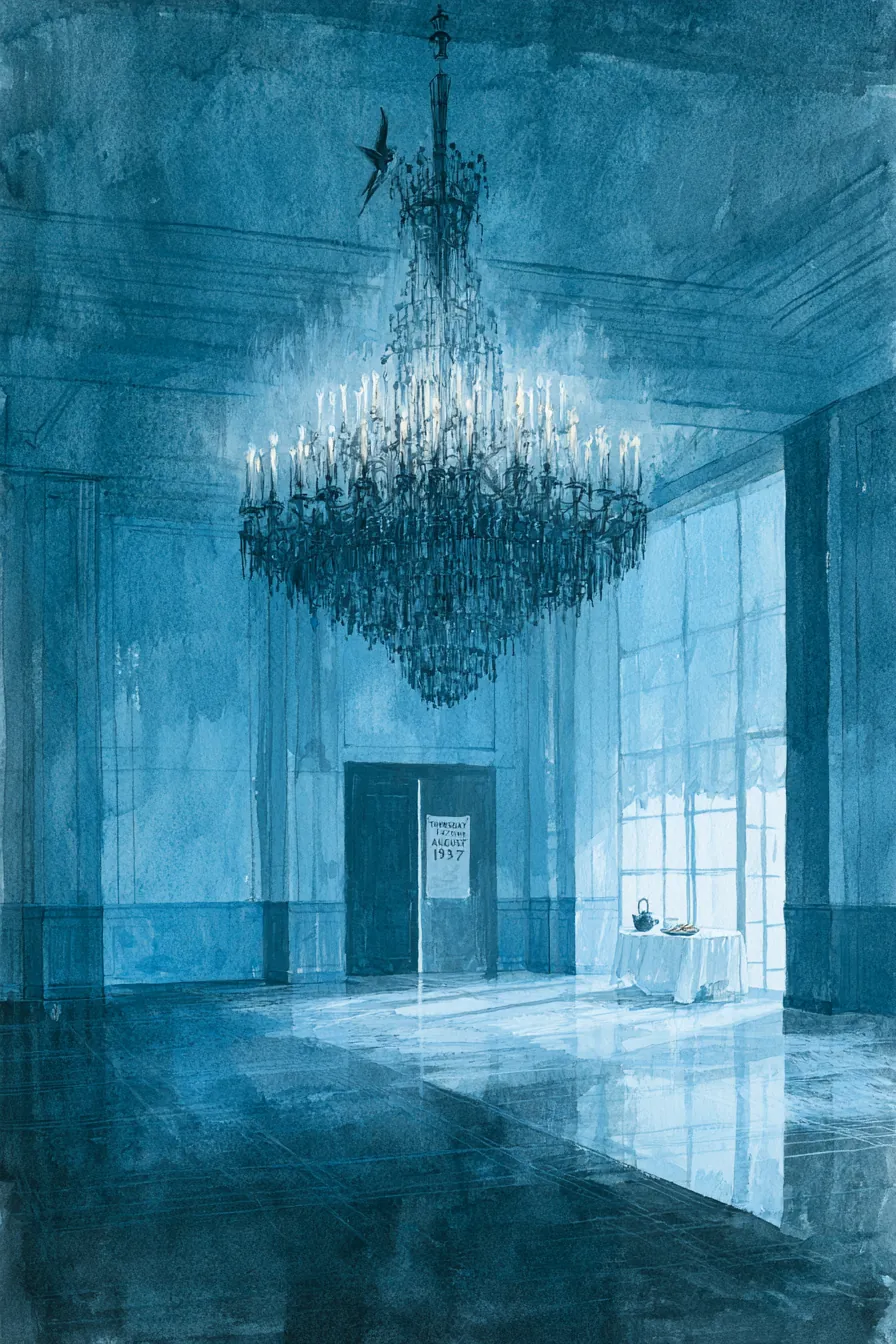
Chapter Twenty-Two — The Last Tea Dance
Thursday the twelfth of August.
The tea dance had been at the Paramount for ten years.
The tea dance was the still hour of the afternoon between half past three and half past five on a Thursday — chandeliers at the rose setting, the East-facing awnings drawn, the brass and rhythm sections and Russian piano and Hungarian first violinist at the bandstand, Jimmy King on the stool with the whisky on its wooden ledge. It had been the Paramount's tea dance for ten years.
The tenth year's tea dance had the printed program at the kitchen-corridor door, set by Mr. Hu's press in the spare English of a Macanese maître d' who had been at the Cathay before the Paramount:
PARAMOUNT BALLROOM TEA DANCE THURSDAY 12TH AUGUST 1937 3:30 to 5:30 P.M. WITH THE PARAMOUNT ORCHESTRA UNDER MR. JIMMY KING FEATURED VOCALISTS MISS PEARL CHIANG, MISS SU WANYIN
The program had been at the door of the kitchen corridor since noon.
I had been at the door of the kitchen corridor at quarter past three.
I had on the grey rehearsal qipao Mr. Hong Xiang had cut me in March. I had on no jewelry except the small silver bracelet from Auntie Lin at the wrist. I had on no pin in the hair. I had on the hair in a loose twist at the nape that Miss Liu had set with three steel pins.
Pearl had been at the door of her dressing room at quarter past three.
She had on the dragonfly qipao in pale blue silk with the dark blue embroidery at the collar and the left hem that Mr. Hong Xiang had cut her in the third week of June. She had on the small jade earrings the Portuguese boyfriend had given her on her twenty-fifth birthday at the second Sunday in May. She had on no pin in the hair. She had on the loose chignon at the nape that Miss Liu had set with two ivory pins.
Pearl had looked at me at the door of mine.
I had come.
We had walked together to the ballroom. At quarter past three, by the rose chandeliers and the drawn awnings, it was the dim rose-pink of a Paramount afternoon in August. The floor was under-attended — fourteen couples, thirteen of forty-six tables occupied: a Belgian banker and his Chinese mistress, an English shipping clerk and his wife, two Filipino sisters, three German Jewish refugees from Hongkew, two old American men from the China Press, an old Chinese woman with a girl of nine, a Mr. Sá Pearl said was Pearl's, the Hungarian first violinist's wife and her sister-in-law, two old French priests, the Cathay's Mr. Almeida on his afternoon off — and a table by the side window at which sat, alone, an old Japanese woman of seventy in a dark grey kimono with a white peony at the obi.
The old Japanese woman of seventy had been at the table by the side window since three.
She had ordered, by Mr. Lopes's information at the door, a pot of jasmine tea and a dish of the kitchen's almond biscuits.
She had drunk one cup.
She had eaten no biscuits.
Pearl had taken hold of my elbow at the distance of a Paramount lead singer taking the elbow of a Paramount lead singer at a Paramount tea dance.
She said: That is the Major's mother. The Major's mother has been at the consulate since the third Sunday of July, come from Tokyo by the mail-boat. By the kitchen boy, she has eaten her meals in the third-floor apartment with her son, a Buddhist who has not spoken Mandarin in four weeks. Today she has decided to come to the tea dance. She has come alone. The Major is not at the tea dance.
I said: No.
She said: She has decided. She has not been told to come; the Major did not know. The kitchen boy heard her ask the housemaid for a rickshaw to the Paramount at quarter past two, and the word came to me by Tony's cousin and Tony. She ordered a white peony from the consulate's gardener for the obi — picked from the flower-bed by the third gate where the Major has been growing peonies since the third week of June. The peony is the Major's peony. The Major's mother is wearing the Major's peony at her obi. I do not know what it means.
I said: No.
She said: I am telling you because she is in the line of your sight from the bandstand at the third song of the second set — Walking on the Wide Road, the new arrangement Mr. King has set for two voices, yours and mine. The walking is a walking, not the third verse — a spare song the kitchen at the third floor of the Paramount sang in 1928, for a quiet tea-dance Thursday. Sing the walking. Do not look at the table by the side window.
I said: I will not.
We had walked along the dance floor at the side to the stair at the corner. We had gone up the stair. We had been at the bandstand. Jimmy King at the stool had lifted his eyes. Jimmy King said: Pearl. Wanyin. Walking on the Wide Road. Two voices. You'll take the verse, sweetheart, Pearl'll take the bridge.
We had stood at the bandstand at the distance of two lead singers at a Paramount tea dance.
Jimmy King had turned to the rhythm section. He said one, two, three. The Filipino guitarist had picked up the first bar. The rhythm section had followed.
The afternoon had become the afternoon.
The afternoon had had the kind of still quiet of a Paramount tea dance on a Thursday in early August that had been the quiet a Paramount tea dance had had in every August.
I had sung the first verse of Walking on the Wide Road.
I had sung it the way the kitchen of the third floor of the Paramount had been singing it in 1928, when I had been thirteen and had been at the boarding house at Mr. Hong Xiang's by way of the auditioner from the Bright Moon, and had heard, on the third Sunday of July at the dish-washing at the third floor of the Paramount where the cousin of Mr. Hong Xiang had been a dish-washer, the kitchen of the Paramount sing the song.
I had sung the verse.
Pearl had sung the bridge.
We had sung the chorus together.
The old Japanese woman of seventy at the table by the side window had drunk a second cup of the jasmine tea.
She had eaten one almond biscuit.
She had not looked at the bandstand.
She had looked at the dance floor.
The awnings at the East-facing wall had been the awnings.
The Hungarian first violinist's wife at the third table from the kitchen corridor had laughed, in the manner of a Hungarian woman of forty-six at the Paramount tea dance on the second Thursday of August at her sister-in-law's joke.
The Chinese girl of nine at the table with the old Chinese woman had clapped.
The Chinese girl had been the smallest at the tea dance.
She had also laughed.
The old Chinese woman had looked at the bandstand. The old Chinese woman had been Mrs. Cao from the second alley at Xinzhakou whose granddaughter the girl was, and who had been bringing the granddaughter to the Paramount tea dance every Thursday for two years because the granddaughter had been born on a Thursday in 1928 at the third floor of the French clinic at Avenue Pichon, and Mrs. Cao had taken to bringing the granddaughter to a Thursday outing every Thursday since the second Thursday of June, 1934.
I had looked at the Chinese girl.
I had sung the third syllable with the close attention of a singer at twenty-two looking at a Chinese girl of nine at the Paramount tea dance on the second Thursday of August, 1937.
The Chinese girl had looked at me.
The Chinese girl had not clapped.
The Chinese girl had smiled.
The song had ended at the count of three minutes and fifty seconds.
The applause had been the applause of a Paramount tea dance on the second Thursday of August: small, polite, the kind of applause a Paramount tea dance had on a Thursday at quarter to four when the tea dance was the tea dance.
Pearl had taken my hand at the bandstand. She had taken my hand the way she had not, in seven years of the two of us at the Paramount, taken my hand at the bandstand. The taking had been the taking of a Paramount lead singer at the second Thursday of August who had known that the second Thursday of August was the second Thursday of August.
The taking had been public.
Mr. Sá at the second table on the side wall had set down his glass of port.
The old Japanese woman of seventy at the table by the side window had set down her cup of jasmine tea.
Pearl had turned to me at the bandstand.
She said: Sweetheart, I'm going to Hong Kong. Mr. Sá is taking the Norwegian coal carrier at the third pier of the customs jetty at six on the Saturday morning. The Norwegian coal carrier is going to Hong Kong by the second Wednesday of August. Mr. Sá is going. I am — by Mr. Sá — going with him. Sweetheart. I am telling you at the bandstand at the tea dance because the second Saturday of August is the second Saturday. I am telling you because I am not, on the second Friday of August, coming back to the Paramount. The second Friday's set is yours and not mine. I have, by Mr. Lopes at the second-floor cloakroom at the folded note at three, sent the folded note to Mr. Hong Jingming at Sun Ya. The note has been sent. Mr. Hong Jingming will, by the third hour, have sent it on to Yao Sanye. Yao Sanye will, by the fourth hour, have sent it on to the Paramount. The Paramount will, by the eight o'clock on the second Friday of August, have my dressing room emptied.
She said: I had wanted, in some other month, to do the leaving as I had done my leavings. I had wanted to leave in the manner of a Paramount lead singer who had, by her own counting, set the price. I am not doing the leaving in the manner I had wanted to do it in. I am doing it in the manner the second Saturday of August at the third pier of the customs jetty has, by the country, decided. I am not setting the price. I am taking what the price has been set at.
She said: Sweetheart. I am not finished. I will, on the second Saturday of August at six in the morning, be at the third pier of the customs jetty. I will, on the second Saturday of August at six in the morning, have a leather case at the third pier. I will, on the second Saturday of August at six in the morning, be at the third pier looking for you. I am not asking. I am looking. You will, by my looking, be at the third pier or not at the third pier. If you are not at the third pier I will, by the second Saturday of August at half past six, be on the Norwegian coal carrier without you. If you are at the third pier I will, by the second Saturday of August at half past six, be on the Norwegian coal carrier with you. I am leaving you the looking. I will not be at the second Saturday of August at six in the morning without you. I will. I will be there at six. I will look. I will, by the looking, take what the looking has given me. I will not wait. The waiting will be the looking. The looking is what I am able to give.
She said: Set the price.
She said: Set the price, sweetheart. Set it high. Do not let them set it for you. Promise.
I said: I promise.
She said: Good. Now sing.
Jimmy King at the stool had turned to the rhythm section. He said one, two, three. The Filipino guitarist had picked up the first bar of the second song of the second set, which was Plum Blossom. The rhythm section had followed.
I sang Plum Blossom.
Pearl sang nothing.
She stood at the bandstand at my distance and held my hand for the count of the first eight bars.
She let go at the ninth.
She turned. She went back to the stair. She came down the stair. She went to the table where Mr. Sá was at the second table on the side wall. She sat. She did not drink the glass of port. She lifted her eyes to the bandstand.
I sang the second verse.
I sang the bridge.
I sang the third verse.
I sang the coda.
I held the last vowel.
I held it for the count of three.
I let it down.
Jimmy King had looked at Pearl. Pearl had nodded. Jimmy King had looked at me. Jimmy King said all right, sweetheart. The third song.
The third song had been Spring Wind Autumn Rain.
I sang Spring Wind Autumn Rain.
I sang the first verse.
I sang the second.
I sang the bridge.
I took the half-breath at the seventh measure.
I took the quarter inch at the third syllable of the third bar.
I sang the lower register on the second word of the fourth line.
The old Japanese woman of seventy at the table by the side window had set down her cup of jasmine tea.
She had turned her face by half an inch toward the bandstand.
She had closed her eyes for the count of two.
She had opened them.
She had not looked at the bandstand.
She had looked at the white peony at her obi.
The Chinese girl of nine at the second table from the kitchen corridor had clapped at the third syllable. She had not known what the half-breath was. She had been told let it sit, child.
The girl had let it sit.
I sang the third verse.
The third verse of Spring Wind Autumn Rain in the kitchen of the third floor of the Paramount in 1928 had had the lines the wind has gone over the third street, the rain has come over the fourth, the spring has gone over the girl's name, the autumn has come over the boy's. I sang the third verse the way the kitchen of the third floor of the Paramount had been singing it in 1928.
I sang the coda.
I held the last vowel.
I held the last vowel until it had stopped being a vowel and had become the room.
The room had been, at quarter past four on the Thursday afternoon of the second Thursday of August, 1937, the room of the Paramount tea dance with the rose-pink chandeliers and the awnings drawn and the under-attended dance floor and the thirteen tables and the table by the side window with the old Japanese woman of seventy in the dark grey kimono with the white peony at the obi who had turned her face by half an inch and had closed her eyes for the count of two.
The old Japanese woman of seventy had stood.
She had not looked at the bandstand.
She had walked across the dance floor to the door of the kitchen corridor. Mr. Lopes had been at the door. The old Japanese woman of seventy said something to Mr. Lopes in Japanese.
Mr. Lopes had bowed.
Mr. Lopes had not said anything in reply.
The old Japanese woman of seventy had walked along the kitchen corridor and out into the back vestibule and into the rickshaw at the lane of Avenue Joffre where the Hongkew rickshaw man Mrs. Tsung's husband had been keeping the rickshaw waiting since three.
She had gone.
Mr. Lopes had come up to the bandstand stair.
Mr. Lopes had caught Pearl's eye.
Pearl had stood from the second table on the side wall. Pearl had come up the bandstand stair.
Mr. Lopes said, to the two of us at the bandstand at the side of the stair: Miss Pearl. Miss Su.
He said: The old Japanese woman of seventy at the table by the side window was Mrs. Itō Mariko of the Tokyo Imperial Conservatory. She had told me her name and had asked that I bring her a folded note at the end of the second set. The folded note is at the lacquer tray at the kitchen corridor. The folded note is for Miss Su.
Mr. Lopes said: Mrs. Itō Mariko of the Tokyo Imperial Conservatory had also told me that she had been told by her son, at half past noon on the Thursday at the second cup of weak tea at the dining room of the apartment at the East end of the third floor of the consulate, that she should not, by his wish, come to the Paramount tea dance on the Thursday afternoon. She had listened to her son. She said yes, my son. She had left the apartment in the dark grey kimono with the white peony at the obi and had come to the Paramount. The folded note is for Miss Su.
Mr. Lopes had bowed.
Mr. Lopes had left the bandstand stair.
Pearl had looked at me.
She said: Read it after the set.
We had sung the third song of the third set — Get Up, the way Yao Sanye had been having me sing it for seven years, the third syllable of the bridge in Yao's manner. Yao had not been at the Paramount for fourteen days. At the second word of the fourth line I did not sing in the lower register; I sang in the register Yao had been having me sing in. At the coda I let the last vowel sit only to the second of three seconds and bowed.
Pearl had looked at me at the bandstand.
She had smiled.
She said: We are two singers.
The tea dance had ended at half past five at the chime of the brass clock at the bandstand corridor.
Jimmy King had stood from the stool.
Jimmy King said: That's all, ladies.
The Filipino brass section had stood. The rhythm section had stood. The Russian piano had stood. The Hungarian first violinist Mr. Ferenc had stood with his violin in the leather case under his arm.
We had come down the stair.
Pearl had taken my hand. Pearl said: I will be at the second Saturday of August at six in the morning at the third pier of the customs jetty. I will look. I will not wait. I will, by the looking, take what the looking has given me.
I said: I promise.
She said: Set the price, sweetheart. Set it high.
She said: Goodbye, Wanyin.
I said: Goodbye, Pearl.
She had let go of my hand.
She had gone to the second table on the side wall where Mr. Sá was at the second glass of port.
I had gone to the kitchen corridor. I had gone to Mr. Lopes at the door.
Mr. Lopes had been at the door.
Mr. Lopes had handed me the lacquer tray.
On the lacquer tray had been a folded note in a cream-paper envelope with the seal of the Tokyo Imperial Conservatory in the corner.
I had opened it.
The folded note had three lines in English.
Dear Miss Su,
I am the mother of a son whom my late husband, who taught piano at the Imperial Conservatory for thirty-one years, would have wanted me to be proud of. I am not, this afternoon, able to be proud of him in the manner my husband would have wished. I am proud of him in another manner. And I am, by your good half-breath at the seventh measure of the bridge of Spring Wind Autumn Rain, proud of a singer I have met in the still hour of an afternoon I should not have come to. My husband would have taught her at our parlor in Setagaya in 1932, had she been at the parlor and not at the bandstand of the Paramount.
I had read the note twice.
I had looked at Mr. Lopes.
Mr. Lopes had not said anything.
I had folded the note. I had put the note in the inside pocket of the handbag.
He said: Good night, Miss Su.
I said: Good night, Mr. Lopes.
I had gone to the dressing room.
I had sat at the vanity.
I had not done anything for the count of nine.
At the third tick of the count, a dust-grey sparrow came in through the gap at the western corner of the bandstand-corridor skylight where Mr. Hu's carpentry had not been finished by his second nephew in June of 1934. It flew along the kitchen corridor and came to rest at the third bracket-lamp, and chirped twice. I went to the doorway of the dressing room and looked at it. The sparrow had been the sparrow.
Jimmy King had come to the door of the bandstand corridor.
Jimmy King said: Sweetheart. There's a sparrow in the corridor.
I said: I see.
He said: Bad omen, sweetheart. Old country says so.
I said: Which old country, Jimmy.
He said: Good tea dance, sweetheart.
I said: Good tea dance, Jimmy.
He had gone.
I had stood at the doorway for the count of nine. The sparrow circled the dim nine-bulb chandelier of the kitchen corridor, then came back to the bracket-lamp and sat. I went back into the dressing room, closed the door, sat at the vanity.
I had opened the lacquer box. Into the inner partition — which held the chrysanthemum pin, the white cotton wrapper, the Major's card, the folded square of paper from 1900, and the folded note from the cot — I put the cream-paper envelope with the seal of the Tokyo Imperial Conservatory. The partition had six objects. I closed the lid.
I had sat for the count of nine.
Beyond the closed door, the sparrow sat at the third bracket-lamp. It did not know the closed door was a closed door. It knew only that the bracket-lamp was the bracket-lamp.
On the second Thursday of August at quarter to six, a dust-grey sparrow had come in through the skylight at the western corner of the bandstand corridor. The country was, on this Thursday, the dust-grey sparrow. It had sat at the third bracket-lamp. It had chirped twice.
I had closed my eyes for the count of nine.
I had opened them.
I said to the lacquer box: Promise, sweetheart.
The lacquer box had heard.
I had got up.
I had gone to the door.
I had opened the door. The sparrow flew along the kitchen corridor and into the bandstand corridor and out through the skylight at the western corner into the dim rose-pink hour of the dusk at five past six. The sparrow had gone.
The country, by the second Thursday of August at five past six, was out of the bandstand corridor. The country would, by the next day, not leave.