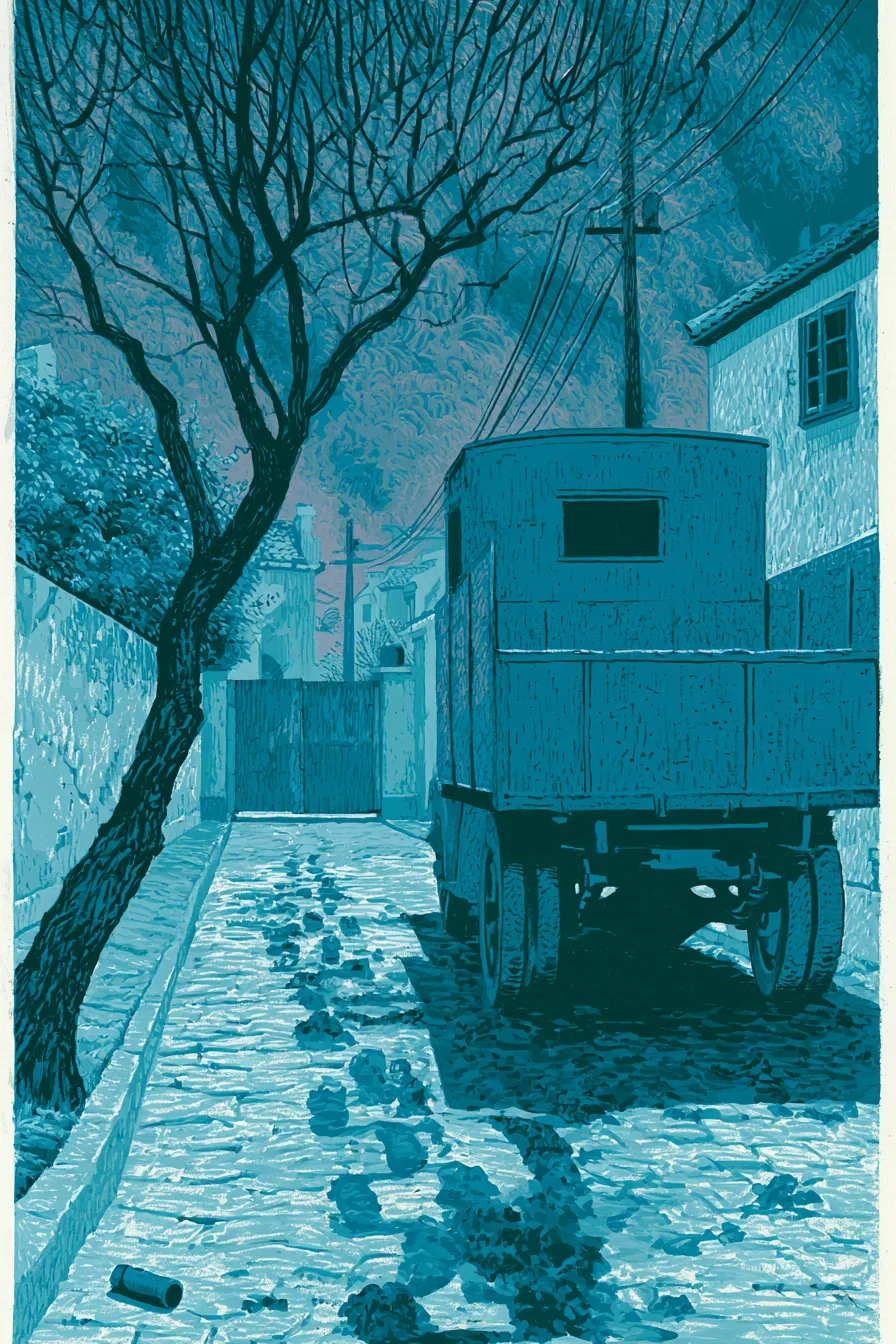
Chapter Thirty-Three — The Rescue
Friday afternoon, the twelfth of November.
I had been at the stone floor at the East wall under the barred window for the count of eleven and a half hours.
The first light at the stone floor, at quarter past six, had set the shape of a rectangle of four feet by two on the small flat grey of the floor. The rectangle had been at the distance of one foot from the East wall. By half past seven, the rectangle had been at the distance of three feet from the East wall, in the colder white of the second hour. By noon, the rectangle had been at the centre. By half past three, the rectangle had begun to slide back toward the East wall in the warmer yellow of the afternoon. By four o'clock, the rectangle had been the dull red of November light at four in the afternoon. By half past four it was at the East wall again, faded to the small thin red of a hour the light had nearly given up.
I had watched the rectangle. The rectangle had been a thing to watch.
I had set my right hand at my broken left wrist. The wrist had, at the second hour of the morning, gone numb at the second knuckle. The numbness had moved, by the fourth hour, to the third knuckle. By noon the third knuckle had begun to throb at the count of four in and six out, the same count I had been keeping at the breath. By three the throb had matched the breath. By four the throb had become the breath. I had not, by the time the rectangle reached the East wall, been able to tell which was which.
I had thought, in the second hour, about the brick room. I had set the brick room at the count of nine and held it there. The brick room had at the West wall the Bechstein upright; at the South wall the cot with the grey blanket; at the North wall the lacquer box at the third crate with the diary; at the East wall the wall ledge with the candle. I had walked the brick room in my head, slowly, the way Auntie Lin had taught me to walk a room in my head at twelve, the year my brother had been taken — Aliang, when the room you cannot leave is the room you are in, walk the room you can. I had walked the brick room. I had walked the second arcade of the Paramount. I had walked the gallery at the second flat at Rue Joffre where Pearl had set the brandy bottle at one o'clock on the second Sunday of June of 1936. I had walked the lane house at the corner of the second lane in Hongkou before the noon of the second Saturday of August. I had walked each in the order I had named them. The order had been a discipline. The discipline had been what was left.
I had not, in the eleven and a half hours, given a name. I had given the name of my brother, three times in three forms. The three times in three forms had not, by my own count, been the giving of a name. The three times had been the keeping of a name. Shen Ahuai of Wuxian, age nineteen, the seventh name of the firing-order at Longhua on the twelfth of April of 1927, had been kept.
The hour of half past four was the hour.
The first sound was the small dry sound of a truck of coal at the alley behind 76 Jessfield Road at the rear gate at the shift change of the guard. The truck had a Crossley engine of perhaps 1932 vintage with a small dry knock at the third cylinder that I had heard for the first time in the afternoon edition of August of 1934 when Mr. Hu the carpenter at the Paramount had bought a similar truck for the second coal delivery at the second basement. The Crossley was the Crossley.
The second sound was the sound of a rifle of the Imperial Japanese Navy Special Landing Force at the distance of forty feet. The Type 38, the small flat crack of the second model.
The third sound was the sound of a Mauser of a Green Gang man at the distance of fifty feet. The Mauser was the C96. The C96 had a small particular bark at the second port.
The fourth sound was the sound of a second Mauser of a Green Gang man at the distance of fifty feet. The second Mauser was the C96 also.
The fifth sound was the sound of the rear gate at 76 Jessfield Road opening at the hinges of the rear gate that had been set with the kerosene of Mr. Hu the carpenter's oil-can on the second Tuesday of November when Mr. Hu had come up to deliver, by the consulate's order, a second supply of kerosene to the basement of the second floor. Mr. Hu had set, by his own small unhurried understanding, three drops of his oil-can at each of the eight hinges of the rear gate, the front gate, and the back stair. The drops had been the drops.
The sixth sound was the sound of the truck of coal at the rear yard of 76 Jessfield Road.
The seventh sound was the sound of a man running up the stair at the rear of 76 Jessfield Road. The footfall was the footfall.
I had heard him at the brick room. The footfall was his. He had not, at any hour at the brick room, run; but the footfall, at the rear stair of 76 Jessfield Road at half past four on the afternoon of the twelfth of November of 1937, was the footfall of a man whose footfall at a walk I had heard for fourteen months at six paces.
The voice set the hand at the door of the cell.
The hand at the door was a gloved hand at the key Mr. Hu the carpenter had set at the key. The key Mr. Hu the carpenter had set had been the key Mr. Hu the carpenter had taken from Mr. Hong Jingming's nephew at Sun Ya. Mr. Hong Jingming's nephew at Sun Ya had been on the payroll of the Japanese consulate at Wuhan Road since 1934 and the second name on the list at the third verse. He had been, since the second Saturday of August at the eight o'clock when the third verse had not yet been sung, also the man at the corner of Sun Ya at the rickshaw at the corner of Nanjing Road and Sichuan Road N. with the Mauser of a Green Gang man of forty at the hip, in a small particular arrangement of the Green Gang's that the second name on the list at the third verse had not understood to be the particular arrangement of his last week alive. He had given Mr. Hu the carpenter the key at three on the afternoon of the eleventh of November in exchange for a small cardboard envelope at the second pocket of Mr. Hu's coat which had contained the second photograph of his second mistress at the second house in the third lane at Avenue Joffre. Mr. Hong Jingming's nephew had not, on the morning of the twelfth of November, been seen. He would not, by Saturday morning at the North-China Daily News, be seen again.
The door of the cell at the third floor at the East end of the corridor at 76 Jessfield Road at half past four on the Friday afternoon of the twelfth of November of 1937 opened.
Lu Jiyuan came in.
He had on the grey wool overcoat over the blue serge suit. He had on the grey felt hat at the brow. He had on no porcelain mask. He had on the face.
He had at the right hand a Mauser of a Green Gang man. He set the Mauser at the coat pocket. He knelt. He set his right hand at the curve of my cheek.
He said: Tell me you are not in pieces.
I said: Tell me you are not.
He took my right hand in his right hand. He set his left arm under my back. He lifted me to standing. I had not, in eleven and a half hours, stood. The standing was, in the first two seconds, the standing of a singer of twenty-three whose left wrist had been broken at half past three in the morning by an officer of forty-two and who had been sitting since at the stone floor. He held me. He waited. He did not, in the second hour, hurry the standing. He let me find the second foot. He let me find the third breath. He let me find, in the small dry light of the third hour of the afternoon at the East wall of the cell, the small flat fact that I was, this afternoon, going to walk out of the building.
I set my forehead at the coastline at the left side of his face. The coastline was warm.
I walked with him to the door.
The corridor at the third floor at half past four on the Friday afternoon of the twelfth of November of 1937 had at the stone floor at the second cell two MPs of the Imperial Japanese Navy Special Landing Force. The two MPs at the stone floor at the second cell were dead. I did not look at them. I had been told, by my own private grammar at the moment I had heard the Mauser at the rear yard, that I would not look at the dead at the second cell, because the dead at the second cell were not my count of nine. The dead at the second cell were Mr. Hu the carpenter's count of nine. I had my own.
Liang was at the corridor. He had on a dark coat. He had at the hip the Mauser. He looked at me. He did not, in the second second, say anything. He set his hand at my shoulder for the count of three. He took the hand back.
We walked to the stair. We went down to the second floor.
At the second floor the corridor had at the stone floor at the door of the interrogation room a Japanese officer of forty-two in the uniform of the Imperial Japanese Navy Special Landing Force at the rank of Lieutenant Commander. The officer of forty-two was dead. He had at the second pocket of the dark khaki tunic the small leather case. The case was closed.
I did not stop. I kept walking.
We went down the stair to the foyer.
At the foyer at the parquet floor and the Persian carpet and the mahogany hat stand at the corner, the Major was at the foyer. He had on the uniform of the Imperial Japanese Navy Special Landing Force. He was alive. He had set his pistol of the Nambu at the holster at the hip. He had not drawn it.
He looked at me. I looked at the Major. The Major looked at Lu Jiyuan. Lu Jiyuan looked at the Major.
I had not, in the long argument I had had with myself for the count of fourteen months about the Major, ever expected to see him in a foyer in this configuration. The Major in a foyer at half past four on a Friday afternoon, at a villa whose interrogation room he had left at one in the morning, with the pistol at the holster and the hand not drawn — was the Major I had not yet, in those fourteen months, allowed myself to imagine. The Major of this afternoon had decided, by some count I would not, in any future, know the steps of, that he would, on the afternoon of the twelfth of November, be the man at the foyer who did not draw.
The Major said: I will give you four minutes.
I said: Goodbye, Major.
The Major stepped aside. He set his back at the mahogany hat stand at the corner. The naval cap at the second hook moved an inch when his shoulder touched the upright of the stand. The cap settled. We walked past the Major to the door of 76 Jessfield Road.
At the door Lu Jiyuan took the Mauser from the coat pocket. At the door we went out.
The alley had at the rear gate the truck of coal. The truck of coal had at the tailgate Teddy Harmsworth in the rumpled white linen suit at the steering wheel. He had on, also, a small dark streak of coal-dust at the second collar of the linen, and the small flat tired expression of a Manchester correspondent at the second column of his second deadline of the week.
Teddy said: Get in.
We climbed up. The tailgate had at the coal-dust the shape of three Green Gang men with the Mausers at the hips. The tailgate had also had Mr. Hu the carpenter at the Paramount basement, with the second oil-can at the second pocket and the Mauser of a Green Gang man at the hip. The tailgate had also Mr. Mendelsohn in the blue serge suit at the round wire glasses at the nose of a man of fifty-three. Mendelsohn had at the second pocket the small leather press portfolio with the second master tape. He had at the third pocket the second copy of the typed transcript of the third verse, in case the first did not, by the second hour, get out of the Bund.
The tailgate had also Liang.
The tailgate had at the coal-dust at the second pile of coal at the rear of the tailgate the body of the third Green Gang man.
The third Green Gang man was Liang's cousin Mr. Zhao. Mr. Zhao had been shot at the shift change. Mr. Zhao had been twenty-four. Mr. Zhao was dead.
Liang set his right hand at Mr. Zhao's shoulder. Mr. Zhao said nothing.
Teddy set the truck at the first gear. The truck of coal went. The truck of coal turned at the corner of Jessfield Road and the alley. The truck of coal went South along Jessfield Road toward the French Concession.
I set my head at the coastline at the left side of Lu Jiyuan's face. The coastline was warm. I closed my eyes.
I said: The Major has let us go. The Major has given us four minutes. The Major will report the rescue to the Japanese consulate at Wuhan Road. The Major will set the hour of the rescue at half past five. The Major will set the direction at the Hongkew docks. The Major will set the truck at the blue Ford the consulate has been told had been hijacked at the corner of Avenue Foch and Jessfield Road.
He did not, that moment, say anything.
I set my right hand at the side of Lu Jiyuan's coat at the left side at three inches below the rib.
The side of Lu Jiyuan's coat was wet.
The side of Lu Jiyuan's coat was the side of Lu Jiyuan's coat at the hour the side had been at the round of an MP of the Imperial Japanese Navy at the distance of forty feet.
The round had gone in at the rib.
The round had not gone out.
The side at my right hand was wet.
I said: You are shot.
He said: I am not in pieces. Lie down at the coal-dust.
I lay down with my head in his lap. The coal-dust was cold. The coal-dust smelled of the second yard at the second basement of the Paramount where Mr. Hu had taught me, in 1932, that the small particular smell of coal-dust on a winter afternoon was the smell of the Yangshupu pits at the third seam. The Yangshupu pits at the third seam — the same brick kilns that had fired the small red bricks of the 1880s I had set my left hand against on the forty-two steps for the count of fourteen months. The bricks were the bricks. The coal-dust was the coal-dust. The city was the city.
He set his right hand at the curve of my cheek.
He said: Tell me you are not in pieces.
I said: Jiyuan. I am not in pieces. Tell me you are not.
He did not say anything for the count of nine.
He said: I am not in pieces. I will try to stay this way.
The truck of coal went South along Jessfield Road through the boundary zone the Settlement Council had called the extra-Settlement roads area. The road was empty at the second mile, because the second curfew was on. The truck of coal had at the side-rails the Pathé syndicate's small painted lettering that Mr. Hu the carpenter had spent the count of three hours at the second basement of the Paramount on Tuesday evening setting in white paint at the second board: PATHÉ STUDIOS / SHELLAC TRANSPORT / AVENUE DU ROI ALBERT. The lettering was Mr. Hu's hand. The lettering would, by half past five, have to convince a Settlement constable at the corner of Avenue Foch that the truck of coal carrying six men and one body was, on a Friday afternoon at half past four, a shellac transport.
The truck turned East. The truck turned South. The truck went South along Avenue Joffre.
At the corner of Avenue Joffre and Rue Bourgeat the truck turned West into Rue Bourgeat. At the corner of Rue Bourgeat and Rue du Père Robert the truck stopped at the rear gate of the French Concession back-lane safehouse Dr. Morancy had, by the information from the Catholic widow of the Polish émigré at the corner, arranged.
The widow was an old woman of seventy-four named Mrs. Wojciechowska, who had lost her husband at the German bombardment of Łódź in 1914 and had lost her second son at the third typhoid epidemic of 1925 at the French Hospital, and who had, since her husband's death, kept a small back-lane house at Rue du Père Robert as a third room for people Dr. Morancy did not, in writing, refer to. Dr. Morancy had said to me, on the second Saturday of October at his parlor: Mrs. Wojciechowska keeps a third room. The third room is where, when I have to, I send people. She does not ask. She is a Catholic widow of seventy-four. She has been a Catholic widow of seventy-four for nine years. The nine years have given her, by her own account, the patience of a Catholic widow of seventy-four. She will give you the third room. Do not give her anything else.
The rear gate opened. The truck went in. The truck stopped at the small yard of the back-lane.
Teddy set the handbrake. He turned at the steering wheel.
He said, in his Manchester English at twenty past five on the Friday afternoon of the twelfth of November of 1937: We are through.
The rear yard of the safehouse at the corner of Rue Bourgeat and Rue du Père Robert was the rear yard. The yard had a small persimmon tree at the third corner that had, by November, lost half its leaves. The yard had a stone basin at the second wall, with a small green tin of water and a copper ladle at the side. The yard had, at the door, Mrs. Wojciechowska in a black wool coat with a small white collar, leaning on a cane of olive wood.
I set my right hand at the side of Lu Jiyuan's coat at the rib.
I said: We are through.
He closed his eyes.
I kept my right hand at the side. The hand was the hand. The hand had at the wrist on the left the bracelet that had not broken. The hand had at the wrist on the right the small thin red mark that had not gone. The hand was at the side at the rib of a man whose left fourth finger had no second joint and whose face was the face the ceiling of a lane house at Zhabei had made in 1934. The hand was the hand.
Mrs. Wojciechowska set her cane at the stone of the basin. She said, in her Polish-accented French, to Mr. Hu the carpenter, Bring him in.
Mr. Hu the carpenter brought him in.
I followed.
The back-lane room of the safehouse was a small low room of the third house at the rear of the lane, with a single iron bed at the West wall, a Pingyang pine table at the centre, and a small kerosene lamp at the table. The kerosene was the same kerosene Mr. Hu had used on the hinges of the rear gate at 76 Jessfield Road and the hinges of the brick room two miles away. The kerosene was the kerosene. Mr. Hu set Lu Jiyuan at the iron bed. Mrs. Wojciechowska set the kerosene lamp at the second wick. The room came up, in the small low yellow of the second wick, to the small low room of a third house at the back-lane of a Catholic widow of seventy-four.
Mendelsohn set his round wire glasses at the table. He took out the small white cotton pocket handkerchief with the embroidered M and wiped, very slowly, the second lens. He set the glasses back. He looked at me.
He said: Dr. Stanisław will be here at six. He is the son-in-law. He has been at the second hospital at Łódź in 1919 with the cavalry. He has set rounds at ribs. He will set this one.
I said: Yes.
Mendelsohn said: Sit. Sit at the small chair at the West wall. I will, at the third hour after Dr. Stanisław, take the second master tape to the second safe at the Pathé pressing room. The third hour will be the third hour. By the third hour, the second master tape will, by my own hand, be in the safe. By the second Saturday of December at the EMI press at Hayes, the second master tape will have made the second voyage. We have, in this room, what we have.
He set his hand at my shoulder. He went out into the front of the house.
I sat at the small chair at the West wall.
I kept my right hand at the side of Lu Jiyuan's coat at the rib.
The hour of twenty past five on the Friday afternoon of the twelfth of November of 1937 was the hour.