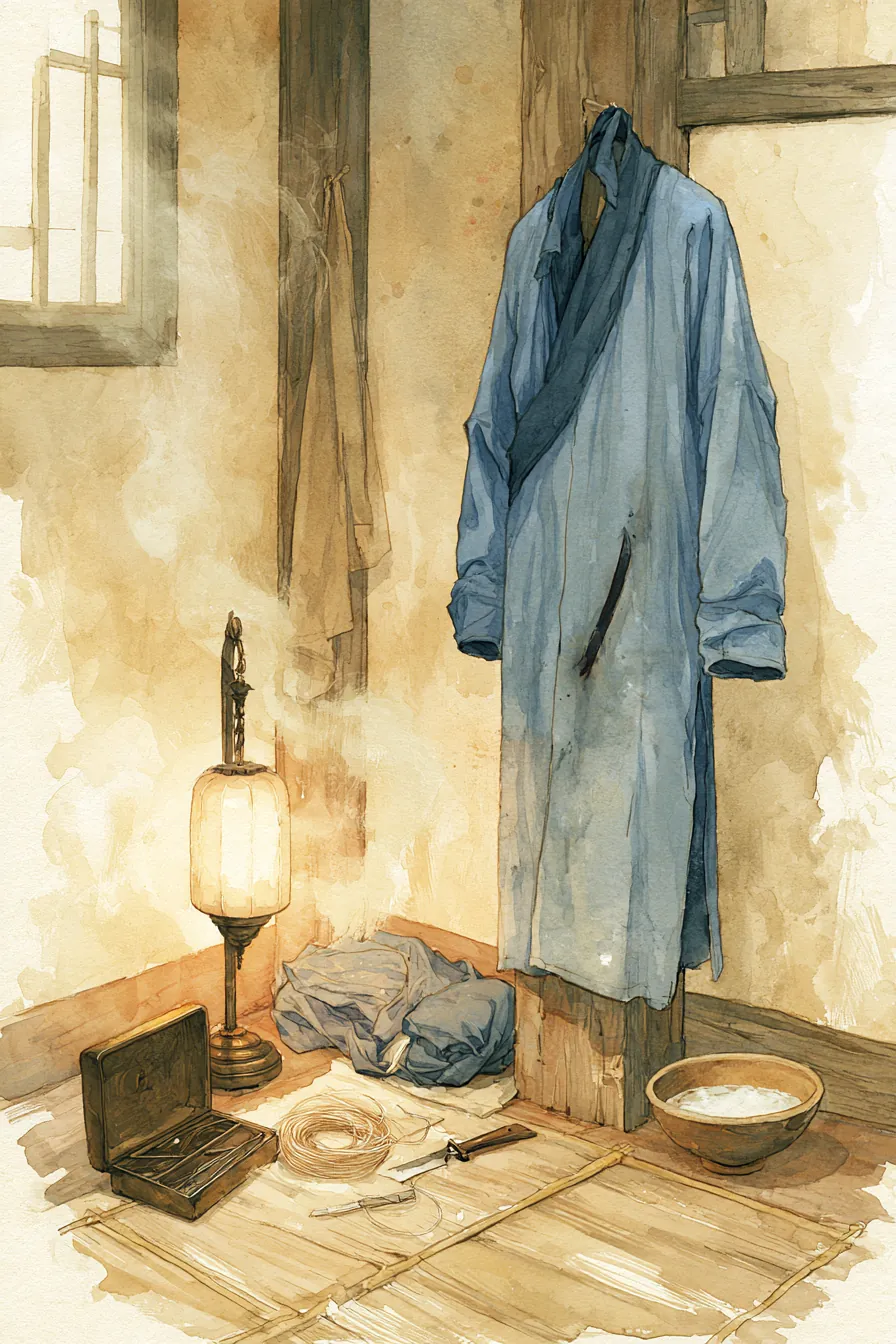
Chapter Fourteen
A Knife in the Lane
Madam Khorshid's note came at the seventh hour of the evening.
It came not by a runner but by Ah-Sa, who had been at the rear gate of Wanjun's compound since the half of the fifth hour without asking to be let in. Nanny Zhou had found him at the second post when she went out to bolt the gate against the dusk drum. He had been standing in the unhurried unmoving stillness of a man who had been told by his master to stand at a particular gate until a particular hour and to ask, on his own account, for nothing.
He had handed Nanny Zhou the slip and had not entered.
The slip was in Madam Khorshid's hand. It said: Lady. A man at the back of the Western Market wishes to sell, this evening, by the third watch, a Liangzhou silver of an unusual purity to a Sogdian wineshop in Pingkang. He has asked for me by my own name. He has asked for an arrival by the back lane. I have agreed. The lady will, on the matter, decide.
Wanjun did not, this evening, decide for the count of perhaps fifty breaths.
She set the slip on the writing-desk beside the lacquered letter-box she had not, since the third watch of the night before, opened. She set her hand on the corner of the desk. She looked, briefly, at the wax tablet with the diagram and the empty circle she had not yet filled.
She lifted her hand from the desk.
She walked to the inner court and took, from the cabinet behind the cistern, the plain dark robe she kept for nights in which she did not wish her grey to read at twenty paces. She set it on the bench beside the cistern. She walked to her bedroom and took, from the lacquered box on the corner of the platform, a single short pin of the kind a Daoist nun did not, ordinarily, carry. The pin was bronze. It had been her father's, and had been, in his late evening of 738, the pin he had pressed into her hand at the doorway of his study with the instruction that it was not, daughter, to be used unless used.
She set the pin in the inside cuff of the dark robe.
She walked back to the writing-desk.
She wrote, on a fresh wax tablet, three lines for Nanny Zhou.
The third watch. Pingkang. By the rear lane. If by the dawn drum I have not returned, Brother Hui at the brick-kiln hut, Pei's deputy by the tea-house. Not the avenue.
She set the tablet on the corner of the desk where Nanny Zhou would, at the half-watch, find it.
She did not, this evening, eat.
\ \ \*
The back of the Western Market was, at the third watch, the colour of charcoal that had been wet at the dusk and dried in the wind of the evening hour. The lanterns of the public stalls were out. The lanterns of the houses behind them were not. The smell of the market — yak butter, camel-piss, the cold smoke of an iron forge that had been damped at the half of the seventh hour — sat in the air at chest height.
She walked the back lane of the seventh quadrant in the dark robe.
She walked alone. Ah-Sa had been told, at the rear gate of her courtyard at the half of the eighth hour, to ride west to the An caravanserai by the back lanes and to deliver to An Naxia, in his own hand, a slip Wanjun had folded into a square the size of her thumb. The slip said: Third watch. Back lane of the Western Market, seventh quadrant, the third gate from the south. If you can, gongzi. By your own discretion. I do not, this evening, send for you.
She had not waited, at the gate, for a reply.
She walked.
The third gate from the south was the gate of a small back warehouse — a one-room hut with a low door, a single hemp curtain, and a lamp inside the curtain set on a clay shelf. Madam Khorshid had been at the hut since the half of the second-to-last watch. She stood, in her own dark robe, at the inside of the curtain with her hands at her sleeves. The man who had brought the silver — a thin Liangzhou fence with the slightly hunched shoulders of a man who had been at the trade for thirty years — sat on the cushion-stone in front of the lamp, with a small wrapped parcel on his knee.
He looked up when Wanjun entered.
"Madam."
"Mister."
"You are the Pingkang."
"I am, mister, of the wineshop the proprietress has named."
"The silver."
He unwrapped the parcel.
The ingot was the size of her own palm. It was the colour of a winter river-stone that had been polished. It bore, on its upper face, a stamp she had not, in eighteen months, seen.
She had not seen the stamp. She had read about it. Her husband had described it once, in a letter from Hexi in the autumn of 748, in a sentence she had filed and not used. The stamp was the fanyang garrison stamp, the seal of a frontier paymaster operating out of An Lushan's command-post in the eastern reaches.
She did not, in the hut at the third watch, allow her face to do anything.
"Mister."
"Madam."
"The weight."
"Twelve liang, madam. Of the kind that, by the assayer's reading, is — the cleaner of the eastern garrison's pours. The eastern garrison, madam, is not, this season, in the habit of paying out in twelve-liang ingots. The eastern garrison pays in eight. This is, madam, an ingot that has been recast in private. The recasting was done, madam, in a kiln that did not — by the assayer's reading — strip the lower face of the older stamp. The older stamp is faintly visible if the lamp is set close."
He turned the ingot.
He set the lamp close.
She did not lift her hand to the lamp.
She read.
The older stamp was, faintly under the upper recast, the small kiln-mark of a Tang official kiln — the same kiln-mark Brother Hui had described to her on the second day, when he had named the cup-shard the An household kept on the third shelf above the kitchen, which was the kind of cup-shard that belonged to a household whose patron commissioned, privately, kilns of the second grade.
She did not allow her face to do anything.
"Madam."
"Mister."
"The price."
"The price, mister, is the price the proprietress has agreed. I am not, this evening, the negotiator. I am the second hand."
He inclined his head. He did not lift the ingot.
"Madam. The hour is the hour. The proprietress has agreed."
She lifted, from her own sleeve, the small purse Madam Khorshid had set in her hand at the rear gate of the warehouse before she had entered. She placed it on the cushion-stone. She did not, in the placing, look at the fence's hand.
He weighed the purse with the small ledger of his own palm.
He inclined his head.
He wrapped the ingot.
He passed it across.
\ \ \*
They stepped from the hut at the half of the third watch.
The lane outside the hut was the colour of a brazier that had gone out. The lanterns of the houses behind the warehouse were not lit. The smell of the iron forge was less, this far back; the smell of an old hemp rope was more. The lane was empty.
It was not empty.
She registered the movement at the second turning before she heard it.
A shadow had shifted, at the curve where the lane bent west, in the particular way a shadow shifted when a person at the curve drew his weight from one foot to the other in the careful unhurried way of a man who had been waiting.
She put her hand to Madam Khorshid's sleeve.
"Madam. Back."
Madam Khorshid did not ask.
She turned. She walked at a steady pace back toward the hut.
A second shadow detached itself, at the south end of the lane, from the wall.
A third detached itself behind the hut.
Three.
She had time, in the count of three breaths between the registering and the closing, to set the silver under her own dark robe at her waist, to draw the bronze pin from the cuff of the robe, and to put her shoulder against the wall of the hut.
She did not, in the three breaths, allow herself a word.
Madam Khorshid had her back to the same wall, two paces to Wanjun's left. Madam Khorshid had drawn, from the inside of her own sleeve, a narrow blade of the length of a writing-pen, which she held flat against her thigh in the way a woman who had grown up in a Persian wineshop held a blade she was not, by her trade, supposed to know how to hold.
The first of the three came at her from the front.
He was a Han, by his build and his stance — broad at the shoulder, light at the foot, with the rolling weight of a man who had been trained at a barracks-yard. He carried a short blade at the right hand. He did not, at the closing, speak.
She did not speak.
She set the bronze pin in the angle her father had taught her — point down, thumb at the cross, wrist locked — and waited for him to step inside her reach.
He stepped.
A second shadow came in at her left.
She did not turn to it.
She let it come.
\ \ \*
What happened in the next forty-five breaths happened in a clarity she would, in later weeks, recall in fragments rather than as a sequence.
A figure dropped from the roof of the warehouse on her right. He landed, in the unhurried way a man who had counted his own jump landed, two paces in front of the first attacker. He did not, in landing, speak. He carried a short Persian blade at his right hand, held loose at the hip in the way a Sogdian caravan-master at a frontier carried a blade he had been carrying for eleven years.
An Naxia.
He had come not by the lane but by the roofs.
The first attacker turned.
The second attacker came in at her left. She took him with the bronze pin in the angle her father had taught her — the angle that did not kill but unbalanced, the angle that placed the pin against the soft hollow at the base of the throat without breaking the skin. He stepped back. He swore in a dialect she did not recognise. She did not press.
The third attacker came in at Madam Khorshid. Madam Khorshid took him with the narrow blade in the way a woman who had grown up in a Persian wineshop took a man with a narrow blade — at the inside of the thigh, in the artery, without raising her arm above her shoulder.
The third attacker fell.
The first attacker, turning, was hit by An Naxia at the side of the rib with the short Persian blade. He fell.
The second attacker turned and ran.
He ran north at the unhurried run of a man who had not, in his training, been told that he was permitted to run; he ran out of the lane and was gone in the second turning west toward the avenue.
An Naxia did not follow.
He stood, briefly, over the first attacker. The first attacker was breathing the slow shallow breath of a man whose ribs had let go. An Naxia did not speak. He bent. He set his hand at the man's wrist. He turned the wrist over.
On the inside of the wrist, at the base of the thumb, was a small tattoo.
It was a kiln-mark.
The same kiln-mark as the lower face of the ingot.
An Naxia did not, on the wrist, allow his face to do anything.
He straightened.
He looked at her.
She looked at him.
He was, in the lamp-spill from the curtain of the hut, paler than he had been in the warehouse a quarter of an hour earlier. His mourning over-robe, on the left side, was darkening at a slow spreading point below the rib.
He had taken the second attacker's first cut. He had not, at the taking, allowed his face to do anything.
She set the bronze pin back in the cuff of her robe.
She walked to him.
She did not, in walking, allow her face to do anything.
"Gongzi."
"Lady."
"How bad."
"Lady. I will, this evening, reach an abbey. I have, lady, in the three of us, two who can walk and one who has been at the inside of a Persian wineshop for twenty years and is, by her own discipline, the steadier of the two who can walk."
"Madam Khorshid."
"Lady. The abbey of Princess Yuzhen, by the back lane south of the third arcade. I have, this evening, the key the abbess gave me at the dusk drum."
"You go first. We will follow. Five paces back."
"Lady."
Madam Khorshid did not, on stepping into the lane, look at the man on the ground.
\ \ \*
The abbey was the small abbey of Princess Yuzhen's quiet cousin, four lanes west of the third arcade, behind a wall of plain dun brick, with a single iron-bound gate and a porter who did not, this evening, ask any question.
The abbess took them at the inner door.
She was sixty. She had been the abbess for twenty-two years. She had, by Lady Wei Wan's word at the dawn drum, been told that a visitor would come this evening by the back lane, that the visitor would be a Daoist nun of Yongchong, that the visitor might or might not arrive on her own feet, and that the abbess would, by the lady Wei Wan's own private hand, give the visitor the third room of the inner gallery and not ask, in the morning, what had been done in the third room of the inner gallery.
The abbess inclined her head a finger's width at the inner door.
"Daughter."
"Mother."
"The third room."
"Mother."
She did not ask about the man behind her.
She walked them, through the small inner garden of the abbey at the third watch, to the third room of the inner gallery. The room had a brazier, a lamp, a low writing-table, a clay water-jar, a clean linen folded on the table, and a single platform-bed of the kind a Daoist nun used for her own night-vigil. The abbess set the lamp at the corner of the writing-table. She set the water-jar on the floor beside the platform-bed.
"Daughter."
"Mother."
"You will, in the morning, by the dawn drum, send word."
"Mother."
She bowed. She left.
\ \ \*
She closed the door.
Madam Khorshid had set herself, by her own quiet direction, at the inner door of the abbey-gate, where she would — by the wineshop discipline of a woman who had spent twenty years at a back room — register any second attacker who might have followed by the back lane.
Wanjun and An Naxia were alone in the third room.
He sat on the platform-bed.
He did not, in sitting, allow his face to do anything. He set his right hand at the inside of his ribs and pressed, briefly, in the slow careful way of a man who had been cut before and was, by his own private count, measuring whether this cut was the cut of the second category or the third.
He looked up.
"Lady."
"Gongzi."
"The second category."
"Tell me."
"It has gone in perhaps three fingerbreadths at the angle of the lower rib. It has not, by my count, gone to the lung. The bleeding, lady, is the bleeding of the muscle and the under-skin. The bleeding will not, by my count, kill me. The cut will, by my count, take perhaps two months."
"Two months."
"Two."
"Lift the robe."
He did.
She did not, on the lifting, allow her face to do anything.
The cut was a clean diagonal at the lower rib, perhaps four fingerbreadths long. The blood was steady but not arterial. It was, by the lamp at the writing-table, the colour of a cut at the under-skin of a man whose own discipline had, in the moment of the cut, kept him from turning into the blade.
She set the linen on the writing-table.
She walked to the brazier and set, beside it, the small iron needle from the inner cuff of her own robe and the spool of black silk her father had taught her, at the age of seven, was the silk a circuit-judge's daughter carried on her own person at all hours against the day she would have to stitch a man.
She had, at seven, stitched her own scraped knee under her father's hand at the second hour of an afternoon she remembered, this evening, in clearer light than she had remembered it in the eighteen months since his death.
She did not allow the memory to do anything in her face.
She walked back to the platform-bed. She knelt at the bed at the angle that brought the lamp at the writing-table to the upper edge of the wound. She wet the linen at the water-jar. She cleaned the wound at the lower edge. She lifted the needle.
He did not, at the lifting, look at her face.
He looked at the lamp.
She did not look at his.
She set the first stitch.
She set it in the way her father had taught her — at the lower edge, drawn slow, the silk pulled to the count of three breaths and tied at the second. She set the second stitch. She set the third.
He did not, this evening, speak.
She did not, this evening, speak.
The lamp at the writing-table burned in the slow patient way a Daoist abbey-lamp burned at the third watch — a flame held at the height of a thumb, the wick trimmed at the dusk by the abbess's own hand, the oil a clean sesame the abbey pressed in its own kitchen yard.
She set the fourth stitch.
She set the fifth.
She set six in all.
She tied the last at the upper corner.
She did not, in the tying, look at his face.
She cleaned the wound a second time at the upper edge.
She set the clean linen at the lower rib in the way her father had taught her — folded twice, pressed flat at the upper edge, tied at the chest with a clean linen strip drawn from the long ribbon at her own waist. She tied it at the strap.
She did not, in the tying, lift her eyes.
She sat back on her heels.
She did not, this evening, allow her face to do anything.
He looked, at last, at the linen at his ribs. He did not, at the linen, allow his face to do anything either.
He drew a breath.
He let it out.
"Be-rasti."
He had spoken in a language she did not, this evening, recognise. It was not the formal Pahlavi of the Sogdian-Persian merchants. It was the older Persian of a household at Samarkand. The word was a word in a register she had not, in two days of standing in the same rooms as him, heard him use.
He did not translate.
She did not ask.
She filed the word in the careful corridor.
He looked at her.
"Lady Cui."
"An gongzi."
"My given name. The name I have, in this city, used only twice. The name I am not, in the registry of the western quarter, registered under."
"You have given it to me before."
"I have, lady. On the third day. At the kitchen door of my uncle's compound. You did not, in the giving, take it."
"I did not."
"Lady."
"Anaxa."
He inclined his head.
"Lady. I have not, in the eleven years of my caravanserai office, brought a Han widow of Yongchong to an abbey at the third watch."
"You have not."
"I have not, in the eleven years, asked one to call me by my given name."
"You have not."
She did not, on the platform-bed at the third watch, allow her face to do anything. She held, against the inside of her own chest, the careful corridor of the registering, in which she had already set down, at the upper edge of the corridor, the kiln-mark on the wrist of the dead attacker and the older lower face of the recast ingot.
She did not, this evening, name the corridor.
She did not, this evening, name the registering.
She held the silence between them for the count of perhaps twenty breaths.
He did not, in the twenty breaths, look away.
She did not, in the twenty breaths, look away.
He drew, again, a breath.
He let it out.
"Be-rasti."
"Tell me what it means."
"In truth."
"In truth."
She inclined her head.
She did not, this evening, give him the second word.
She rose.
She walked to the writing-table, took the lamp by its iron ring, lifted it, and carried it across the room to the corner of the platform-bed where it could light, until the dawn drum, the wound at his ribs. She set it on the floor by the platform-bed's lower edge.
She walked back to the writing-table and sat at it on the low stool, with the spool of black silk and the small iron needle laid in front of her at the angle her father had taught her was the angle one laid one's tools at after a stitching, against the chance the stitching might, in the third or the fourth hour of the watch, have to be done a second time.
She did not, at the writing-table, allow her face to do anything.
She sat.
She watched the lamp at his ribs.
He did not, this evening, sleep.
She did not, this evening, sleep.
The dawn drum, when it came, came at the half of the fifth watch.